


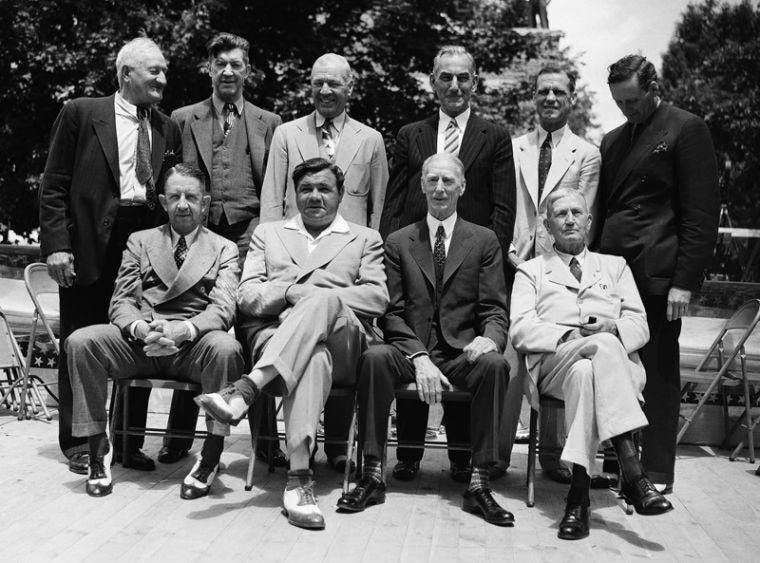
For many baseball fans, the National Baseball Hall of Fame in Cooperstown represents the pinnacle of achievement in the sport. Enshrinement in this institution signifies a player’s lasting impact on the game and their contributions to America's pastime. However, the path to achieving this honor is far from straightforward. The criteria for earning a place among baseball's legends have evolved significantly over time, and the voting process itself remains somewhat of a mystery to many —much like trying to decode the infield fly rule after a couple of beers.
The infield fly rule is a quirky but important rule in baseball designed to prevent the defense from taking advantage of certain situations. Here's the gist:
When it applies:
Less than two outs: There must be either zero or one out in the inning.
Runners on base: First and second base, or first, second, and third base must be occupied.
Fair fly ball: The batter hits a pop-up into the infield that an infielder can catch with "ordinary effort." This doesn't include line drives or bunts.
What happens:
Umpire's call: The umpire yells "Infield fly!"
Batter out: The batter is automatically out, even if the ball is dropped.
Runners' choice: The runners on base can stay put or try to advance at their own risk. If the ball is caught, they must tag up before running to the next base.
Why it exists:
Without the infield fly rule, the defense could intentionally drop an easy pop-up, then force out runners at multiple bases for a double or even triple play. This rule keeps the game fair by preventing those cheap outs and giving the baserunners a fighting chance.
Welcome to Ballpark Confidential: Baseball’s Backstory on Culture, Society, & History. Whether you’re a die-hard fan, a newcomer to the game, or just someone who enjoys a good baseball story, we’re set to dive deep into the essence of baseball, uncovering pivotal moments and key figures. This is more than a history lesson; it’s a judgment of how baseball reflects and influences our culture and society.
A new installment of Cooperstown Credentials comes out every Wednesday.
In this series, "Cooperstown Credentials: A History of Changing Standards," we'll dive into the history and details of what it takes to be inducted into the Hall of Fame.
When the Hall of Fame was established in 1936, the criteria for induction were relatively straightforward but not without controversy. The initial focus was on players who had made significant contributions to the game during its early years, many of whom were still living and had played during the sport’s formative decades. This period set a precedent for the types of players who would be considered for induction.
As baseball grew and evolved, so did the standards for Hall of Fame eligibility. The introduction of specific rules regarding the number of seasons played, the waiting period after retirement, and considerations for players who passed away prematurely all reflect the changing landscape of the sport and its recognition.
The BBWAA (Baseball Writers' Association of America) has long been the primary body responsible for voting on Hall of Fame candidates. We'll examine how the BBWAA's role has evolved over the years, including changes in the eligibility criteria for voters, the introduction of the 75% vote threshold for induction, and the controversies and debates that have shaped the voting process.
In addition to the BBWAA, the Hall of Fame has established various committees to consider players, managers, umpires, and executives who might have been overlooked by the writers. These committees, which have undergone several name changes and restructurings, play a crucial role in ensuring that deserving candidates from all eras of baseball are given a fair evaluation.
"I signed with the Milwaukee Braves for $3,000. That bothered my dad at the time because he didn’t have that kind of dough. But he eventually scraped it up." - Bob Uecker
The rise of sabermetrics and advanced statistics has transformed how players are evaluated for the Hall of Fame. Traditional milestones such as 3,000 hits, 500 home runs, or 300 wins were once almost guarantees for induction. However, the introduction of advanced metrics like WAR (Wins Above Replacement), OPS+ (On-base Plus Slugging Plus), and ERA+ (Earned Run Average Plus) has provided a more nuanced view of a player's contributions. These metrics account for factors such as the era in which a player competed and the ballparks in which they played, offering a more comprehensive assessment of their performance. This shift has helped recognize players who might not have reached traditional milestones but were nonetheless exceptional in their contributions to the game.
We’ll highlight key rule changes, such as the 1991 rule that bars players on the permanently ineligible list from induction, a rule directly affecting Pete Rose. This change was significant as it underscored the Hall of Fame's commitment to maintaining the integrity of baseball. By preventing those who had seriously violated the sport’s ethical standards from being honored, this rule reinforced the idea that character and adherence to the rules are as important as on-field performance. The rule’s impact extends beyond Pete Rose, serving as a deterrent for future misconduct and setting a clear precedent for how the Hall handles cases of severe infractions.
The establishment of a five-year waiting period after a player's retirement before they can be considered for induction was another crucial change. This rule allows for a cooling-off period during which voters can more objectively assess a player's career in its entirety, free from the immediate aftermath of their retirement. The waiting period ensures that the evaluation process is more reflective and thorough, reducing the influence of recent performance or popularity.
This series will provide a comprehensive look at the players, the process, and the ever-changing standards for baseball immortality. By understanding the history and nuances of Hall of Fame induction, we gain greater appreciation for the legends of the game and the timeless legacy they leave behind.
Join me, John “Baseball Buddha” Reimer, as we journey through the fascinating history of the Hall of Fame, uncovering the stories behind the plaques and the standards that have defined baseball greatness. From the early days of straightforward eligibility criteria to the modern era's complex interplay of statistics and character considerations, "Cooperstown Credentials: A History of Changing Standards" will illuminate the path to baseball's highest honor.