

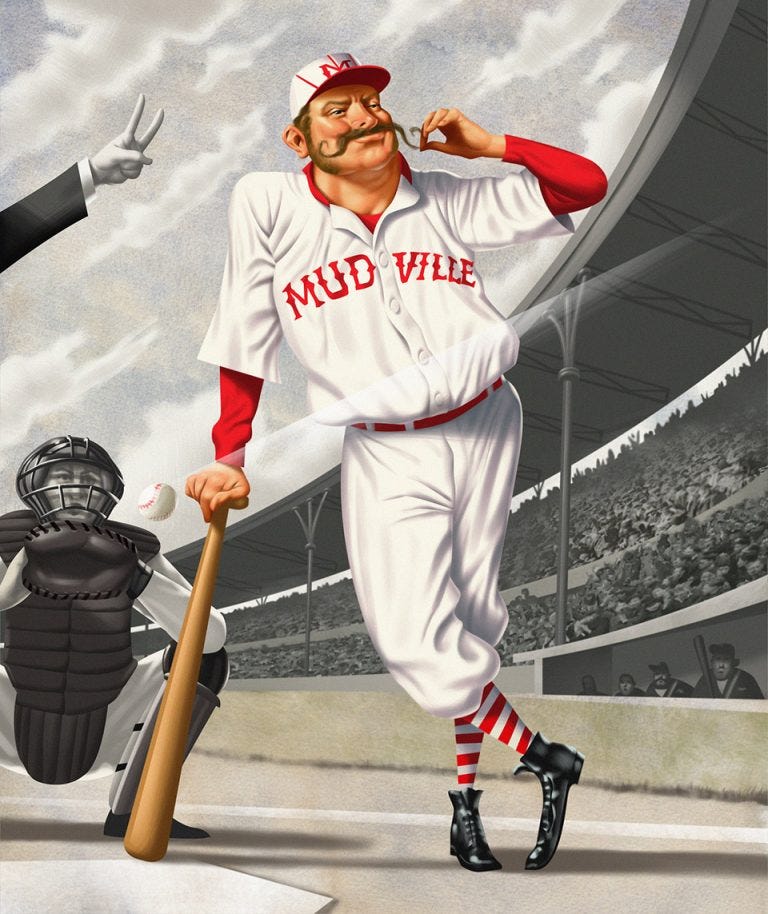
"Casey at the Bat," written by Ernest Lawrence Thayer in 1888, is a classic American poem that has become one of the most famous works related to baseball. Set in the fictional town of Mudville, the poem tells the story of a tense baseball game where the home team is down by two runs in the final inning. The crowd eagerly anticipates victory as their star player, Casey, comes up to bat. However, after letting the first two pitches go by, confident in his ability, Casey shockingly strikes out on the third pitch, leaving Mudville to lose the game. The poem ends with the famous line, "But there is no joy in Mudville—mighty Casey has struck out."
The poem explores themes of hubris and the unpredictability of sports, highlighting how even the most skilled athletes can falter under pressure. "Casey at the Bat" has had a lasting impact on American culture, helping to solidify baseball's place as the nation's pastime. Its vivid imagery and memorable lines have made it a staple of baseball literature, often recited at games and events. Despite writing one of the most beloved poems in American history, Thayer never replicated the success of "Casey at the Bat," but the poem’s legacy endures as a symbol of the drama and excitement of baseball.
The National Baseball Hall of Fame and Museum in Cooperstown pays tribute to "Casey at the Bat" for its enduring cultural impact on the game of baseball. The Hall of Fame includes references to "Casey at the Bat" in exhibits that explore the connection between baseball and popular culture, highlighting how literature and art have helped shape public perception of the game. Additionally, the poem is featured in educational programs and events, where it is often recited to showcase its significance in the history of baseball. Through these efforts, the Hall of Fame ensures that "Casey at the Bat" remains a cherished part of baseball's rich cultural heritage.
A Ballad of the Republic, Sung in the Year 1888
The outlook wasn’t brilliant for the Mudville nine that day; The score stood four to two with but one inning more to play. And then when Cooney died at first, and Barrows did the same, A sickly silence fell upon the patrons of the game.
A straggling few got up to go in deep despair. The rest clung to that hope which springs eternal in the human breast; They thought if only Casey could but get a whack at that— We’d put up even money now with Casey at the bat.
But Flynn preceded Casey, as did also Jimmy Blake, And the former was a lulu and the latter was a cake; So, upon that stricken multitude grim melancholy sat, for there seemed but little chance of Casey’s getting to the bat.
But Flynn let drive a single, to the wonderment of all, and Blake, the much despised, tore the cover off the ball; And when the dust had lifted, and men saw what had occurred, there was Jimmy safe at second and Flynn a-hugging third.
Then from 5,000 throats and more there rose a lusty yell; It rumbled through the valley, it rattled in the dell; It knocked upon the mountain and recoiled upon the flat, For Casey, mighty Casey, was advancing to the bat.
There was ease in Casey’s manner as he stepped into his place; There was pride in Casey’s bearing and a smile on Casey’s face. And when, responding to the cheers, he lightly doffed his hat, no stranger in the crowd could doubt ’twas Casey at the bat.
Ten thousand eyes were on him as he rubbed his hands with dirt; Five thousand tongues applauded when he wiped them on his shirt. Then while the writhing pitcher ground the ball into his hip, Defiance gleamed in Casey’s eye, a sneer curled Casey’s lip.
And now the leather-covered sphere came hurtling through the air, And Casey stood a-watching it in haughty grandeur there. Close by the sturdy batsman the ball unheeded sped— “That ain’t my style,” said Casey. “Strike one,” the umpire said.
From the benches, black with people, there went up a muffled roar, Like the beating of the storm-waves on a stern and distant shore. “Kill him! Kill the umpire!” shouted someone on the stand; And it’s likely they’d have killed him had not Casey raised his hand.
With a smile of Christian charity great Casey’s visage shone; He stilled the rising tumult; he bade the game go on; He signaled to the pitcher, and once more the spheroid flew; But Casey still ignored it, and the umpire said, “Strike two.”
“Fraud!” cried the maddened thousands, and echo answered fraud; But one scornful look from Casey and the audience was awed. They saw his face grow stern and cold, they saw his muscles strain, and they knew that Casey wouldn’t let that ball go by again.
The sneer is gone from Casey’s lip, his teeth are clinched in hate; He pounds with cruel violence his bat upon the plate. And now the pitcher holds the ball, and now he lets it go, and now the air is shattered by the force of Casey’s blow.
Oh, somewhere in this favored land the sun is shining bright; The band is playing somewhere, and somewhere hearts are light, and somewhere men are laughing, and somewhere children shout; But there is no joy in Mudville—mighty Casey has struck out.
Baseball in 1888 was a rapidly growing sport in America, transitioning from a recreational pastime to a professional and organized game. By this time, baseball had solidified its status as the national pastime, with an increasing number of fans, teams, and professional leagues emerging across the country.
The late 19th century was a pivotal era for baseball, marked by the formalization of rules and the establishment of professional teams. The National League (NL), founded in 1876, was the first major professional baseball league and dominated the sport throughout the 1880s. The league provided a structure that allowed for more organized competition and set standards for player contracts, schedules, and gameplay. In 1882, the American Association (AA) was established as a rival league, and the two leagues often competed for players and fans.
Baseball's popularity surged in the 1880s, partly due to the growth of urban areas, which provided larger audiences and more accessible stadiums. The sport became a significant part of American culture, particularly in cities where teams represented local pride. Games were often covered in newspapers, bringing the excitement of baseball to readers across the nation.
The players of the 1880s were a mix of local stars and early legends who would lay the groundwork for future generations. Notable players included Cap Anson, one of the era's best hitters and a long-time star of the Chicago White Stockings (later the Cubs), and King Kelly, a charismatic and versatile player known for his daring play and colorful personality. Many players in this period played multiple positions, reflecting the game's evolving strategies and the less specialized nature of the sport compared to modern times.
Baseball in 1888 was characterized by a rough-and-tumble atmosphere, both on and off the field. The sport was still developing its code of conduct, and games could be rowdy affairs, with intense rivalries and often unruly crowds. Players were not the highly paid celebrities they are today; they were working-class athletes who sometimes had to work other jobs during the off-season.
The late 1880s also saw several innovations that shaped the modern game. The introduction of the pitcher's mound in 1893, for instance, came shortly after this period, but the 1880s set the stage with evolving pitching techniques and strategies. However, the era also faced challenges, including labor disputes between players and team owners, which foreshadowed future conflicts over players' rights and salaries.