


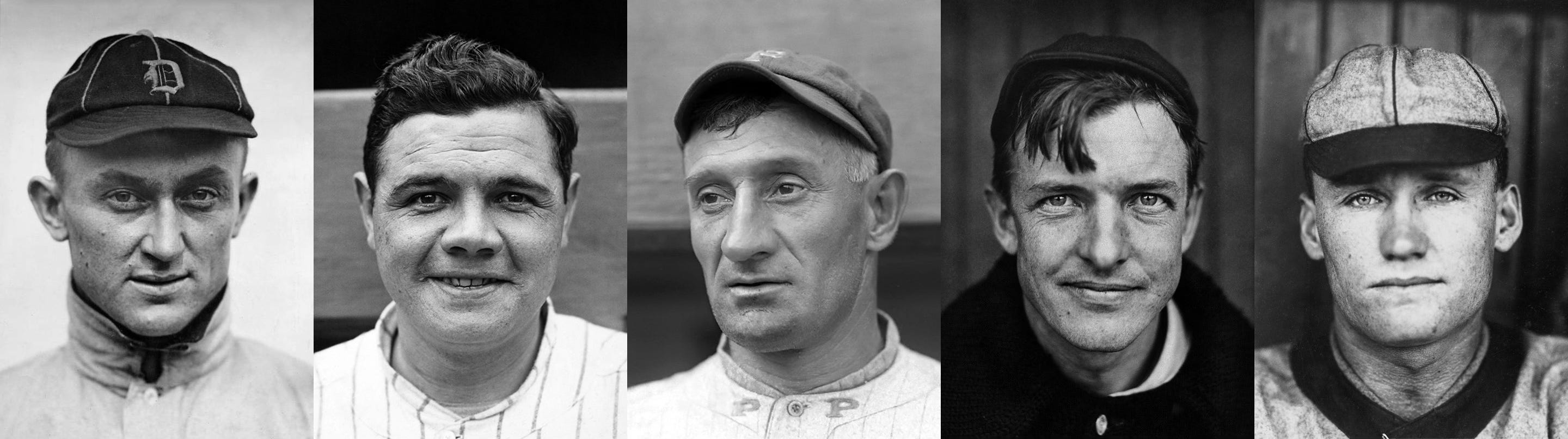
The first class of the Baseball Hall of Fame was inducted in 1936, and it included five legendary players who had made significant impacts on the game. The members of this inaugural class were:
Ty Cobb - Widely regarded as one of the greatest hitters in the history of baseball, Cobb played most of his career with the Detroit Tigers. He set numerous records, including a .366 career batting average, which remains the highest in MLB history.
Babe Ruth - Known as "The Sultan of Swat," Ruth was a prolific home run hitter and a charismatic figure who transformed the game. He played for the Boston Red Sox and New York Yankees, setting a then-record 714 home runs.
Honus Wagner - Often considered the greatest shortstop of all time, Wagner played the majority of his career with the Pittsburgh Pirates. He was known for his hitting, speed, and defensive prowess.
Christy Mathewson - A dominant pitcher for the New York Giants, Mathewson was known for his control and strategic approach to the game. He won 373 games and was one of the most respected players of his era.
Walter Johnson - Known as "The Big Train," Johnson was a powerful right-handed pitcher who played for the Washington Senators. He was renowned for his fastball and accumulated 417 career wins, a record for the American League.
Welcome to Ballpark Confidential: Baseball’s Backstory on Culture, Society, & History. Whether you’re a die-hard fan, a newcomer to the game, or just someone who enjoys a good baseball story, we’re set to dive deep into the essence of baseball, uncovering pivotal moments and key figures. This is more than a history lesson; it’s a judgment of how baseball reflects and influences our culture and society.
In this series, "Cooperstown Credentials: A History of Changing Standards," we'll dive into the history and details of what it takes to be inducted into the Hall of Fame.
A new installment of Cooperstown Credentials comes out every Wednesday!
The idea for a Baseball Hall of Fame originated in the early 1930s, driven by the desire to celebrate the centennial of the sport in 1939. The Hall of Fame aimed to recognize the game's most outstanding players and preserve its history. In 1935, the Baseball Writers' Association of America (BBWAA) was tasked with selecting the inaugural class.
To select the first inductees, the BBWAA held a special election in 1936. The process was carefully designed to ensure that only the most deserving players would be honored. Here’s how it worked:
Eligibility: The BBWAA decided that only retired players would be considered. This meant that active players were not eligible for the inaugural class.
Ballot Creation: A list of eligible candidates was compiled, featuring the most prominent retired players from the early years of Major League Baseball. The list included both position players and pitchers.
Voting System: The voting process used a point system. Each voter (members of the BBWAA) was asked to select up to 10 players. Players received points based on their position in each voter’s list: 10 points for a first-place vote, 9 points for a second-place vote, and so on down to 1 point for a tenth-place vote.
Threshold for Induction: To be elected to the Hall of Fame, a player had to receive votes on at least 75% of the ballots cast. This high threshold ensured that only the most exceptional players would be honored.
The results of the voting process were announced in January 1936. Out of the many candidates, five players received the requisite 75% of the votes, thus becoming the first class of inductees into the Baseball Hall of Fame:
Ty Cobb: Cobb received the highest number of votes, appearing on 222 out of 226 ballots (98.2%).
Babe Ruth: Ruth received 215 votes (95.1%).
Honus Wagner: Wagner was named on 215 ballots (95.1%).
Christy Mathewson: Mathewson garnered 205 votes (90.7%).
Walter Johnson: Johnson received 189 votes (83.6%).
The election of these five players set the tone for the standards of excellence that the Hall of Fame would maintain. Their induction was part of the ceremonies leading up to the formal opening of the Hall of Fame in 1939, coinciding with the centennial celebration of baseball’s origins. Each of these players left an indelible mark on the game, and their induction recognized their significant contributions to baseball.
The voting process has evolved over the years, but the fundamental principles established in that first election have remained. The Hall of Fame continues to be a place where the legacies of the greatest players are honored and preserved for future generations.
Basic Eligibility Requirements for Players
1. Years Played: A player must have been active in Major League Baseball (MLB) for at least 10 seasons.
2. Retirement Period: A player must have been retired for at least five full seasons. For example, if a player last played in the 2018 season, they would be eligible for consideration starting with the 2024 ballot.
3. Not on the Ineligible List: A player must not be on MLB's permanently ineligible list. This rule was notably instituted to address the case of Pete Rose and ensures that players who have been banned from the game for serious misconduct are not eligible for Hall of Fame consideration.
"Good pitching will always stop good hitting and vice versa." Casey Stengel
1. A Player Must Have Been Active in Major League Baseball (MLB) for at Least 10 Seasons
This rule ensures that only players with significant careers are considered for the Hall of Fame. Playing for at least 10 seasons means that a player has had a lengthy and impactful career in the major leagues.
A player who lasts 10 years in MLB has shown the ability to compete at a high level over a long period. Baseball is a demanding sport, and sustaining performance over a decade indicates resilience, skill, and durability.
Over a decade, players have the opportunity to accumulate impressive stats, awards, and memorable moments. This time frame allows voters to evaluate a player's overall contribution to the sport.
2. A Player Must Have Been Retired for at Least Five Full Seasons
A player becomes eligible for the Hall of Fame five years after retiring. For example, if a player last played in the 2018 season, they would be eligible for consideration starting with the 2024 ballot.
The five-year waiting period allows for a cooling-off period where recent biases and emotions can settle. It gives everyone time to reflect on the player's career objectively.
This gap ensures that a player's career is definitively over, preventing any mid-retirement comebacks from complicating the evaluation process.
3. A Player Must Not Be on MLB's Permanently Ineligible List
This rule ensures that players who have been banned from baseball for serious misconduct are not considered for the Hall of Fame. The most famous case related to this rule is Pete Rose.
Baseball values the integrity and ethics of the sport. Players who have committed serious infractions, such as betting on games or other forms of cheating, are barred from Hall of Fame consideration to uphold these values.
This rule serves as a deterrent for current and future players, signaling that serious misconduct has long-lasting consequences, including being excluded from one of the sport’s highest honors.
A player like Derek Jeter, who played for 20 seasons with the New York Yankees, exemplifies someone with a long and storied career. His extended tenure allowed him to amass numerous accolades and become a household name.
After retiring in 2014, Jeter became eligible for the Hall of Fame in 2020. The five-year waiting period provided voters with the necessary time to evaluate his career without the immediate influence of his recent retirement.
Pete Rose, despite being one of the greatest hitters in baseball history, is on the permanently ineligible list due to betting on baseball games, which he denied for many years. This rule ensures that his achievements on the field do not overshadow the severe misconduct he committed off the field.
The eligibility requirements for the Baseball Hall of Fame are designed to ensure that only players with significant, ethical, and impactful careers are considered. By requiring 10 seasons of play, a five-year waiting period after retirement, and excluding those on the ineligible list, the Hall of Fame maintains its prestige and integrity, honoring those who have truly contributed to the sport in a positive and lasting way.