


I am coming back to this after saying I wouldn’t.
When Pete Rose died, I thought I was done writing about him. I started this Substack by working my way through the Dowd Report. Looking back, I don’t think I did my best work. I was still finding my voice and figuring out how I wanted to approach difficult subjects. Since then, I’ve spent a lot of time writing about baseball, power, money, ownership, character, and accountability. Which brings me back to Pete Rose.
Pete Rose was one of my favorite players growing up. When the gambling scandal broke, I was disappointed. I didn’t make excuses for him then and I’m not going to make excuses for him now. He knew the rules. He broke them. Then he lied about it for years. That matters.
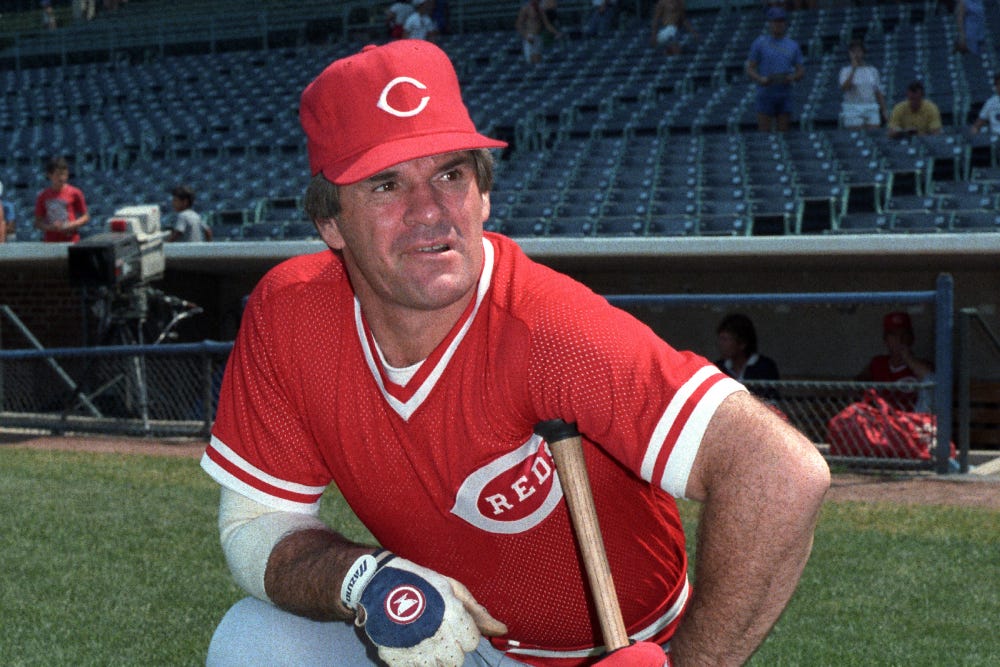
What also matters is why I accepted the punishment. I accepted it because Major League Baseball told me integrity mattered more than any player. More than 4,256 hits. More than records. More than fame. More than money. Baseball told us that gambling represented a threat to the integrity of the game itself. It wasn’t negotiable. It wasn’t complicated. It wasn’t open for debate.
Pete Rose became the sacrifice on the altar of baseball’s integrity. That was the message. No individual player was bigger than the game, and the integrity of the game had to be protected at all costs. For decades, I accepted that argument because I believed baseball believed it too.
Today, I’m not so sure what Major League Baseball actually believes.
The same sport that told me gambling was such a threat that it permanently banned the all-time hit leader now wraps itself in gambling money. Sportsbooks sponsor broadcasts. Betting odds are discussed during games. Gambling advertisements are everywhere. Teams partner with sportsbooks. The league profits from gambling. What was once presented as a threat to the game is now treated as a business opportunity.
And that’s where I start to have a problem.
Not because Pete Rose was innocent. Not because gambling should be illegal. Not because I don’t understand the difference between a fan placing a bet and a manager placing a bet. I understand all of that. What I don’t understand is how Major League Baseball can spend forty years telling me gambling threatens the integrity of the game while simultaneously making gambling part of the product it sells.
If gambling is such a threat to integrity, why are you promoting it? If gambling is not a threat when properly managed, why did Pete Rose become baseball’s moral example for the last four decades? You don’t get to have it both ways. You don’t get to spend decades standing on a moral principle and then quietly abandon it when there is enough money involved.
That’s the part that drives me nuts.
Major League Baseball wants credit for protecting the integrity of the game while collecting checks from the gambling industry. Those two things exist in tension with one another whether the league wants to admit it or not. The irony is that Pete Rose eventually admitted what he did. Major League Baseball has never admitted what it has done. The league changed its relationship with gambling completely. It just never wants to acknowledge how dramatically the standards shifted once there was enough money involved.
For me, this has become less about Pete Rose and more about consistency. If integrity is your guiding principle, it has to cost you something. Otherwise it’s just marketing. Pete Rose paid the price for violating baseball’s standards. Today I look around the game and wonder whether Major League Baseball is willing to hold itself to the same standard.
That is the question I can’t stop coming back to. Not whether Pete Rose deserved punishment. Not whether gambling should exist. But whether integrity is still the principle baseball follows, or whether integrity only matters until there is enough fuqquin money on the table.
I still believe Pete Rose deserved to be punished. I still believe what he did was wrong. What I no longer believe is that Major League Baseball occupies the same moral high ground it claimed when it made Pete Rose the symbol of gambling’s danger. If integrity matters, it has to apply to everyone. Players. Managers. Owners. Commissioners. And the league itself.
That’s the conversation I wish baseball would have. But as long as the gambling money keeps flowing, I don’t expect to hear it.
One can't help but mention MLB made the Ohtani issue disappear overnight. Though that's somewhat understandable after visit Japan, where you see he has demigod status.
The harshest thing I can say about Pete regards the lying. He was caught, own up to it. He was one of my baseball heroes growing up and the ban was shattering. Baseball owns no moral highground when it comes to gambling.