


They swap out the bases every three innings now.
Not because they’re worn out. Not because the game demands it. But because Major League Baseball knows there’s fucking money to be had. The bases come pre-tagged - a placard stuck on all four sides, visible during the game, date, teams, location. Like a display case in progress. Like a for-sale sign on the property before the final out has even been recorded.
You watch a player slide into third, and you’re watching a future auction listing.
It would be easy to roll my eyes. It is absurd. The whole ballpark feels like a showroom now. Game-used balls. Broken bats. Limited edition jerseys. City Connect drops. Commemorative locker tags. The more they flood the market with these artifacts, the more the word “collectible” starts to mean available everywhere, meaningful nowhere.
And yet…
I own one of those bases.
Third base. Dodgers vs. Brewers. Miller Park. Final score: 3–2, Milwaukee.
Mookie Betts stood on it. The dirt’s still on there.
My brother bought it for me.
I didn’t ask for it. I didn’t chase it. It wasn’t bought to resell it.
That base means something.
Because we were there. Because he thought of me. Because that game mattered to us, in a way no price tag or hologram can replicate. That dirt isn’t a feature. It’s a layer of memory. Authentic. Unfiltered. Real.
Same with my 1988 Kirk Gibson replica jersey. I bought that. Willingly. I didn’t care about stitching or tags or whether it was "official." I just wanted to hold onto a moment I still remember like it was yesterday, that swing, that limp, that impossibility. Some things you buy because they already matter.
That’s the difference. It’s not the price, it’s the purpose.
Baseball’s problem today isn’t that they sell stuff. It’s that they don’t let it become sacred before they slap a label on it. They assign significance before the moment even breathes. They turn a live game into a liquidation sale.
It didn’t used to be like this.
There was a time especially in the first half of the 20th century when baseball lived in the pages of books. Fiction, mostly. Zane Grey’s The Shortstop (1909), John R. Tunis’s The Kid from Tompkinsville (1940), the Baseball Joe series, and so many others. These weren’t souvenirs. They were entrances. Pathways into the emotional and moral drama of the game. They helped young fans imagine what it felt like to be there. To be part of it. To care.
Even the sports pages were written like short stories. Grantland Rice made box scores read like Homeric poetry. You didn’t collect memorabilia; you collected meaning through language. You got close to the game by reading about it, not scrolling through clearance sales.
There were no bobbleheads. No mic’d-up players hamming for the camera between pitches. No bases rotated out mid-game like seasonal décor. Just story. Just imagination. Just connection forged quietly, word by word.
There’s some psychological research — I can’t place the study right now — but it explored how we form attachments to physical objects through narrative association. That is, the more story we attach to an item, the more we value it.
That connection has gotten noisier now. Flashier. Shallower.
Walk into any vintage or antique shop and you’ll see the fallout: stacks of bobbleheads people once stood in line for. Foam fingers. $5 clearance merch from “special nights” no one remembers. Most of it was free. Now, even the giveaways feel like upsells. You leave the ballpark carrying bags, not memories.
But still, not everything is empty.
There’s the “nodders”. The old-school bobbleheads, from the ’60s. My mom still calls them that. They’re chipped. Faded. Hand-painted. Somehow, they carry more soul than anything sealed in plastic. They weren’t made to be collectible; you bought your team and that was it. They just lasted. That’s what gives them meaning. Not monetarily. Personally. Spiritually. Emotionally.
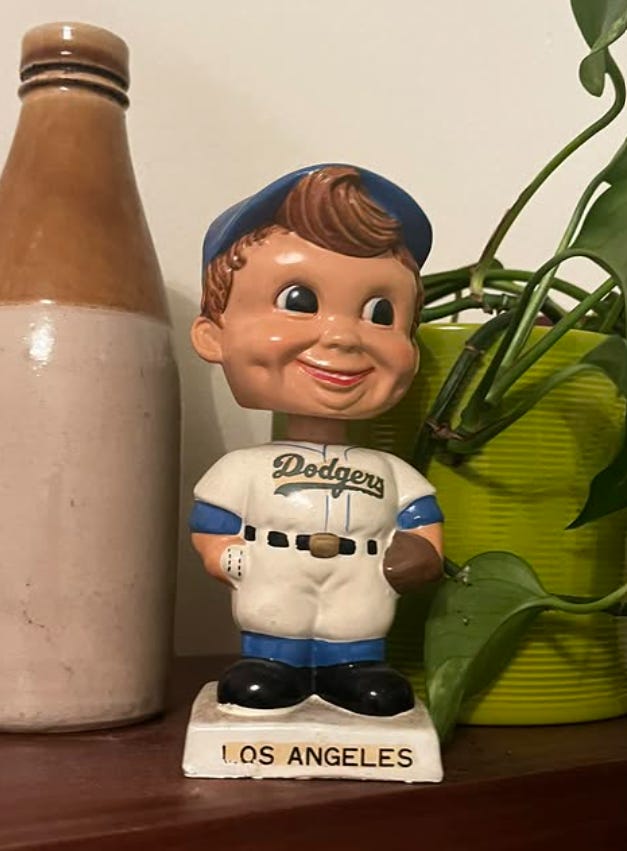
The base from the Mookie game has that story. So does the Kirk Gibson jersey.
And that’s what I hold onto.
Not everything that’s sold is worthless.
But nothing should be sacred before it’s real.
Because what we remember, what we hold onto, isn’t what we bought.
It’s what we felt. Who we were with. The weight of that moment.
Sometimes the dirt on a base is just dirt.
And sometimes it’s the story.
Right on, man! The American way: commoditize whatever you can as much as you can; squeeze for every dime that can be made. To corrupt "Field of Dreams", if you sell it, they will buy it. It's partially on us for being so into ephemeral knick-knacks. I have a Ken Griffey, Jr. mini statue from a visit to Seattle and a Mariners game as well as a Rod Carew bobble head someone gave me. Neither has particular meaning, both just gather dust and will eventually end up in the trash.
Which is not to say there isn't meaning in some souvenirs and mementos, but it seems their rarity and what they mean to us that makes them special. Your base or jersey, for example. Or a fly ball one catches while at a game. Never happened to me, but it would be awesome.