


I live in Milwaukee, and I am a Dodgers fan.
I root for the Brewers. I go to a lot of Brewers games. I respect the Brewers organization. I enjoy the ballpark, the fans, the tailgates, the rhythm of summer in Wisconsin, and the way the team has become part of the state’s identity. I want the Brewers to win. I think they are one of the two best-run organizations in Major League Baseball.
I know both teams better than I know any other organizations in baseball because I live in the middle of one baseball culture while carrying another one with me. I know what American Family Field feels like on a cold April night with the roof closed, on a summer Saturday when the parking lots are already smoking before first pitch, and during a playoff race when the whole place carries that strange Wisconsin mix of hope, suspicion, beer, and civic duty.
I also know Dodger Stadium, the blue, the hills, the traffic, the light, the crowd, and the mix of old Los Angeles, new Los Angeles, working-class Los Angeles, immigrant Los Angeles, celebrity Los Angeles, and baseball Los Angeles all sitting in the same bowl under the same sky. Vin Scully still hangs over the place. His voice made Dodger baseball feel literate, patient, humane, and bigger than the score. He gave Los Angeles a baseball conscience.
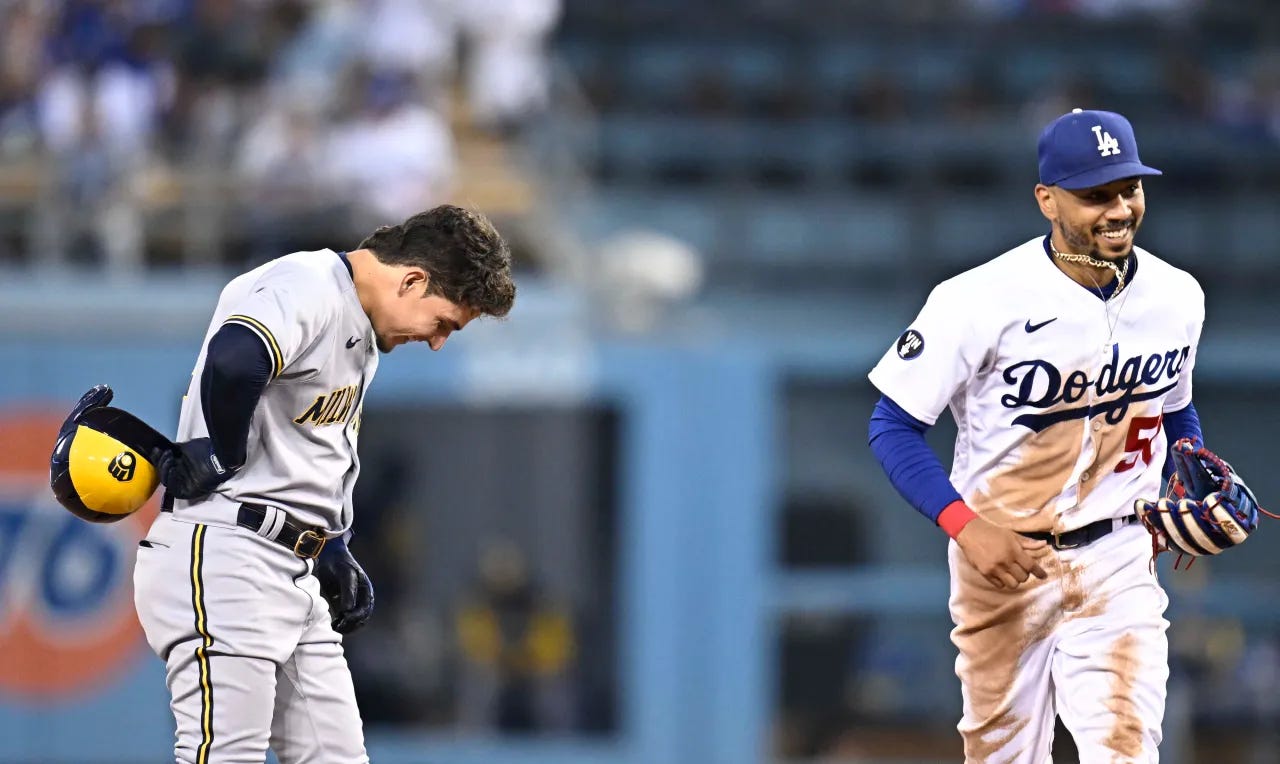
So this is not me pretending to be neutral. I am not. I am a Dodgers fan living in Milwaukee who roots for the Brewers until the Brewers run into the Dodgers.
Dodger blue. I do want the Brewers to win a World Series it will be great for the city and the state, for my Dad, Mom and brothers and sisters, it feels amazing when your team wins it all.
I picked the Dodgers and Brewers because I think they are, right now, the two best-run organizations in Major League Baseball. I also picked them because I know them better than I know any other organizations in the sport. The Dodgers and Brewers should not belong in the same comparison if baseball were only about market size, payroll, and brand power. One plays in Los Angeles with the kind of financial reach most franchises will never have. The other plays in Milwaukee, where every good player eventually comes with a clock attached and every major decision has to survive the reality of a small-market balance sheet.
The Dodgers can miss and keep moving. The Brewers miss and they feel it. Los Angeles can absorb mistakes as expensive annoyances. Milwaukee has to live with them like bad weather.
That gap is real, and pretending otherwise is another way of lying about modern baseball. But the comparison works because both teams have mastered their own realities better than anyone else. The Dodgers are rich smart. The Brewers are poor smart. One turns abundance into pressure. The other turns pressure into discipline. Both have become mirrors for the rest of the league, because the Dodgers make other rich teams look lazy and the Brewers make other small-market teams look like they are hiding behind excuses.
A dumb rich team throws money at problems and mistakes activity for ambition. A smart rich team uses money to create margin for error, optionality, and pressure. That is the Dodgers. They are not just buying players. Baseball is full of teams that have spent stupid money and still looked confused by Memorial Day. The Dodgers are dangerous because their spending sits on top of an actual baseball machine. They can sign the superstar, absorb the injured pitcher, eat the bad contract, trade prospects and still have more prospects, take on risk and survive if the bet goes sideways. Money gives them room, but competence tells them what to do with the room.
That is where the lazy anti-Dodgers argument falls apart. The Dodgers are not ruining baseball because they are ambitious. They are exposing the owners who have money and no imagination. They are also exposing the front offices that hide behind complexity while failing to build anything durable. Spending big does not mean spending well. The Dodgers have become the scariest kind of organization because they are no longer just the big-market bully. They are the big-market bully that learned how to develop pitching, scout internationally, read the market, manipulate time horizons, and think three moves ahead. They are a superpower with engineers, not just celebrities.
The Brewers are a different kind of intelligence. Milwaukee cannot operate with that kind of arrogance. The Brewers cannot pretend every mistake is accounting. They cannot simply buy their way out of a bad winter. They cannot fall in love with their own players past the point of reason. They cannot make emotional decisions just to keep the fan base warm for six weeks, because emotional decisions are expensive and expensive mistakes in Milwaukee do not just hurt. They linger. A bad Dodgers contract becomes a luxury tax conversation. A bad Brewers contract can clog the arteries of the whole organization.
That is why I respect the Brewers more than the usual small-market praise allows. They are not baseball’s cute little underdog story. That framing is condescending. The Brewers are not winning because of vibes, bratwurst, and a good bullpen song. They are winning because they have built a serious, repeatable baseball operation in a place where the margin for error is thin. Poor smart does not mean poor in intelligence. It means smart under constraint. Smart with consequences. Smart when you cannot afford to lie to yourself.
Milwaukee has to know when to trade a player before the fans are ready. It has to identify pitching before it gets expensive. It has to find defense, athleticism, bullpen arms, platoon value, and developmental wins in places richer teams may not be looking carefully enough. It has to make uncomfortable decisions early because waiting too long can turn a strength into a problem. Anybody can talk about discipline when there is no cost. The Brewers live inside discipline. They do not always get to do the romantic thing. They often have to do the adult thing, which is one reason fans can respect the organization and still get pissed off at it.
If the Dodgers are the machine, the Brewers are the workshop. Los Angeles has every tool imaginable, polished floors, unlimited parts, and a staff large enough to keep the whole thing humming. Milwaukee has a smaller room, sharper eyes, less waste, and a better understanding of what happens when you cut once without measuring twice. Both can produce something beautiful. They just do it differently. The Dodgers use money to create optionality. The Brewers use limitation to create clarity.
That distinction carries into the fan experience. Brewers fans know every good player comes with joy and dread attached. You watch him grow, you watch him become real, and then somewhere in the back of your mind the clock starts ticking. How long do we get him? When does the arbitration number jump? Will they extend him? Will they trade him? Is this the last summer? Dodgers fans live with a different burden. Their burden is expectation. In Los Angeles, the question is not whether the organization is trying. The question is whether anything short of a championship counts as failure. A 95-win season can feel like an audit failure when the roster is built to dominate. Stars are not enough. Division titles are not enough. October is where the bill comes due.
That is not just payroll. That is psychology. Milwaukee lives with impermanence. Los Angeles lives with expectation. Brewers fans learn to love with one eye on the transaction wire. Dodgers fans learn to celebrate with one eye on October. One fan base worries the window will close before the moment arrives. The other worries the moment will be wasted despite the window being wide open.
The perception of the cities sharpens the contrast. Los Angeles is viewed as glamour, excess, celebrity, traffic, money, sunshine, and power. It is the place where baseball becomes entertainment business. The Dodgers do not just play in a city. They play inside a global brand machine. The uniform is clean. The stadium is iconic. The crowd includes movie stars, executives, lifelong fans, casual fans, tourists, influencers, and people who may or may not arrive in the third inning and leave in the seventh. That stereotype survives because there is some truth in it, but it also hides the better truth.
The Dodgers fan base, especially the one that actually shows up at Dodger Stadium, may be the best cultural mix in baseball. Latino, Asian, White, Black, old, young, rich, working class, lifelong Los Angeles families, new arrivals, people whose parents and grandparents loved Fernando Valenzuela, people who still hear Vin Scully in their head, people who came through Brooklyn history, Chavez Ravine, Koufax, Garvey, Lasorda, Nomo, Piazza, Kershaw, Mookie, Freddie, and Ohtani. Dodger Stadium gets reduced to celebrity shots and traffic jokes, but the crowd itself is far more blue collar and culturally layered than people give it credit for. It is one of the few places in American sports where the fan base actually feels like the city around it. Los Angeles is enormous, messy, multilingual, spread out, expensive, unequal, beautiful, frustrating, and alive. Dodger Stadium reflects that.
Milwaukee is viewed completely differently. Milwaukee is beer, brats, tailgates, neighborhoods, working people, Lake Michigan, summer urgency, and a kind of Midwestern loyalty that does not need to announce itself every five minutes. The Brewers do not feel like a global entertainment property. They feel like a civic habit. Something passed around families. Something connected to parking lot smoke, radio calls, roof decisions, and the strange little miracle of warm baseball nights after six months of gray. But even that description is incomplete because the Brewers are not only Milwaukee. The Brewers are a Wisconsin team that happens to play in Milwaukee.
You cannot separate the Brewers from Bob Uecker. Uecker was the sound of summer in Wisconsin. He made the Brewers feel less like a corporation and more like something sitting next to you on the porch. Funny, dry, self-deprecating, loyal, sharp, and never too impressed with itself. If Scully gave the Dodgers grace, Uecker gave the Brewers humility. Organizations are built through payroll, trades, scouting, and development. They are also built through memory, language, and the voices people trust while they are driving, grilling, sitting in the garage, or listening alone in the dark.
That matters more than people outside the state understand. American Family Field is not just pulling from the city. It pulls from suburbs, small towns, lake communities, farm towns, the Fox Valley, Madison, Green Bay, Racine, Kenosha, Waukesha, Sheboygan, Eau Claire, Ashland and everywhere in between. The Brewers are a state habit. The fan base is regional, practical, family-oriented, tailgate-driven, proud, and more culturally uniform than the Dodgers crowd. Milwaukee the city is diverse, but the Brewers’ emotional market is Wisconsin, and Wisconsin is not Los Angeles. The ballpark reflects the state as much as the city.
That is why comparing Los Angeles to Milwaukee city alone misses the point. The Dodgers are built around Los Angeles as a massive global city and metro culture, but Scully gave that sprawl intimacy. Los Angeles can feel impossible to hold in one hand. Too big, too wide, too fragmented, too many languages, too many freeways, too many versions of itself. Scully somehow made it feel like one listener at a time. The Brewers are built around Milwaukee as the home city, but Wisconsin as the emotional market, and Uecker did something similar in a completely different register. He made the state feel like it was in on the same joke, the same hope, the same long summer conversation. At Dodger Stadium, the world seems to show up. At American Family Field, the state pulls into the parking lot. Scully made the world feel personal. Uecker made the parking lot feel like home.
This also changes how the organizations are judged. Dodgers fans expect greatness because Los Angeles expects greatness. It is a city built on performance, ambition, reinvention, image, and scale. The Dodgers are supposed to be big. They are supposed to have stars. They are supposed to matter nationally. If the Dodgers act small, it feels like institutional malpractice. Brewers fans expect competence, but they also live with limits. Milwaukee and Wisconsin fans understand markets, weather, payroll, attendance, and the reality that not every star stays. The Brewers are not expected to behave like the Dodgers. They are expected to behave like a smart Wisconsin organization: tough, practical, resourceful, and not full of shit.
The typical Dodgers fan is often perceived as spoiled. Maybe not individually, but collectively. The outside world sees Dodgers fans as people who expect stars, spending, October, and a front office that behaves like a superpower. When the Dodgers sign another great player, nobody is shocked. When they win 95 games, nobody throws a parade. When they lose in October, the season feels like a failure. That can look like entitlement from the outside, and sometimes it probably is. But it also comes from living inside a baseball culture where the organization has taught the fan base to expect dominance.
The typical Brewers fan is perceived almost the opposite way: loyal, patient, practical, slightly fatalistic, and maybe a little too used to heartbreak. Brewers fans do not assume stars are permanent. They do not assume spending is coming. They do not assume the front office will keep everyone they love. In Milwaukee, fandom often comes with emotional math. The fan experience is rooted in attachment, but also in impermanence. You celebrate development, but you also know development creates future payroll problems. You want the team to be aggressive, but you know one dumb contract can create years of cleanup.
Neither caricature is complete. Dodgers fans are not all spoiled rich people eating sushi behind home plate. A lot of them are deeply loyal, multi-generational baseball people who carry the history of the franchise like family memory. Brewers fans are not all humble Midwestern saints drinking beer in the parking lot and clapping politely. They can be angry, demanding, suspicious of ownership, and sick of being told to be grateful for competitiveness instead of championships. Both fan bases contain truth and contradiction, but the perception shapes how every move is judged. When the Dodgers spend, people say they are ruining baseball. When the Brewers trade a star, people say they are cheap. Sometimes both criticisms are too easy.
The Dodgers are not automatically ruining baseball by being ambitious. They are often showing what a wealthy franchise should look like when money is tied to intelligence. The Brewers are not automatically cheap every time they move a player. They are often making the kind of hard decision a smaller-market team has to make before sentiment turns into dead money. But fans do not live in front-office theory. Fans live in memory. Dodgers fans remember October failures more sharply because the roster tells them they should be celebrating parades. Brewers fans remember every player who left because departure is built into the emotional architecture of small-market baseball.
Vin Scully made the Dodgers feel timeless. Bob Uecker made the Brewers feel like home. Scully carried elegance without arrogance. Uecker carried humor without cheapness. Scully could make a routine fly ball feel like it had a lineage. Uecker could make a bad inning feel survivable. Scully belonged to a city that wanted greatness to sound graceful. Uecker belonged to a state that wanted baseball to sound human.
That is where these two organizations become mirrors for the rest of the league. The Dodgers make other rich teams look lazy. The Brewers make other small-market teams look dishonest. If the Dodgers can spend big and still build a real development machine, then wealthy teams have no excuse for being sloppy. You cannot wave a checkbook around and call it ambition. You need infrastructure, scouting, player development, patience, nerve, and a coherent baseball philosophy. And if the Brewers can keep competing from Milwaukee, then small-market teams cannot hide forever behind market size. The economics are real. The inequality is real. The Dodgers have advantages Milwaukee will never have. But some owners use that truth as a shield. They confuse restraint with strategy. They sell patience when what they really mean is profit protection.
The Brewers complicate that excuse. They show that smaller-market baseball does not have to mean small-minded baseball. That does not mean every small-market team should be expected to win every year, and it does not mean baseball’s financial structure is fair. It means fans are allowed to ask whether their organization has a plan or whether it is just hiding behind the same tired speech about payroll flexibility and future windows. The Dodgers and Brewers are not proof that baseball is fair. They are proof that intelligence still matters inside an unfair system.
That is why I do not see this as a debate over which organization is better run. The better question is what an organization does with its reality. The Dodgers understand theirs. They are rich, powerful, global, and expected to win, so they behave like a superpower that still remembers it needs engineers. The Brewers understand theirs. They are regional, constrained, and always one bad contract or one missed development cycle away from trouble, so they behave like a shop where every tool has a place and every decision has to earn its keep.
The Dodgers are the best-run organization in baseball if the question is how to turn every possible advantage into sustained dominance. The Brewers are the best-run organization in baseball if the question is how to turn limitation into a repeatable competitive system. I do not think those two ideas contradict each other. I think they explain the sport better than almost anything else happening right now.
The Dodgers are Los Angeles in uniform: big, bright, expensive, ambitious, diverse, impatient, impossible to ignore. The Brewers are Wisconsin in uniform: practical, stubborn, local, resourceful, loyal, and better than outsiders usually assume. One ballpark feels like the world showed up. The other feels like the state pulled into the parking lot. One organization turns abundance into pressure. The other turns pressure into discipline.
Right now, I think they are the two best-run organizations in Major League Baseball because they do not waste time pretending to be something they are not. They understand their markets, their fans, their limits, their advantages, and their obligations. In an era where too many teams either spend without wisdom or save without shame, the Dodgers and Brewers are not just different ways to win. They are two different kinds of organizational truth.
Great essay. As much as you explain the unique differences of a well-run small/smart market team and a large/smart market team, you helped me see the similarities. I definitely am more interested in the underdog stories and The Dodgers remain the Goliath, but there’s a reason they have been so successful for so long and The Mets and Giants and Yankees, etc. are either flailing or barely holding on.
Excellent analysis; however, I expect that the landscape will change (for both teams) after the lockout.