


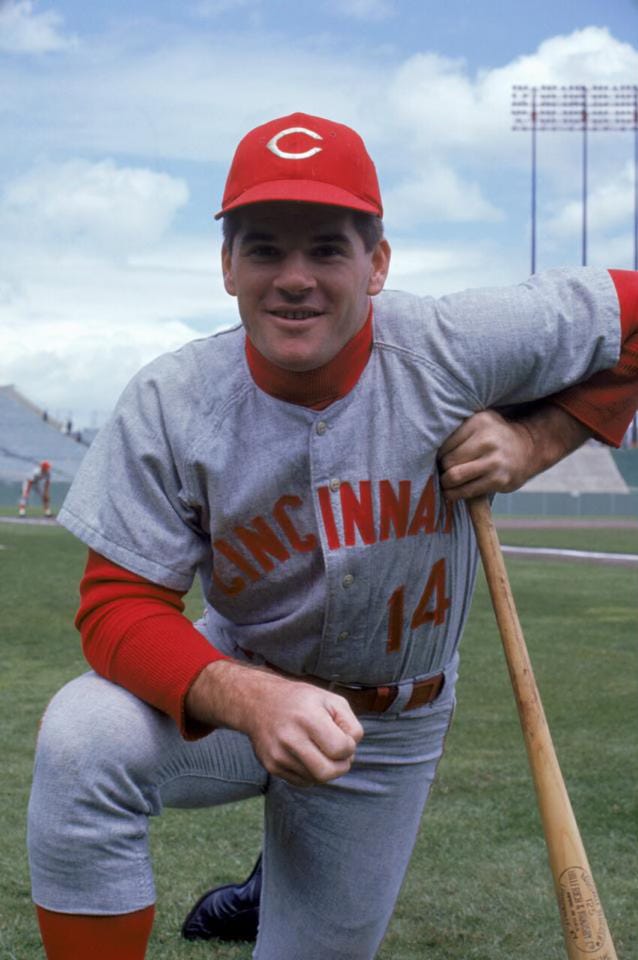
Janszen testified that Rose initially won close to $25,000 during the first week of betting with Peters which Janszen collected and gave to Rose. During the second week, Rose lost most of the money he had won the first week. Janszen described how Rose took cash out of his kitchen cabinet, counted out the money he lost, and gave it to him.
Welcome to Ballpark Confidential: Baseball’s Backstory on Culture, Society, & History. Whether you’re a die-hard fan, a newcomer to the game, or just someone who enjoys a good baseball story, we’re set to dive deep into the essence of baseball, uncovering pivotal moments and key figures. This is more than a history lesson; it’s a judgment of how baseball reflects and influences our culture and society.
A new installment of River Rat – “Hustle, Heroism, and Hubris: The Pete Rose Conundrum” comes out every Friday!
In this first series, titled River Rat – “Hustle, Heroism, and Hubris: The Pete Rose Conundrum” I’m examining books, articles, opinions, watching TLC reality TV show “Hits & Mrs.” on Pete and will read the document that rocked Major League Baseball – The Dowd Report sparking a 35+ year debate on one of baseball’s greatest players.
Over the past several weeks, we have embarked on a comprehensive journey through the Dowd Report, breaking it down section by section. This analysis has allowed us to examine the evidence, testimonies, and conclusions that led to Pete Rose's lifetime ban from Major League Baseball. Each section of the Dowd Report has been explored to provide a clear and nuanced understanding of the events and actions that defined this pivotal moment in baseball history.
In this section of the Dowd report, we dive into Pete Rose's alleged betting activities in 1987, particularly through intermediaries Paul Janszen and Ron Peters. The report outlines the transactions, debts, and alleged cover-ups, raising serious questions about Rose's integrity and adherence to Major League Baseball's strict gambling prohibitions. The evidence presented paints a picture of a manager entangled in illicit betting, even “potentially” on his own team's games.
If you just started reading this series, I suggest starting with Part One.
Section III. RESULTS OF INVESTIGATION, D. THE ROSE-JANSZEN-PETERS BETTING — MAY, JUNE & JULY 1987
Since Val refused to take any more action, Rose asked Paul Janszen to contact Ron Peters to place his bets. Peters informed Janszen that he was willing to take Rose's action, but that Rose still owed him $34,000 from Rose's 1986 betting. Janszen relayed Peters' message to Rose. Rose explained to Janszen that during Spring training in 1987, he had authorized his attorney, Reuven Katz, to issue a check from his account in the amount of $34,000 to Tommy Gioiosa to pay off the debt to Peters. (The check was dated March 12, 1987.) Accordingly, Janszen told Peters that if he had not been paid, it was only because Gioiosa had not given the $34,000 from Rose's check to him. Therefore, to demonstrate Rose's good faith in paying his debt to Peters from the 1986 betting, Janszen obtained a copy of the $34,000 check in May 1987 from Pete Rose and gave it to Peters.
Rose was specifically asked how Janszen and Peters came into possession of the $34,000 check in May 1987, and he gave the following answers:
DOWD: [T]his check. Did you keep it at home?
ROSE: No.
DOWD: Okay. Can you tell me how Paul Janszen got a copy of that check in May 1987?
ROSE: I couldn't tell you.
DOWD: Could you tell me how Ron Peters got a copy of that check in May 1987?
ROSE: I couldn't tell you.
DOWD: Did you give it to them?
ROSE: No, I didn't give them no check.
DOWD: Did Peters have access to Bob Chaiken and your checks?
ROSE: Not to my knowledge.
DOWD: Did you ever authorize Janszen to go down to Chaiken's office and get a copy of this check?
ROSE: No.
DOWD: Did you ever tell Peters he could have a copy of that check?
ROSE: Tell who?
DOWD: Peters. He could go down to Chaiken's office and get a copy of that check.
ROSE: No.
Peters and Janszen both independently recalled the transaction, the amount of the check issued by Chaiken and Katz, and recognized the check when it was shown to them. The back of the $34,000 check reflects that the check was cashed at the bank by Gioiosa. Peters denied receiving any of the money from Gioiosa.
Rose offered a different version of the $34,000 check transaction. He testified that the check was given to Gioiosa to pay Rose's gambling debts including bets placed on the 1987 Super Bowl and the NCAA basketball tournament. He testified that the $34,000 debt had accumulated over a month and a half and did not cover any betting in 1986. He testified that Gioiosa paid the "bookie" after the "bookie" had threatened "to burn [Rose's] house down and break my kid's legs if I didn't pay him." Gioiosa conveyed the threat to Rose. Rose testified that he was in Florida in Spring Training at the time of the threat, so he directed his attorney (Reuven Katz) and accountant (Robert Chaiken) to issue the check payable to Gioiosa. Rose testified that he did not tell Katz or Chaiken about the purpose of the check or notify the police or the FBI about the threat. Rose explained that he did not call the authorities about the threats because he did not take them seriously:
See, what you have to realize, John [Dowd], and you probably don't, I know you don't. But the majority of bookmakers are crybabies. You know, they could have the biggest weekend in the world and they're always complaining about they lose. In reality, they've got the world by the ass. Because no bookmakers lose.
Notwithstanding this vivid insight into the personality of bookmakers, Rose denied ever betting or dealing with a bookmaker.
Rose's testimony that the $34,000 check of March 12, 1987 was to cover gambling losses on the 1987 Super Bowl and the 1987 NCAA basketball tournament appears to be in conflict with his other testimony that the most he ever bet was $2,000 on the Super Bowl and with the fact that the 1987 NCAA tournament did not begin until March 12, 1987, the date of the $34,000 check.
After seeing a copy of the $34,000 check, Peters was satisfied that Rose had attempted to pay off the debt. Thus, on May 17, 1987, Rose began betting with Peters again. Peters testified that during the period from May to July 4, 1987, Janszen was betting $2,000 to $5,000 for Rose per game on baseball, including the Reds. Peters testified that he would not have accepted bets if they were Janszen's, and not Rose's, due to Janszen's lack of financial ability. As Peters testified:
DOWD: And, again, were you satisfied that those bets were for Rose?
PETERS: Yes.
DOWD: Would you have taken those size bets from Janszen?
PETERS: No.
DOWD: Because he didn't have the wherewithal?
PETERS: Right.
On a few occasions, Peters explained that he also accepted bets from Danita Marcum, Janszen's girlfriend, on behalf of Rose.
Peters told Morgan that Gioiosa was no longer betting for Pete Rose, but rather Paul Janszen was now doing the betting for Pete Rose in 1987. Morgan believed that he heard Janszen's voice on the telephone approximately five times when Janszen called to place a bet with Peters. Peters handled most of the calls that came in during that time.
As stated previously, Peters stated that Rose was his only betting customer for baseball. Peters also testified that Rose won $27,000 in the first week of betting in May 1987 and approximately $40,000 for the month of June 1987.
Janszen and Marcum testified they placed bets on baseball games, including games of the Cincinnati Reds, for Pete Rose with Ron Peters from mid-May 1987 to the All-Star Game on July 14, 1987.
JANSZEN: From maybe the third or fourth week in May, all through June, up until the All-Star break, Pete Rose bet through me with Ron Peters in Franklin, Ohio. I have phone numbers, tape recordings with Ron Peters.
DOWD: He bet on?
JANSZEN: Baseball, only baseball.
DOWD: Including the Reds?
JANSZEN: Yes, sir, every game.
Janszen testified that Rose initially won close to $25,000 during the first week of betting with Peters which Janszen collected and gave to Rose. During the second week, Rose lost most of the money he had won the first week. Janszen described how Rose took cash out of his kitchen cabinet, counted out the money he lost, and gave it to him.
Janszen then took the money to Peters. Janszen testified that during June and July 1987, Pete Rose won approximately $40,000 from Peters betting on baseball, including the Reds:
JANSZEN: Pete started betting with Ron Peters. Pete won his first two weeks. I went up there and collected $25,000, $2,000 was mine and $23,000 was Pete’s. I handed Pete the money...
* * * * * * * * *
JANSZEN: Week three he loses back almost all of it. I take the money from Pete's house, from Pete’s hand, take it up to Franklin, Ohio and that’s week three. Weeks four, five, six, seven and maybe eight, Pete won every week, or if he didn’t win, he might have broke even... At the end of that time, he was up 40 some thousand dollars.
Peters, however, refused to pay the $40,000 to Rose because Rose owed him $34,000 from losses in 1986.
Janszen's and Marcum's testimony is further supported by the testimony of Jim Procter and Dave Bernstein. Procter is a body builder and acquaintance of Janszen with no criminal record. Procter recalled sitting in Janszen's car one evening in the spring of 1987 when Janszen had a series of phone calls with Pete Rose. Procter recalled the conversation as follows:
DOWD: Was this a speaker phone that you could hear that?
PROCTER: If it wasn't a speaker phone, he had the volume up awfully high.
DOWD: All right.
PROCTER: Because I heard it. I mean I heard the dial tone and everything. So, I would assume it was a speaker phone.
DOWD: Okay.
PROCTER: He called the clubhouse; he asked, "Is Pete there."
DOWD: Clubhouse of —
PROCTER: I would imagine down at the Stadium or something. I have no idea. And they said, "One moment, please." Came back, "He's busy." That was it, end of conversation. And I won't swear to if I had heard the phone ring, but I heard another transaction between the two within like a minute's time, a minute to two minute's time.
DOWD: So, he could have redialed also?
PROCTER: Right. And —
DOWD: You're just not sure whether he received a call —
PROCTER: No. That's what I'm saying.
DOWD: — or he redialed. Okay.
PROCTER: But I had heard Pete's voice because I heard him —
DOWD: Pete Rose's voice?
PROCTER: Right.— make a statement — do you want me to give you the statement?
DOWD: Yes, please.
PROCTER: Okay. Because he said, "Hey, Paul, you son-of-a-bitch." And I just thought, you know, "You're on pretty good terms if somebody like that calls you something like that. And he goes, "What's up?" And they started talking and he goes, "Are you ready?" And he said, yes.
DOWD: Who said, "Are you ready?"
PROCTER: Paul.
DOWD: Okay.
PROCTER: And he would read the teams off. I would hear, "Give me a dime on this; give me a dime on that." And I knew it was baseball, okay? For one because of the time of the year. And two, at the time I knew what the teams were. And they went on with that. And when that was all through — I kind of turned my head because it was like, I don't want him to sit here and think I'm nosing, you know, in on—
this.
After Janszen finished his conversation with Rose, Procter said to Janszen, "You've got to be kidding me ... Pete Rose is betting on baseball." Janszen answered, "Yes ... Can you believe that?" Procter then shook his head, and asked Janszen, "Has he ever bet the Reds?" Janszen responded, "He never bet against them."
Dave Bernstein is a friend of Janszen who used to purchase steel drums for Mikessen Chemical and used to work out with Janszen at Gold's Gym. He has no criminal record. In early 1987, Bernstein was transferred to Chicago and had to commute back and forth to Cincinnati until he closed on his new residence in late May 1987. He would return to Cincinnati on Friday night every week and meet Janszen at Janszen's apartment. Bernstein testified that, "Every Friday night, without fail, Pete [Rose] would call and Paul would take down whatever he wanted to bet that night and then call Ron Peters with the bets." Bernstein witnessed and overheard the
exchange between Rose and Janszen. Bernstein also answered several calls from Rose and then passed the phone to Janszen. Bernstein recognized Rose's voice when he answered the phone because he had met Rose several times through Janszen. Janszen also would confirm that it was Rose on the telephone after the conversation had ended.
Bernstein testified that on these Friday nights Rose called in bets on "baseball and basketball." He recalled hearing bets on teams such as the "Yankees, Cardinals, Pirates, Giants, Dodgers." Although Bernstein did not recall the Cincinnati Reds being mentioned during these particular betting conversations, he specifically recalled Janszen telling him during that time period that Rose bet on the Cincinnati Reds.
Bernstein also went to several Reds games with Janszen where he witnessed Janszen give Rose hand signals indicating how Rose stood on his bets. Bernstein explained that Janszen, from their seats behind home plate, would indicate with his fingers and a thumbs up or down sign how many games Rose was winning and how many he was losing. Rose would come out of the dugout and look over at them when he wanted an update on the scores. Janszen kept abreast of the scores by calling a sports hot line from a pay phone at the stadium. During the same time period that Bernstein observed the hand signals between Rose and Janszen, i.e., April-May 1987, the stadium scoreboard which reported scores of other baseball games was out of order. According to Jon Braude, the Cincinnati Reds Director of Information, the scoreboard was out of order for 18 games during the period April 17 to May 28, 1987. When confronted with this allegation, Pete Rose said it was preposterous because "the scoreboard has never not worked."
Rose testified that Paul Janszen never placed bets for him on any sports activity, nor was he aware that Janszen ever bet at all. This testimony is contradicted by Donald Stenger. Stenger recalled having dinner with Pete and Carol Rose, Janszen, Danita Marcum and Stenger's girlfriend at a Chinese restaurant in Philadelphia when the Reds were in town to play the Phillies in 1987. While at the restaurant, Janszen pulled out a sheet of paper with betting information on it and went to make a phone call. Stenger said there was no discussion about betting, or what was on the sheet. Stenger believes that the four or five games listed on the sheet were basketball games. He concluded this based on his personal opinion that Rose would never bet on baseball.
Janszen also recalled the incident but adds that Rose asked him "how are we doing?" on the bets for that day. Janszen then got up from the table to call the sports information line. Rose corroborated being in the restaurant. He testified that every time he goes to Philadelphia he eats "at the Chinese place downtown." Rose could not recall if Stenger ever ate with him at that restaurant.
End of Section
Questions to consider when thinking about the section, why did Pete Rose rely on Paul Janszen to place bets, especially considering Janszen's alleged financial instability? What does this suggest about the nature of their relationship and Rose's desperation to continue gambling?
What is the true story behind the $34,000 check? Was it meant to settle a gambling debt from 1986, as Peters and Janszen claim, or was it for other purposes as Rose contends? The conflicting testimonies and timeline discrepancies raise significant doubts.
How extensive was Ron Peters' involvement in illegal bookmaking? Did he knowingly accept bets from Pete Rose, and if so, what does this reveal about the broader gambling culture surrounding baseball at the time?
How credible are the testimonies of individuals like Procter and Bernstein? What motives might they have for corroborating Janszen's account, and how does their evidence contribute to the overall case against Rose?
What character flaws are exposed by the evidence presented in this section? Does it portray Rose as a reckless gambler willing to deceive and manipulate others to continue his habit, or is there another interpretation of his actions?
What does this section of the report reveal about the challenges of enforcing gambling prohibitions in professional sports? How did individuals like Janszen and Peters allegedly exploit the system, and what measures can be taken to prevent similar situations in the future?
In the next post we discuss :
Section III. RESULTS OF INVESTIGATION, E. THE ROSE–JANSZEN DEBT DISPUTE