


The baseball season is a week old, and I haven’t said a word about Pete Rose.
I wrote something when Bob Uecker passed. That felt like something I needed to do right away, a tribute that came naturally, almost without effort. Uecker was joy. He was the game’s sense of humor. He was the guy in the booth who made you feel like baseball was a living room, and he was your uncle telling stories. But Pete? Pete was different. Writing about him took time. It required space. It required sitting in something heavier. I wrote a quick R.I.P. piece when it happened, I was conflicted…
He passed back in September and I’ve carried it with me since. Quietly. I didn’t know how to say goodbye, and honestly, I wasn’t sure I even wanted to. Because the first thing I felt when I heard the news wasn’t sadness. It was anger.
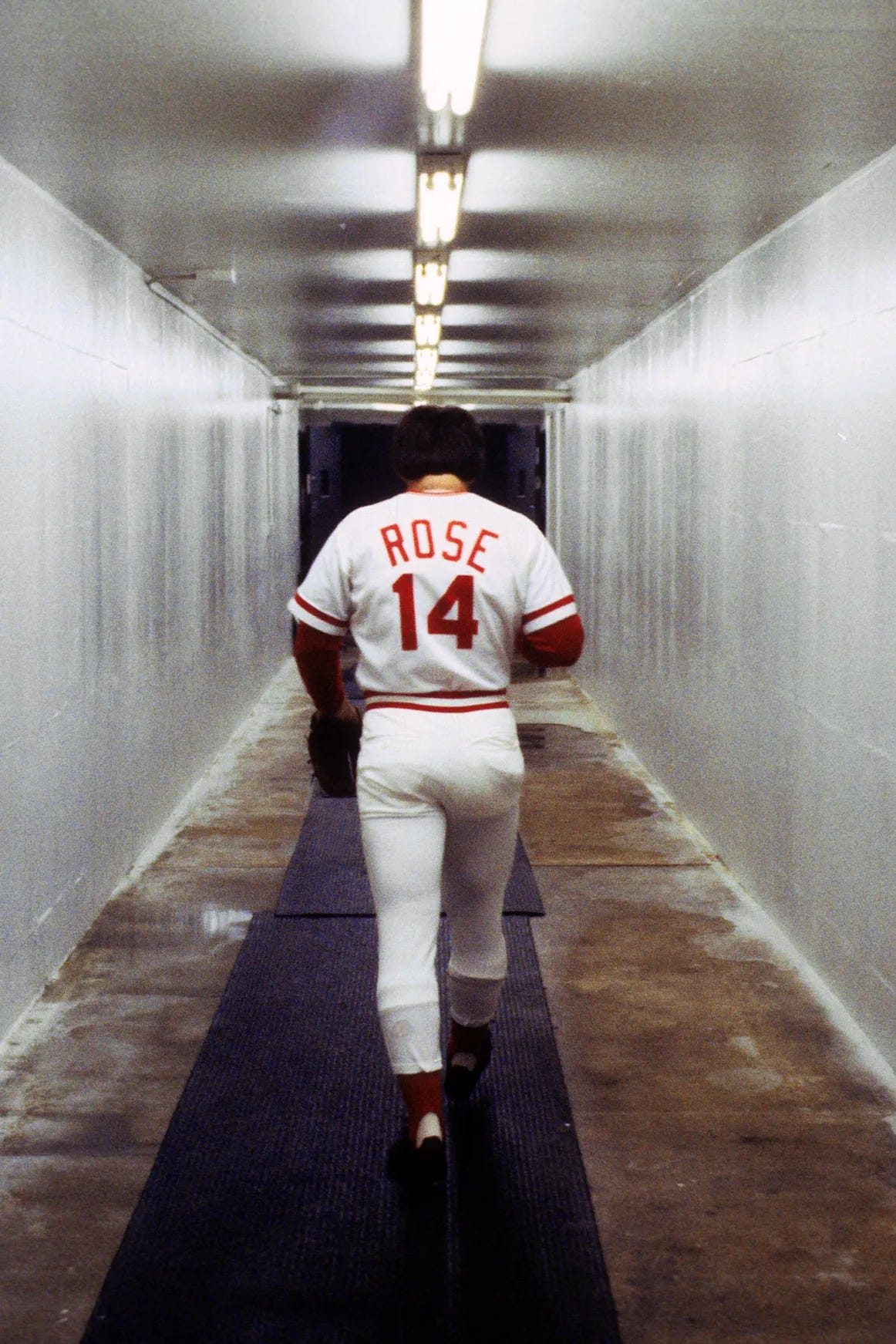
I was angry because I had just started to come around. After a lifetime of watching, reading, arguing, and wrestling with Pete Rose’s story, I had begun to believe he deserved to be in the Hall of Fame. And now, that door’s closed, at least for him. There’s no last moment of redemption. No reconciliation. No speech on the Cooperstown lawn. No chance for him to stand in front of the game that shaped him and have it say, even quietly, “You’re home.” That ending, as flawed and complicated as it might’ve been, will never happen now.
I spent all of last season writing the River Rat series, my own reckoning with Pete. I dug into everything. The books. The interviews. The Dodd Report. I didn’t go into it trying to exonerate him. I went into it trying to understand him. What I found was a man who made his life into a battlefield, who chased validation like it was oxygen, and who, despite his obvious flaws, truly and deeply loved the game.
That’s the part that still gets me. For all the controversy, the betting, the lying, the ego, Pete Rose loved baseball. It wasn’t just what he did; it was who he was. The game gave him everything, and in the end, it was the one thing he couldn’t live without. Even in exile, he never really left it. He spent decades on the outskirts, signing autographs, showing up at Cooperstown on induction weekend like a ghost just beyond the gates. Baseball never let him back in, but he never walked away from it either. That’s not stubbornness. That’s heartbreak.
And now he’s gone. And I’m angry because I was ready to forgive him, truly. I was ready to see his career for the totality of what it was: extraordinary, flawed, unforgettable. I was ready to stop holding him at arm’s length. But now I’ll never get to see him receive the thing he wanted more than anything. And maybe that’s justice. Or maybe it’s just tragedy. Maybe it’s both.
As a kid, Pete was everything I wanted to be. Loud. Aggressive. Always sure of himself, even when he shouldn’t have been. I didn’t wear #14. I didn’t imitate his stance. But I watched him with a kind of awe, the way he attacked every pitch like it had insulted his family, the way he slid headfirst into bases like he was trying to beat more than just the throw. He played baseball like it owed him something, and in that, I think I saw a kind of desperation I didn’t know how to name back then.
Now I do. It was the desperation of someone who didn’t know how to be anything else.
I’ve always been drawn to people who burn hot. Maybe because I know what that heat feels like, the drive to prove something, to push harder than necessary, to chase validation that never really satisfies. Pete lived inside that storm. And sometimes it lifted him to greatness. Other times it wrecked everything.
That duality is what made him so hard to let go of.
And it’s why, a week into the season, I’m just now saying goodbye. Because losing Pete Rose at the end of last season and Bob Uecker this offseason wasn’t just the loss of two baseball men. It was the end of a thread from my childhood, the thread that tied me to the game in its purest, rawest form. Uecker was the voice. Pete was the fire. Together, they formed the background noise of my early summers. Now both are silent.
I hope Pete finds peace now, the kind he never seemed to find here. I hope the game, in time, finds the wisdom to induct him posthumously. I’m not lobbying. I’m just saying what I believe: he earned it on the field, and he paid his price off of it.
This isn't a eulogy. It's not forgiveness. It’s just acknowledgment. Of a man who mattered. Of a player who changed the game. Of a complicated legacy I’ll be wrestling with for the rest of my life.
Rest in peace, Pete. You weren’t perfect, but you were unforgettable. And that should count for something.
I grew up in Tampa and saw Pete play for the Tampa Tarpons when he was an 18 year-old out of high school. He set the Florida State league record for triples because he never stopped at second base when he hit a gap shot. I also followed him in spring training every year at Al Lopez field, where the Reds trained in Tampa.
I think it is atrocious that he was banned for so long for gambling when MLB and all the networks now sponsor gambling sites.
The first and last thing that should be said about Pete is that he was a ball player.
Leon St. John
It can be so hard to let go of the heroes from our past. I was an SF guy, not a sports guy, so for me it was finding out William Shatner wasn't anywhere near as beloved as Captain Kirk. Quite the contrary for some of his fellow actors. Or learning that he thought the role was just another acting job, that it didn't *mean* anything to me (but it meant so much to me).
Not at all the same sort of situation, but similar enough that I know what it feels like to be disappointed by your heroes.