


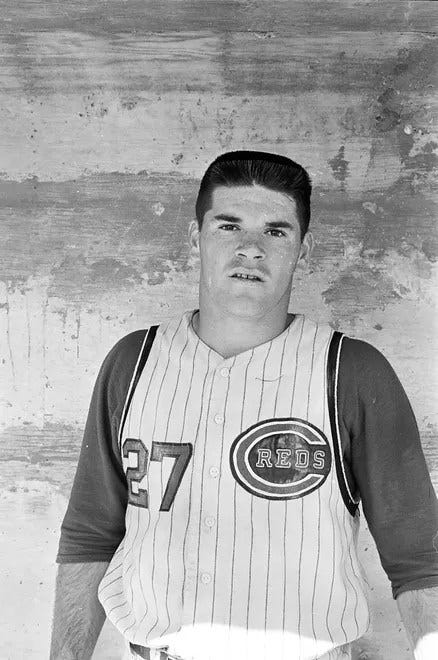
Pete Rose, AKA Charlie Hustle a monster on the diamond, the ‘hit king’ with 4,256 career base hits, versatility to play multiple positions, selected to 17 All-Star games, three World Series championships, the‘63 Rookie of the Year and the ‘73 NL MVP. All first ballot Hall of Fame achievements.
This is Ballpark Confidential: Baseball’s Backstory on Culture, Society, & History. Whether you’re a die-hard fan, a newcomer to the game, or just someone who enjoys a good baseball story, we’re set to dive deep into the essence of baseball, uncovering pivotal moments and key figures. This is more than a history lesson; it’s a judgment of how baseball reflects and influences our culture and society.
A new installment of River Rat – “Hustle, Heroism, and Hubris: The Pete Rose Conundrum” comes out every Friday!
In this first series, titled River Rat – “Hustle, Heroism, and Hubris: The Pete Rose Conundrum” I’m examining books, articles, opinions, watching TLC reality TV show “Hits & Mrs.” on Pete and will discuss the document that rocked Major League Baseball – The Dowd Report sparking a 35+ year debate on one of baseball’s greatest players.
I remember reading about Pete Rose’s betting in Sports Illustrated back in 1989, Rose was the kind of ball player I wanted to be. His tenacity and what he represented — it was everything I admired, with the revelations in the SI articles it got complicated.
Baseball has always been my escape. The slow pace, the strategy, the skill, the nostalgia — it is comfort. At the time, I didn’t care Rose bet on baseball, even on his own team. ‘He bet on them to win’ what is wrong with that? But that was before I really thought it through; before I learned to critically think about the impacts. I have read the Dowd Report, studied it and what stood out the most wasn’t just the evidence, but his lack of integrity, his refusal to take responsibility.
Integrity – the quality of being honest and having strong moral principles. Integrity is to consistently adhere to ethical standards and values. This for me his paramount and is my word and my bond.
I do believe he deserves recognition in the Hall of Fame, he is already celebrated in the museum portion and rightly so, but to be elected is a different honor. It’s about trusting the process and having integrity, something Pete never embraced. If he had admitted his gambling when he was confronted with the evidence, shown some contrition, maybe we wouldn’t still be having the arguments we have regarding him.
How do we reconcile the achievements of Rose with his flaws? Can we separate the player from the person?
To set the stage of this story, the mid to late 1980s, baseball mirrored the extravagance of the times — it was an era of excess, defined by the ‘me’ generation and an economy that was bullish. The Cold War was drawing to a close with the fall of the Berlin Wall, one of the most catastrophic environmental disasters occurred when the Exxon Valdez oil tanker spilled millions of gallons of crude oil into Alaska’s Prince William Sound. A massive earthquake measuring 7.1 on the Richter scale struck the San Francisco Bay area during the World Series between the Giants and Oakland A’s.
The sport itself was in flux, evolving rapidly with the infusion of television money, ballooning player salaries, and a cultural shift towards the commercial. Fans were closer to the game than ever, thanks to technological advances that brought the ballpark experience into living rooms nationwide. But with increased visibility came increased scrutiny.
Enter the Dowd Report, a document that laid bare allegations of betting on baseball against Pete Rose, then the manager of the Cincinnati Reds. It was a revelation that sent shockwaves through the heart of America’s Pastime, putting its principles up against hard truths.
In baseball’s history betting looms large, the Black Sox Scandal of 1919, where eight Chicago White Sox players were accused of intentionally losing the World Series, is a stark early example of how betting could corrupt the integrity of the game. It was a scandal rooted in player involvement, where the betrayal of the sport’s ethos was direct and active.
Then there was Tris Speaker and Ty Cobb, two of the most iconic figures in baseball history. Speaker, known for his exceptional defensive skills and hitting, was a center fielder primarily for the Cleveland Indians and Boston Red Sox. Cobb, known for his aggressive playing style and remarkable batting ability, spent the majority of his career with the Detroit Tigers.
In 1926, both Speaker and Cobb were implicated in a gambling scandal that damaged their legacies. A letter written by Dutch Leonard, a former pitcher, to American League president Ban Johnson alleged that Speaker and Cobb had conspired to fix a game between the Detroit Tigers and Cleveland Indians in 1919. Leonard claimed that Cobb and Speaker, along with Smoky Joe Wood, planned to bet on the Tigers to win a game that Wood would pitch against the Indians.
The accusations stated that Cobb and Speaker had agreed to lose the game intentionally in order to profit from betting on the outcome. Leonard provided letters and telegrams as evidence, which seemed to indicate that a plot had been discussed.
The scandal led to an investigation by Commissioner Kenesaw Mountain Landis. After a thorough review, Landis declared that the evidence was inconclusive and that Cobb and Speaker could continue playing. However, the incident left a stain on their reputations and raised suspicions about their integrity.
Cobb and Speaker were both acquitted of any wrongdoing, but the accusations lingered in the public’s mind. This episode remains one of the darker chapters in the history of early baseball, highlighting the sport’s struggle with gambling issues even before the infamous Black Sox Scandal of 1919.
Denny McLain of the Detroit Tigers career was marred by numerous off-field issues, including gambling. known for his remarkable 1968 season when he won 31 games and earned both the American League MVP and the Cy Young Award. His dominance on the mound made him a household name and a key figure in the Tigers’ World Series victory that year.
In 1970, it was revealed that McLain had been involved in bookmaking activities during the 1967 season. Commissioner Bowie Kuhn suspended him indefinitely, which was later set at three months. This suspension marked the beginning of McLain’s decline.
In addition to his gambling activities, McLain was implicated in a loan-sharking scheme. He was allegedly connected to mobster Tony Giacalone, which further tarnished his image and credibility.
McLain’s gambling and related activities led to multiple suspensions, and he struggled to maintain his performance on the field. His once-promising career spiraled downward, and he retired in 1972 under a cloud of controversy.
The gambling accusations against Tris Speaker, Ty Cobb, and Denny McLain illustrate the ongoing challenges baseball has faced in maintaining its integrity. While Speaker and Cobb managed to avoid formal punishment, the allegations left an indelible mark on their careers. McLain, on the other hand, saw his once-bright future darkened by repeated involvement in gambling and criminal activities.
Fast forward to the 1980s, and the nature of baseball betting had evolved, now heavily influenced by organized crime. Unlike the Black Sox era, where players themselves were the direct actors in the scandal, the 1980s saw players like Pete Rose entangled in a web of betting that was more complex and layered. The mob, with figures similar to John Gotti, played a significant role in controlling the illegal betting markets.
The key difference between the two eras lies in the nature of involvement and the context of the betting. While the Black Sox Scandal was a clear-cut case of players conspiring to fix games, the Pete Rose saga was part of a broader, more intricate system of illegal betting. In Rose’s case, like Denny McLain, his involvement, though serious, was part of a larger network run by organized crime, rather than a direct attempt to alter the outcome of games for profit.
Today, technological advancements and stringent enforcement by Major League Baseball have led to greater scrutiny and accountability. The once-covert world of betting, overshadowed by the mob’s presence, has now transitioned to a regulated and legal framework.
As we dive into the Dowd Report and SI articles, we’ll explore how this landscape impacted the game and its players, especially Rose. How did the betting culture of the 80s influence his actions? What can we learn from this chapter in baseball’s history about integrity, accountability, and the complexities of human behavior? The lifetime ban handed to Rose for his actions invites us to question the balance between punishment and fairness, between personal flaws and professional accolades.
These are more than questions of baseball. They are questions of life, probing how we navigate the gray areas in our daily walk, in our careers, and in the relationships we hold dear.
Dowd Report: Section I – Introduction
In this segment of the series on the Dowd Report on Ballpark Confidential, I investigate the context that led to the commissioning of the Report, which was authorized by Peter Ueberroth, who was the Major League Baseball (MLB) Commissioner at the time the investigation began in February 1989. The report was later delivered to A. Bartlett (Bart) Giamatti, who took over as MLB Commissioner on April 1, 1989. The findings of this report were instrumental in the decision to place a lifetime ban on Pete Rose from baseball.
The buzz around Pete Rose, the manager of the Cincinnati Reds, wasn’t just hearsay—it was a matter of internal concern. The MLB’s director of security was informed that Rose might be betting on baseball, including games involving his own team. These rumors were a direct challenge to one of baseball’s most sacred edicts: No betting on the game. Such infractions threaten the very integrity of the sport.
Faced with these allegations, Ueberroth was compelled to uphold the sanctity of baseball. With the authority granted by the Major League Agreement, in Article 1, Section 2, he had the responsibility to initiate a thorough investigation. It was a pivotal moment that required decisive action to either clear Rose’s name or confirm the unthinkable—that a celebrated figure in baseball might have betrayed the trust of the game he embodied.
To thoroughly investigate these claims, Ueberroth appointed John Dowd, a lawyer with a notable background in criminal investigations. Dowd’s experience was extensive, having served at the Department of Justice where he was involved in high-profile cases, including investigations into organized crime and political corruption.
The Dowd Report, delivered to Bart Giamatti in 1989, was extensive. Spanning 225 pages, it contained eight sections of evidence and supplementary material, which we will cover in detail. The investigation focused on Rose’s gambling activities during the 1985, 1986, & 1987 seasons, both as a player and a manager.
Read Section I the Introduction of the report in its entirety that highlights its scope and then I will discuss the implications.
Report to the Commissioner dated May 29th, 1989 – Introduction
On February 23, 1989, This firm was retained and empowered by the Office of the Commissioner to investigate Peter Edward Rose, the Manager of the Cincinnati Reds Baseball Club, pursuant to the Major League Baseball Agreement. Your decision was based on the fact that the Director of Security for Major League Baseball had received reports during the past year that Pete Rose had bet on Major League Baseball games, including games of the Cincinnati Reds, in violation of Major League Rule 21. Rule 21(d) provides:
Any player, umpire, or club or league official or employee, who shall bet any sum whatsoever upon any baseball game in connection with which the bettor has no duty to perform, shall be declared ineligible for one year.
Any player, umpire, or club or league official or employee, who shall bet any sum whatsoever upon any baseball game, in connection with which the bettor has a duty to perform shall be declared permanently ineligible.
Betting on baseball by a participant of the game is corrupt because it erodes and destroys the integrity of the game of baseball. Betting also exposes the game to the influence of forces who seek to control the game to their own ends. Betting on one’s own team gives rise to the ultimate conflict of interest in which the individual player/bettor places his personal financial interest above the interests of the team.
Gambling is conducted in secret by its participants. Normally little is recorded and what is written down is destroyed shortly after payment of the wager. Payments are often made in cash by runners between the bookmaker and the gambler because cash is fungible and difficult to trace. The runners provide insulation and, thus, deniability to the gambler and the bookmaker. The telephone is used to conduct the wagering business by the participants. It is often difficult to determine who is wagering with whom because many phones are used by the bookmakers, runners, and gamblers. The product of gambling — particularly sports action — is debt, enormous debt which leads to obligations, which leads to corruption. The secret gambling enterprise is typically exposed only when a participant is apprehended and begins to cooperate with the authorities. The difficulty for the investigator lies in the gathering of corroborative evidence. The gambling enterprise is designed to leave few cracks, and upon exposure, to provide alibis to the participants.
This is the end of the Introduction.
Let’s unpack this – Major League Baseball’s Rule 21 clearly states the consequences of betting on baseball games. For any player, umpire, or official involved in betting, the penalties range from a one-year ban to permanent ineligibility. Pete Rose knew the rules since he was a player and a manager, as it is posted in MLB locker rooms.
This segment of the story isn’t just about the rules of baseball; it’s about its integrity. This is a crucial aspect of baseball that goes beyond the field. What does integrity mean in the context of baseball?
Integrity in baseball is the backbone of the sport. It’s about fair play, respecting the game’s rules, and playing with honor. But it’s more than just following the rules. It’s about honesty and transparency, both in actions and communication.
True sportsmanship is key. This means showing respect for everyone involved – teammates, opponents, coaches, and fans. It’s about acknowledging good play and maintaining decorum, even in the heat of competition.
Accountability and consistency are also vital. Players and officials must own their actions, on and off the field. Upholding ethical standards, irrespective of personal gain or competitive advantage.
And let’s not forget the role each person plays in preserving the sport’s reputation. Avoiding actions that could tarnish the game in my mind is crucial. Integrity isn’t just an individual responsibility; it’s a collective commitment to uphold the game’s values.
So, integrity in baseball? It’s about more than just the rules. It’s the fabric that holds the game together, ensuring that baseball remains a sport respected for its fairness and spirit.
In the next segment of The Dowd Report I will discuss Section II, titled Summary of the Report.
Section II is where the investigation begins to unfold in detail. it summarizes the extensive evidence gathered against Pete Rose, pointing to the heart of the allegations. It’s a pivotal section, laying the groundwork for the conclusions that would eventually be drawn.
Notes & Links
Peter Ueberroth was Commissioner until March 31, 1989. On April 1, 1989, A. Bartlett Giamatti became Commissioner.
Article I, Section 2 of the Major League Agreement empowers the Commissioner to, inter alia:
investigate … any act, transaction or practice charged, alleged or suspected to be not in the best interests of Baseball.
determine, after investigation, what preventive, remedial or punitive action is appropriate in the premises, and to take such action either against Major Leagues, Major League Clubs or individuals, as the case may be.
formulate … the rules of procedure to be observed by the Commissioner and all other parties in connection with the discharge of his duties. Such rules shall always recognize the right of any party in the interest to appear before the Commissioner and be heard.