


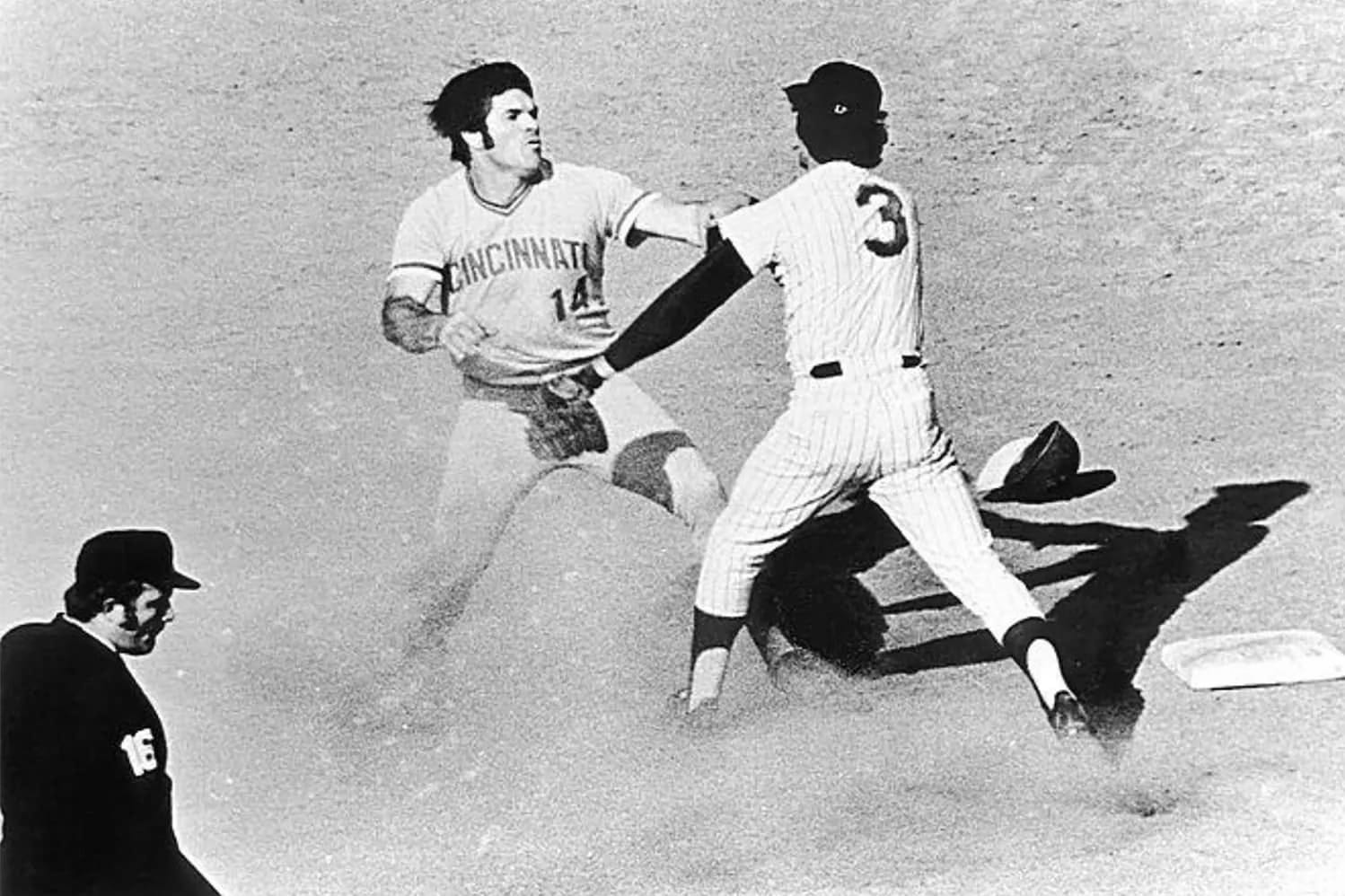
"Well, every Monday came around and every Monday he had another excuse for me...I heard every excuse..." This revealing conversation between Paul Janszen and Steve Chevashore, captured in a taped conversation in December 1988, offers a glimpse into the mounting financial pressures facing Pete Rose due to his alleged gambling activities."
Welcome to Ballpark Confidential: Baseball’s Backstory on Culture, Society, & History. Whether you’re a die-hard fan, a newcomer to the game, or just someone who enjoys a good baseball story, we’re set to dive deep into the essence of baseball, uncovering pivotal moments and key figures. This is more than a history lesson; it’s a judgment of how baseball reflects and influences our culture and society.
In this first series, titled River Rat – “Hustle, Heroism, and Hubris: The Pete Rose Conundrum” I’m examining books, articles, opinions, watching TLC reality TV show “Hits & Mrs.” on Pete and will read the document that rocked Major League Baseball – The Dowd Report sparking a 35+ year debate on one of baseball’s greatest players.
A new installment of River Rat – “Hustle, Heroism, and Hubris: The Pete Rose Conundrum” comes out every Friday!
Over the past several weeks, we have embarked on a comprehensive journey through the Dowd Report, breaking it down section by section. This analysis has allowed us to examine the evidence, testimonies, and conclusions that led to Pete Rose's lifetime ban from Major League Baseball. Each section of the Dowd Report has been explored to provide a clear and nuanced understanding of the events and actions that defined this pivotal moment in baseball history.
This section highlights several aspects of human nature, particularly in the context of Pete Rose's behavior, consistent denial of his gambling activities, even in the face of mounting evidence, reveals a common human tendency to protect oneself from the consequences of wrongdoing. His attempts to shift blame onto Janszen further demonstrate a desire to avoid accountability.
Rose's persistent gambling, despite his growing debts and the risks involved, suggests a possible addiction. His behavior reflects the compulsive nature of such addictions, where the desire for the activity overrides rational decision-making.
Rose's reliance on Janszen and Marcum to manage his gambling and debts, while offering them little compensation, demonstrates an exploitative aspect of his character. He seemingly took advantage of their loyalty and willingness to help.
One of the things that struck me most is Rose's apparent lack of remorse for the consequences of his actions, including the financial burden he placed on Janszen and the potential harm to his team, suggests a lack of empathy and conscience. His focus seemed to be solely on his own desires and interests.
These aspects of human nature are not unique to Pete Rose but are common traits that can be observed in various individuals and situations.
Within this section of the Dowd Report details the expansion of Pete Rose's gambling activities, highlighting his growing reliance on associates Paul Janszen and Steve Chevashore to place bets and manage his escalating debts. As you read, pay attention to the detailed accounts of Rose's betting patterns, the mounting financial strain he faced, and his repeated denials despite the mounting evidence against him.
The section also reveals the increasing involvement of Janszen and Marcum in Rose's gambling operation, illustrating the extent to which his activities were intertwined with their lives. Finally, consider the growing tension and mistrust between Rose and his associates as his debts continued to accumulate, ultimately leading to threats and accusations.
If you just started reading this series I suggest starting with Part One.
Section III. RESULTS OF INVESTIGATION, C. THE ROSE-JANSZEN–CHEVASHORE –“VAL” BETTING - APRIL & MAY 1987
1. PAUL JANSZEN AND DANITA MARCUM ARE INTRODUCED TO PETE ROSE
In the fall of 1986, Gioiosa introduced Paul Janszen to Pete Rose. Janszen had attended the University of Cincinnati and worked as a salesman for the Queen City Barrel Company. Janszen, who worked out at Gold's Gym, had seen Gioiosa with Rose from time to time in Gold's Gym, but he had never met Rose. Janszen was also a distributor of steroids. He knew Gioiosa was a big gambler and the “mule” for the cocaine operation for Stenger and Fry. He also knew that Gioiosa was placing bets for Rose:
“Tommy would not only discuss this [his placing bets on sports for Rose] with me but he would brag about the money that was being wagered. And I think he felt somewhat important because he was handling such a huge task for Pete Rose.”
Janszen's introduction to Rose took place at Rose's home during the National League playoffs. Janszen testified he recalled that Pete Rose bet through Gioiosa on the 1986 National League playoffs between Houston and the New York Mets. According to Janszen, Rose explained to Gioiosa, “It made them more exciting, ... to bet [on the baseball playoffs].” At this time in 1986, Rose's bets were being placed by Gioiosa with Ron Peters. Janszen recalled meeting Peters when he and Gioiosa visited Peters at the end of 1986.
From September 1986 through December 1986, Janszen became closer to Pete Rose and was invited to go on card show trips with Rose. Janszen was first introduced to Mike Bertolini at a card show in October 1986. At the shows, Rose asked Janszen to count the money. He counted the cash and put it into a brown paper bag for Rose. Janszen estimated that Rose made between $8,000 - $12,000 in cash on each card show. Yet, there are no deposits from card shows identified in Pete Rose's financial records. According to Janszen, Rose wanted to be paid in cash because 'cash money did not have to be claimed.' On one occasion, Janszen recalled that Rose was 'aggravated' when a dealer had paid him by check.
Janszen's girlfriend, Danita Marcum, also got to know Pete Rose and became close friends with Rose's wife, Carol. Rose. Marcum would accompany Janszen to Rose's home and joined him on some of Rose's out of town trips, particularly if Carol Rose went.
Danita Marcum confirmed that she and Paul Janszen were invited to Pete Rose's home during the period of September through December of 1986. She recalled witnessing Rose, Gioiosa and Bertolini placing bets. She said she saw large amounts of cash in Pete Rose's home and stated that Rose, Janszen, Gioiosa and Bertolini would spend all their time watching sports events on television. Marcum described a visit to the Rose home accordingly:
“If we were sitting at Pete Rose's house, Pete would have a book, a ledger book, hard-bound, and then he would have a legal pad inside of it which he would put down his gambling wins and losses. I know we would go over there, and we would sit, and we'd be watching the games on TV. Or if we were over there during like the early afternoon, Pete may be looking at the paper, or even late morning, and he would tell Paul who he wanted for that day.”
Janszen testified, and Peters recalled, that Gioiosa and Rose had a falling out in late 1986 and early 1987. As a result, Paul Janszen became closer to Rose. Rose acknowledged that he "had [his] outs with" Gioiosa around the time of Spring training in 1987. Rose explained that Gioiosa started a "ruckus" at the track while sitting in his special room and that led to the racetrack closing down the room. Rose explained that the "ruckus" resulted from Gioiosa's "drinking problem."
2. JANSZEN AND MARCUM ATTEND SPRING TRAINING WITH PETE ROSE
In the middle of February 1987, Rose invited Janszen and Marcum to come to his home in Florida while he was at Spring training. Janszen and Marcum accepted the invitation. Gioiosa, however, was not invited. They stayed for six weeks at Rose's rented house in Tampa, Florida. Janszen had quit his job at the Queen City Barrel Company and was essentially living off the proceeds of his steroid business. Rose confirmed that Janszen and Marcum stayed at his house for free during spring training. Rose also testified that they stayed at his house for six weeks for "nothing ... and I got [Janszen] a rent-a-car for nothing."
Following afternoon Spring training sessions, Rose and Janszen routinely would go to Tampa Bay Downs Racetrack. There, Rose introduced Janszen to Mario Nunez, a/k/a, the Cuban, who was the maître d' for the restaurant at Tampa Bay Downs.
Rose also introduced Janszen to Steve Chevashore, and Chevashore’s uncle, Howard Bernstein. Janszen watched Rose bet large amounts of money on horse racing. According to Janszen, Rose had Chevashore cash his winning tickets to evade his tax liability.
Rose, however, denied that Chevashore ever “ran” bets for him at the track. Rose also testified that he bet very little money at Tampa Bay Downs and that the most he lost there was “seven hundred bucks.”
At Pete Rose's request, Janszen began placing Rose's bets with Steve Chevashore on various sports action, including basketball, hockey and, later, baseball. Since Janszen had never previously placed bets, Rose and Chevashore explained the mechanics and language of betting to him. Chevashore informed him that there were special "key words" that he should use when placing a bet over the phone in the event the phone was being tapped. Specifically, Chevashore explained that Janszen should never use the word “bet” or ever refer to Pete Rose when placing a bet for him. Instead, Janszen was directed to say "my friend," and Chevashore would accordingly know that this friend was in fact Pete Rose. With this understanding, the Rose-Chevashore connection was cemented, using Janszen as Rose's runner. According to Chevashore, Rose specifically instructed him that Janszen would handle all of his gambling business.
CHEVASHORE: You mean when he was in Florida - when you were there in Florida?
JANSZEN: Right, remember how it would be?
CHEVASHORE: I understand. I had to go over to see him in the dugout and he used to say, well didn't you see Paulie, he's supposed to take care of everything, remember that.
Rose, Janszen, and Chevashore had an understanding that the size of the bets Janszen was placing for Rose would always be for $2,000, "no matter what the game was, no matter when the game was being played." Janszen explained that he did not Rose had the financial capability to place these bets himself. Rose denied that Paul Janszen ever placed bets for him on baseball, football or basketball games, or did anything other than possibly place a bet for him at the racetrack.
As the Janszen-Chevashore relationship continued, Janszen learned the identity of the bookmaker whom Chevashore used to place Rose's bets. Janszen never knew his last name, but his nickname was Val, and he was located in Staten Island, New York.
In April 1987, Rose asked Janszen to continue placing the bets with Steve Chevashore in Florida. At this time, Rose Janszen betting on baseball, basketball and hockey. Rose's betting activity is corroborated not only by the other evidence previously described, but also by documentary evidence such as betting sheets showing bets on baseball games in Rose's own handwriting; Janszen's betting notebook; and the numerous telephone calls to Chevashore from Janszen's home and Rose's home. In mid-April 1987, Chevashore directed Janszen to place Rose's bets directly with Val in New York:
JANSZEN: This maybe started, we started our betting on 4/7/87, direct betting with Val began maybe on 4/17/87....
JANSZEN: I'm sorry 4/17/87. Our time period right now is April, May and June 1987. There is basketball and then of course there is baseball on there.
Janszen's betting notebook for this time period contains the word "Val," and telephone records during this time period began to show calls to Val in New York. Thereafter, Janszen, and occasionally his girlfriend, Danita Marcum, contacted Val directly to place the bets:
DOWD: Did you bet on the Cincinnati Reds baseball team at the request of Pete Rose?
MARCUM: Yes.
DOWD: While he was Manager of the Cincinnati Reds baseball team?
MARCUM: Yes.
DOWD: And you placed those bets with Ron Peters?
MARCUM: Yes. Not as many times as Val. Just a couple of times with Ron Peters.
One incident which occurred during this period illustrates that Janszen indeed did not have the financial capability to place large bets for himself. The incident occurred when Marcum, at Janszen's request, called Val to place bets on the games of May 14, 1987. Janszen asked Marcum to put "three" on the Cincinnati-Montreal game for him, in addition to the bets being placed for Rose. Marcum got confused and bet "three dimes" ($3,000). When the error was discovered, Marcum called Val, the bookmaker, directly to try to change the bet.
In a taped conversation between Paul Janszen and Steve Chevashore on December 27, 1988, Chevashore confirmed the incident, and that Rose was betting on the Cincinnati-Montreal game:
CHEVASHORE: OK. I want you to verify this.
JANSZEN: That, you...I...Stevie...
CHEVASHORE: I just want to tell you the story because I don't know what happened that day. Danita called up and she bet 3 dimes. She said you and Pete wanted to bet 3 dimes on Cincinnati, they were playing Montreal.
JANSZEN: Right.
CHEVASHORE: Listen to the story. So, she calls back Val and she says, Val you got to cancel the bet I made a terrible mistake.
JANSZEN: Yeah
CHEVASHORE: She says they don’t want that thing. So, Val says, Look Danita, if there's no score, I'll do you the favor. I'll cancel the bet.
JANSZEN: Right.
CHEVASHORE: Am I right?
JANSZEN: Right.
CHEVASHORE: So, Val calls up, they're leading 6 nothing, so what's Val going to do. He can't cancel, he’s only a clerk, right.
JANSZEN: Uh um.
CHEVASHORE: He says, 'I'M SORRY I can't do nothing about it...[PAUSE ON THE TAPE] ...Send me the 13970, I'll send you back the 3,000 that you have to eat at the bank.
JANSZEN: Now, what happened was that night I had asked Danita for me, I was leaving here OK, and Pete - you know, what happened was Pete would call here about every night about like a quarter to seven.
CHEVASHORE: Yeah.
JANSZEN: And leave the...you know, the numbers of the teams he wanted and when I was leaving here, I told her I wanted 3 on Cincinnati myself. Well, when she started you know putting in Pete's and everything else, she got confused and put 3 dimes for me and instead of 3 dimes it should have been 3 nickels.
CHEVASHORE: Right.
As it turned out, the Reds came from behind to beat the Expos 10-9, so Janszen did not lose the $3,000. Janszen continued to place bets on baseball and other sports with Val on behalf of Rose until the middle of May 1987 when Val refused to take any more bets from Pete Rose because of Rose's unpaid debts. Janszen testified that he then made arrangements at the request of Rose to place bets with Ron Peters.
Throughout the time Rose was placing bets with Val, the New York bookmaker, through Chevashore and Janszen, he was constantly delinquent on his gambling debts, which were due for payment on Mondays. The conversation below between Janszen and Chevashore establishes the Rose-Chevashore-Val connection and Rose's failure to pay his debts on time:
JANSZEN: OK. Well, I did, and I explained to him [Rose] that you guys wanted business taken care of every Monday.
CHEVASHORE: Right, right.
JANSZEN: OK. Well, every Monday came around and every Monday he had another excuse for me.
CHEVASHORE: Right.
JANSZEN: Now, in Florida I was betting like up to 250, 3 up to 500. OK. He was doing two dimes.
CHEVASHORE: Right, and you used to add on to it.
* * * * * * * * *
JANSZEN: OK, now let me explain what happened.
CHEVASHORE: Yeah.
JANSZEN: When, remember when every Monday, like three Mondays came and went, and there was no more money sent?
CHEVASHORE: Right.
JANSZEN: And Val kept saying, man, and you kept saying, you got to get things taken care of. Well, I kept going to the son of a bitch saying, straighten it up, not only pay the balance, but pay me my fuckin' money.
CHEVASHORE: OK.
JANSZEN: And he kept coming up with excuses, Steve, I heard every excuse.
CHEVASHORE: Paul, he used to tell me, Steve, he’s in, he flew to St. Louis, he’s got a $25,000 check that is not cleared yet, remember you used to give me...
* * * * * * * * *
CHEVASHORE: I know yourself. You got yourself, you used to keep taking care of them. Don’t worry, he’ll tell me stories. You used to say to me, Jeez, could he carry it over for like three weeks or a month, but they couldn’t do it, those people.
* * * * * * * * *
JANSZEN: Can I ask you something Steve. I just want to ask you something. Do you believe what I’m saying to you?
CHEVASHORE: Well, you know something Paulie. I’ll tell you why I believe you. Because you know what they said to me. The guys in the office, the bosses, they said, this guy probably did this before with other people.
JANSZEN: Yep.
CHEVASHORE: OK?
JANSZEN: Yeah.
CHEVASHORE: They said, something is not right here.
JANSZEN: Yeah.
CHEVASHORE: Because you know what they said, if you were the culprit and wrong, he is supposed to take care of it because we did everything under his merit.
JANSZEN: Yep.
CHEVASHORE: If you were doing something wrong, which you're telling me you didn't...
JANSZEN: Yeah.
CHEVASHORE: ...he's still supposed to take care of this because, you know, we did everything under him. We figure, well we'll never get in trouble anything that's called up by you, he's got to stand by.
JANSZEN: Yeah.
CHEVASHORE: Do you understand?
JANSZEN: Yeah.
CHEVASHORE: Am I right?
JANSZEN: That's absolutely right.
* * * * * * * * *
CHEVASHORE: You might have gotten your balls twisted if I kept calling you to say Paul you got to send this thing because they've got to pay other people and you said Steve you're right. Danita told me all the time, Stevie, you're right. My boyfriend is trying to do the best he can you know. She says, it's his fault because you know, he didn't leave checks, he has $25,000 worth of checks that weren't any good. Hey, let me tell you something. When you gave me that check for $7500. You remember the first time, and it was no good?
JANSZEN: And who did that check come from?
CHEVASHORE: It was his.
JANSZEN: That's right.
CHEVASHORE: And you know something. He exposed himself doing that. Because you know what they did. When they first got the check when they were gonna cash it, they went to the bank, and it was no good and the people were looking, and I think they made a photostatic copy of that too.
JANSZEN: Oh really.
CHEVASHORE: Yeah, I think they did.
* * * * * * * * *
Chevashore's statement to Janszen about Rose giving a check for $7,500 which was "no good" finds support in the records of Rose’s personal account at the First National Bank of Cincinnati. While the bank records do not show a $7,500 check actually "bouncing," they do reveal that two checks totaling $7,500 were paid by the bank on March 31, 1987, which caused the account to be overdrawn. While the checks were not returned by the bank, Rose’s account was charged a $10 "NSF" fee for each item. The $7,500 represents two checks written to cash by Pete Rose and cashed at Tampa Bay Downs: one dated March 26, 1987 for $5,000; and the other dated March 29, 1987 for $2,500. Rose acknowledged these were his checks.
Rose explained that when something like this happens, the bank would call his accountant, Bob Chaiken, who would immediately put money into the account.
In the taped conversation between Janszen and Chevashore, Chevashore discussed a mid-May 1987 conversation with Rose in which Rose acknowledged betting, but claimed he stopped during the Reds trip to New York on May 4-6, 1987:
CHEVASHORE: I can't understand that. I mean, I—have to believe you Paulie, but you know, the only thing is, when I spoke to Pete when you were there and he said, I says, 'Pete you know we keep falling behind this and that and you know they won't take any more action I don't know what the figure was.
JANSZEN: Yeah.
CHEVASHORE: Maybe it was 15 or 16. He said Stevie I stopped betting when we were in New York on the last trip. He said I'm not betting any - I haven't bet since over ten days. I said so whose betting this? So, we thought it was you making…
JANSZEN: No, no
CHEVASHORE: ...betting everything under him.
JANSZEN: No, no.
CHEVASHORE: And that's what he said to me. He said 'I'm not betting anymore.
Chevashore, however, acknowledged that Janszen could not have been betting on his own, for several reasons:
CHEVASHORE: He [Rose] said this [post May 6, 1987 betting] was yours personally, [but] never said that you were betting and using his name, you know.
JANSZEN: Stevie, do you really think that I would have been betting $2,000 every game.
CHEVASHORE: No, you couldn't afford that.
JANSZEN: Thank you. I mean I just hope.
CHEVASHORE: Paulie, I don't know you, but to me I don't think [it was] you. You know why?
JANSZEN: Ok.
CHEVASHORE: Because it makes sense that when you used to call me up, I would say when you called those guys in New York, you used to say you know, give me 2 dimes [$2,000] for Pete and add 3 [$300] for me. I remember, I mean that's the truth, you know. I understand that.
Chevashore went on to express his frustration at Rose's failure to pay his debts:
CHEVASHORE: What's he crazy, what's the matter with him, he's got money, he's not broke. But I mean Jeez, he cost me money, he caused me nothing but problems, then I had problems with you, and I you know, and he told me, he told me on the phone and his wife got mad at me and she says Carol please don't, Carol says to me Stevie, please don't call up and bother my husband. I'm not responsible for what he does you know, and I just don't want you to call him. I says Carol, I won't call you anymore because I called her twice and that was it. He told me, he says, I don't do, he says, I haven't done anything since I left New York with you, with you and Paulie. He says, I have, you know, I stopped betting because with those people because I wasn't lucky, he said to me you know, whatever was done you did and you know, he didn't say that you were betting under a false pretense, under ghost bets.
Rose's claim to Chevashore that Rose stopped betting after the Reds trip to New York in early May 1987 is not corroborated by any evidence developed in this investigation. Indeed, in the very conversation in which Chevashore talked about Rose's claim that he stopped betting while in New York, Chevashore also confirmed the betting placed by Danita Marcum with Val on May 14, 1987 (subsequent to the New York trip), when Marcum placed bets for Rose, and a mistakenly large bet for Janszen, on the Reds-Expos game.
From April 7, 1987 until May 13, 1987, Rose lost $67,900 as a result of his bets with Val. Rose, however, only gave Janszen a small amount of money to cover these losses. Janszen and Marcum testified that Janszen took cash from his safety deposit box and sent it via Federal Express to Val to keep the action going for Rose. Janszen also borrowed money to pay off Rose's gambling debts with Val. Janszen was always concerned that Val would expose Rose and his gambling on baseball if the debts were not paid. Janszen estimated that he paid Val approximately $30,000 of his own money on Rose's behalf, believing Rose would pay him back. According to Janszen, Rose told him that:
“Paul, don't worry, I'll get you some stew, don't worry, you know, I'll have some in a couple of months, things are tight right now, you know, tell the bookie, hey don't worry about it.”
The last bet placed with Val through Janszen was on May 13, '1987. Val was "furious" about Rose's unpaid debt as he had only received "bits and pieces of money" owed him. From the outset, Val had made numerous telephone calls to Janszen in attempts to collect what he was owed, as payments from Rose were neither timely nor complete. Val finally told Janszen that he would not take any more action until Rose had settled up on his debt.
Rose called Janszen the very same night that Janszen received the ultimatum from Val. Rose wanted to give Janszen some teams on which to place bets. Janszen informed Rose that Val would not take the action, but Rose insisted that Janszen call Val. Val, in fact, did refuse to take the action, which would have had Rose winning six out of seven games. The next day, Rose called Janszen thinking he had won, but Janszen told him Val had refused to take the action. Rose became furious and told Janszen that he would have been "up" had Val taken the action.
After this incident, Janszen continued to receive calls each day from Val and Chevashore about paying Rose's debt. Janszen recalled an occasion at Rose's home when Rose received a call from Chevashore demanding payment. Rose told Chevashore that Janszen was betting for himself in Rose's name and to seek payment from Janszen. Rose then turned to Janszen and told him not to worry, Chevashore was afraid of him. Thereafter, Janszen's mother received a threat on Janszen's life, which is confirmed in the taped conversation between Janszen and Chevashore.
CHEVASHORE: But I was very upset, and I was, and I said Jeez, I better call Paulie's mother up and let her hear my voice, so she knows that that wasn't me who called her that day because you told me she was crying, this and that, you know.
JANSZEN: Yeah, I went over there that night, and she was like in tears and
CHEVASHORE: I understand.
JANSZEN: She said somebody called, she said.
CHEVASHORE: Yeah
JANSZEN: I think it's the same guy that was calling Stevie and he threatened to kill you.
When questioned about the Janszen-Chevashore-Val connection, Rose denied that he ever placed bets of any kind with Chevashore and Val. Rose testified that he knew Chevashore only as "Stevie," the nephew of a friend of his by the name of Howard Bernstein. He testified that his only dealings with "Stevie" were to sit with him at his uncle's table at Tampa Bay Downs racetrack. Rose denied knowing anyone by the name of Val. Additionally, Rose denied ever placing any bets with Paul Janszen at any time.
When confronted with the fact that telephone records show numerous telephone calls from his home and his hotel rooms in Chicago and Pittsburgh, to Val in New York, Chevashore in Tampa, Florida, and Ron Peters in Franklin, Ohio, Rose denied making any of the calls. Rose added that while they were in Chicago, the hotel was filled and Paul Janszen stayed in the "suite part" of his room. Rose stated that, if there were telephone calls to Ron Peters, "I'll guarantee you that Paul
Janszen was in the room." Rose said that Janszen was probably in Rose's home more frequently than Rose was.
End of Section
Questions to ponder as you continue to read through remaining sections of the report.
Given the extensive evidence against him, why did Pete Rose consistently deny his involvement in gambling? Was it an attempt to protect his reputation, a denial of his addiction, or a calculated strategy?
How did Pete Rose's gambling affect his managerial decisions for the Cincinnati Reds? Did his betting influence his in-game strategies or player selections?
In the next post we discuss :
Section III. RESULTS OF INVESTIGATION, D. THE ROSE-JANSZEN-PETERS BETTING — MAY, JUNE & JULY 1987