


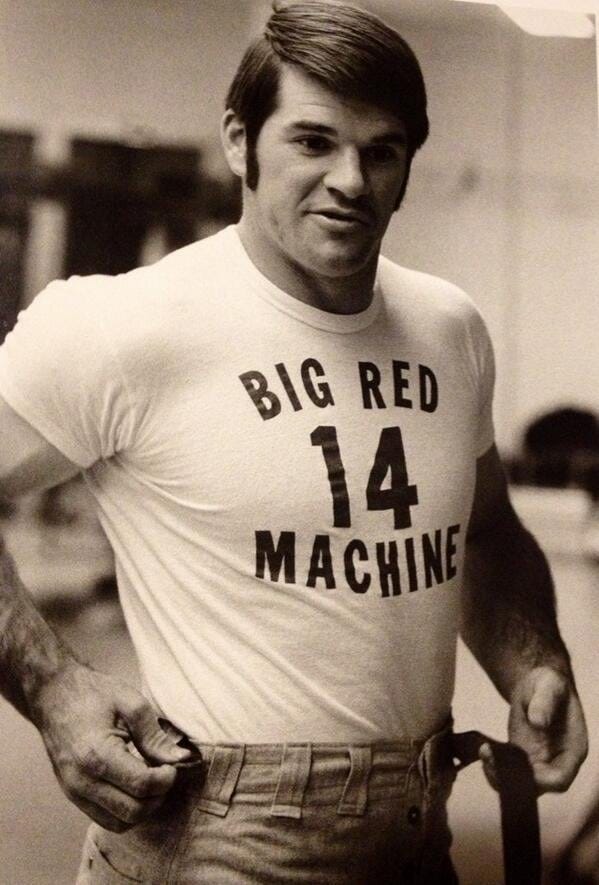
The Dowd Report: a shadow forever cast over Pete Rose, baseball’s hit king. This series, River Rat – “Hustle, Heroism, and Hubris: The Pete Rose Conundrum,” delves into the report along with many other articles and books written and the complexities surrounding Rose. Like many, Pete Rose was my baseball idol. His “Charlie Hustle” persona, the way he played the game with every fiber of his being, deeply resonated with me. But the Dowd Report forced a harsh reality check.
Welcome to Ballpark Confidential: Baseball’s Backstory on Culture, Society, & History. Whether you’re a die-hard fan, a newcomer to the game, or just someone who enjoys a good baseball story, we’re set to dive deep into the essence of baseball, uncovering pivotal moments and key figures. This is more than a history lesson; it’s a judgment of how baseball reflects and influences our culture and society.
A new installment of River Rat – “Hustle, Heroism, and Hubris: The Pete Rose Conundrum” comes out every Friday!
For years, I’ve been on a mission to understand Rose. Books, articles, and yes, the Dowd Report itself, have all been part of this journey. My aim isn’t to glorify or demonize him, but to present a balanced picture – the triumphs and the transgressions. We’ll explore the Dowd Report in its entirety, with a link to the original document and a reader-friendly PDF copy I created. Join me as we dissect the evidence that led to Rose’s ban from baseball and tackle the ongoing debate: Does Pete Rose, despite his flaws, deserve a place in Cooperstown? I say that he does now, I didn’t always believe he did, please read the report, I took out all the footnotes from the original document to make it easier, download the PDF I created when finished because there is some interesting information in the footnotes. In the coming weeks I will unpack and comment on the different sections of the report.
THE DOWD REPORT
REPORT TO THE COMMISSIONER
I. INTRODUCTION
On February 23, 1989, this firm was retained and empowered by the Office of the Commissioner to investigate Peter Edward Rose, the Manager of the Cincinnati Reds Baseball Club, pursuant to the Major League Baseball Agreement . Your decision was based on the fact that the Director of Security for Major League Baseball had received reports during the past year that Pete Rose had bet on Major League Baseball games, including games of the Cincinnati Reds, in violation of Major League Rule 21. Rule 21(d) provides:
Any player, umpire, or club or league official or employee, who shall bet any sum whatsoever upon any baseball game in connection with which the bettor has no duty to perform, shall be declared ineligible for one year.
Any player, umpire, or club or league official or employee, who shall bet any sum whatsoever upon any baseball game, in connection with which the bettor has a duty to perform shall be declared permanently ineligible.
Betting on baseball by a participant of the game is corrupt because it erodes and destroys the integrity of the game of baseball. Betting also exposes the game to the influence of forces who seek to control the game to their own ends. Betting on one’s own team gives rise to the ultimate conflict of interest in which the individual player/bettor places his personal financial interest above the interests of the team.
Gambling is conducted in secret by its participants. Normally little is recorded and what is written down is destroyed shortly after payment of the wager. Payments are often made in cash by runners between the bookmaker and the gambler because cash is fungible and difficult to trace. The runners provide insulation and, thus, deniability to the gambler and the bookmaker. The telephone is used to conduct the wagering business by the participants. It is often difficult to determine who is wagering with whom because many phones are used by the bookmakers, runners, and gamblers. The product of gambling — particularly sports action — is debt, enormous debt which leads to obligations, which leads to corruption. The secret gambling enterprise is typically exposed only when a participant is apprehended and begins to cooperate with the authorities. The difficulty for the investigator lies in the gathering of corroborative evidence. The gambling enterprise is designed to leave few cracks, and upon exposure, to provide alibis to the participants.
II. SUMMARY OF REPORT
As detailed more extensively herein, Pete Rose has denied under oath ever betting on Major League Baseball or associating with anyone who bet on Major League Baseball. However, the investigation has developed evidence to the contrary. The testimony and the documentary evidence gathered in the course of the investigation demonstrates that Pete Rose bet on baseball, and in particular, on games of the Cincinnati Reds Baseball Club, during the 1985, 1986 and 1987 seasons . The evidence showed that with few exceptions, Rose did not deal directly with bookmakers but rather placed his bets through others.
As discussed in Section III, during the 1985 and 1986 seasons, Rose placed bets on baseball with Ron Peters, a bookmaker in Franklin, Ohio. Although Rose placed his bets with Peters primarily through Tommy Gioiosa, on several occasions Rose placed bets on baseball games, including Cincinnati Reds games, directly with Peters. Rose’s dealings with Gioiosa, and ultimately with Peters, are corroborated by the testimony of others and by Rose’s own financial records as well. Rose admitted placing bets with Gioiosa on football and basketball games but denied placing any bets on baseball games.
The evidence also showed that Rose placed bets through another friend, Michael Bertolini. Bertolini, in turn, placed bets on Rose’s behalf with an unidentified bookmaker in New York City. One source of this information is a 1988 tape recorded conversation between Bertolini and another of Rose’s associates, Paul Janszen. During that conversation, Bertolini mentioned, among other things, that Rose had incurred substantial debts to Bertolini, and the New York bookmaker and that Rose had given Bertolini personal checks which Bertolini had cashed, and the proceeds sent to the New York bookmaker. Rose’s financial records reveal checks in the amounts described by Bertolini, made out by Rose to fictitious payees. Rose denied placing bets with Bertolini and denied owing anyone money. Rose acknowledged sending eleven $8,000 checks to Bertolini made out to fictitious payees but said that those checks were loans to Bertolini to be used as payments to athletes for baseball card shows.
During the 1987 baseball season, Rose utilized Paul Janszen to place his baseball bets after Rose and Gioiosa had a falling out in the spring of 1987. Janszen relayed Rose’s baseball bets to an acquaintance of Rose, Steve Chevashore, who in turn placed Rose’s bets with a bookmaker in Staten Island, New York, identified only as “Val.” Rose’s betting on professional baseball, including Reds games, was testified to by Janszen and his girlfriend, Danita Marcum, and was discussed during a taped telephone conversation between Janszen and Chevashore. Rose’s betting on baseball is further corroborated by betting records from Rose’s home which have been identified by an expert as being in Rose’s handwriting. Rose has denied ever placing any bets with Janszen at any time.
In May 1987, “Val” refused to accept bets on behalf of Rose due to Rose’s failure to pay his gambling debts. Thereafter, Rose’s baseball bets were again placed with Ron Peters. However, instead of being placed by Gioiosa, Rose’s bets were placed with Peters by Paul Janszen. Between May and July 1987, Rose bet with Peters $2,000 per game on baseball, including Reds games. Rose’s betting on baseball was also witnessed by Jim Procter and Dave Bernstein who were acquaintances of Janszen.
Section IV analyzes the documentary evidence, including Pete Rose’s betting sheets, the betting notebook maintained by Paul Janszen, and the betting records of Ron Peters. These documents have been analyzed by an expert in gambling investigations who has verified that they reflect actual games played and actual betting lines.
Finally, Section V summarizes the 1987 betting activity, incorporating information from the betting sheets and telephone traffic between Rose, Janszen, Chevashore, “Val,” and Peters between April 8, 1987, and July 5, 1987. As stated by the gambling expert, telephone records indicating short but frequent telephone calls to and from bettors, and to bookmakers, are indicative of professional betting activity. In addition, the timing of the calls also lends further corroboration to the statements of the witnesses questioned during the investigation.
Thus, in sum, the accumulated testimony of witnesses, together with the documentary evidence and telephone records, reveal extensive betting activity by Pete Rose in connection with professional baseball and, in particular, Cincinnati Reds games, during the 1985, 1986, and 1987 baseball seasons.
III. RESULTS OF INVESTIGATION
A. THE ROSE-GIOIOSA – PETERS BETTING – 1985 & 1986
In 1978, Pete Rose befriended a young man from New Bedford, Massachusetts, named Tommy Gioiosa (also known as Tommy Gio) . Rose was introduced to Gioiosa by his son, Pete Rose II, in Florida during Spring training where Gioiosa was playing in a community college baseball tournament. Gioiosa became, over the next few years, a constant companion and runner for Pete Rose. Gioiosa moved in with Rose and his family in 1978 and, after Rose was divorced on July 31, 1980, he moved into a condominium with Rose . Rose added that “[Gioiosa] paid no rent; he didn’t have to buy food; and I let him drive one of my cars.”
The evidence uncovered during the investigation revealed that Gioiosa started running bets for Pete Rose in the fall of 1984, several months after Gold’s Gym opened in suburban Cincinnati, Ohio, on June 1, 1984. Michael Fry was the owner of Body Power, Incorporated, doing business as Gold’s Gym .
Donald Stenger, an investor of $25,000 in the gym and the Vice President of Body Power, Incorporated, was a good friend of Pete Rose . Don Stenger introduced Tommy Gioiosa, who claimed to have prior experience in the management of health clubs, to Mike Fry . Gioiosa and Stenger began regularly working out at Gold’s Gym around September of 1984. Around November 1984 , Gioiosa and Stenger began to bring Pete Rose to Gold’s Gym . Gioiosa and Stenger became critical of the operation of the gym, and as a result, Gioiosa became the manager of the gym around February 1985 . He ran the gym with the assistance of Don Stenger and Linda Kettle .
James Eveslage, who runs the Miami Beach Tanning Salon in Oxford, Ohio, was a member of Gold’s Gym and had known Don Stenger for eight years prior to the opening of Gold’s Gym. Stenger told us that Gioiosa once asked him if he knew someone who could take bets. Stenger thereupon introduced Gioiosa to Jim Eveslage . Eveslage recalled that Gioiosa approached him and asked if he, Eveslage, knew of anyone who could take “big action” for Pete Rose . Gioiosa told Eveslage that he wanted to “lay down” bets on football for Rose . Eveslage was aware that Rose and Gioiosa were associated because he had seen them together on occasion . Eveslage also knew that Gioiosa was a gambler who made bets on all types of sports activities . Eveslage told Gioiosa that he would give him the name of someone who could handle his betting action .
Following his conversation with Gioiosa, Eveslage contacted Ron Peters, a bookmaker in Franklin, Ohio . Eveslage and Peters were good friends. They had known each other for about ten years — from the time Peters was the assistant golf pro at Beckett Ridge Country Club in Franklin, Ohio. Eveslage was a member of that club. Eveslage and Peters used to play poker at the club together at night. Eveslage told Peters: “I don’t know if this guy, Gioiosa, is in business or not. He says he is laying down money for Pete Rose.” Eveslage subsequently introduced Gioiosa to Peters . Although Eveslage failed to state when the introduction took place, Peters claims it occurred in the fall of 1984 .
For a period of two to three weeks after the introduction of Gioiosa to Peters, Eveslage claimed to have served as an intermediary between Gioiosa and Peters on each weekend during the football season . Eveslage stated that Gioiosa placed bets on ten football games a weekend at $2,000 per game . Eveslage advised that gambling payoffs were delivered to him at his home personally by Peters or Gioiosa . Michael Fry confirmed Eveslage’s recollection that Gioiosa placed bets for Pete Rose while Gioiosa was a regular at Gold’s Gym . Fry stated that Rose bet on football and basketball, but he added that he did not believe Rose bet on baseball . Fry also stated, however, that Paul Janszen bet on baseball based on tips from Rose:
“I can say for sure that Janszen was, but Pete — and I can say for sure that Pete was helping Janszen pick the teams, but then I remember Janszen also making the statement that Pete he was having better luck picking the teams than Pete was for the baseball bets.”
Further, Fry said that Janszen could not afford to bet $2,000 a game on baseball:
BRI: Would Janszen bet $2,000 a game?
FRY: No. He didn’t have the money.
BRI: So, if there were bets placed with Ron Peters say $2,000 a game…
FRY: You can bet on it; you can almost be assured that it was Pete Rose.
BRI: And you say Paul Janszen did not have that kind of money?
FRY: No. Paul didn’t have that kind of money. Not to bet no $2,000 a game.
The betting records of Janszen and Peters, however, indicate baseball bets of $500, $1,500, $2,000 and $2,500 on the Cincinnati Reds and other Major League teams. According to Janszen and Peters, the $500 baseball bets were Janszen’s, and the $2,000 bets were Rose’s.
Lance Humphrey, the daytime manager of Gold’s Gym, stated that Tommy Gioiosa boasted of being a professional gambler. Humphrey personally observed Gioiosa placing bets for $1,000 to $5,000 per game on football, basketball and baseball. Rose would call Gioiosa at the gym frequently, and Gioiosa told Humphrey that he was placing the bets for Pete Rose. Humphrey also advised that Gioiosa did not have the financial wherewithal to place bets for himself, except possibly with drug proceeds.
Peters verified Eveslage’s account. He testified that he was introduced to Tommy Gioiosa by Eveslage in the fall of 1984 and began to take bets from Gioiosa for Pete Rose. The amount of the bets was usually $2,000 per game, sometimes as high as $5,000 per game. The bets at that time were on football.
Peters testified that he took bets from Gioiosa and Pete Rose during the period from late 1984 to late 1986, when he stopped taking Rose’s action. He stated that Pete Rose bet on professional football, college basketball, and Major League baseball. He specifically stated that Pete Rose bet on Major League baseball games in 1985, 1986, and 1987, including games played by the Cincinnati Reds while Pete Rose was both a player and manager.
DOWD: “And when he bet baseball, did he bet on the Cincinnati Reds?”
PETERS: “Yes, he did.”
DOWD: “And was this at a time that he was Manager of the Cincinnati Reds?”
PETERS: “Yes, sir.”
DOWD: Is there any doubt in your mind?
PETERS: Absolutely not.
Although Gioiosa usually placed the bets for Rose during this period, on four to six occasions, Rose contacted Peters directly. On one of these occasions, in 1985 or 1986, Pete Rose called Peters to place bets on baseball, including the Cincinnati Reds. Peters recorded the conversation, and then played the tape back to Pete Rose. Rose became upset and asked him why he had taped him. Peters explained to him that he wanted an insurance policy to make sure Rose would pay his gambling losses. The tape, however, cannot be located.
During his deposition on April 20-21, 1989, Pete Rose denied that Gioiosa ever placed bets on baseball games for him.
DOWD: Did Tommy-bet major League baseball for you?
ROSE: No. Nobody bets major league baseball for me.
However, Rose admitted that he has bet on sports events since 1975. The only person with whom Rose acknowledged making bets was Tommy Gioiosa, with whom Rose said he placed bets on professional football and college and professional basketball games, from 1986-1988. Rose stated that Gioiosa was not a bookmaker, but claimed he did not know with whom Gioiosa placed the bets. Rose stated that Gioiosa never called a bookmaker from Rose’s house.
During his deposition, Rose revealed a good deal of personal knowledge of how bookmakers operate. For example, Rose stated that he settled up his bets on Tuesday after the weekend and Monday night football games were over. Rose explained that bookies make their money by charging a 10% fee, which he volunteered was called “vigorish,” a bookmaking term.
Rose elaborated that if you bet $1,000 and you lose, you pay $1,100; if you bet $500 and lose, you pay $550. Rose also testified that when Gioiosa bet, he bet on credit, i.e., he did not have to put cash up before betting. Rose said he could not recall whether it was his credit or Gioiosa’s, because he did not know how Gioiosa called in the bet.
Rose said he always bet the same amount — $1,000 per professional football game. The most he ever bet was $2,000 on the Super Bowl. The most he ever lost was $34,000 on college basketball games.
While acknowledging a good deal about gambling, Rose did not acknowledge that in gambling parlance, a “dime” means “ten.” When asked whether a “dime” means “one thousand,” Rose said, “It don’t to me.” This assertion by Rose is belied by a key exhibit in this case: three betting sheets in Pete Rose’s own handwriting listing bets on baseball games, including the Cincinnati Reds. These sheets, which are Discussed in more detail in the “Documentary Evidence” section of the report, cover baseball games played in early April 1987. They have been determined by a handwriting expert to be in Rose’s handwriting. The sheets include three Cincinnati Reds games and handwriting showing “5 dimes” being bet on several games. A “dime” means one thousand dollars in gambling parlance.
During his deposition Rose was confronted with the betting sheets determined by expert analysis to be in his handwriting. When asked whether the handwriting on the sheets was his, Rose responded that “I couldn’t tell you if that’s my handwriting” and “I don’t recognize it as my handwriting.” Rose also testified that he did not recognize the betting sheets as something he had seen before. When advised that a handwriting expert had analyzed the sheets and determined that the handwriting was his, Rose responded: “All I can tell you is what I know. I can’t disagree or agree with that. I mean I never seen that before.”
Peters’ testimony about Rose’s betting on sports events, including baseball, is supported by Peters’ associate, Dave Morgan. Morgan was a golf course maintenance man at the Beckett Ridge Country Club where Peters was an assistant golf pro. Morgan also attended high school with Peters and lived with him for approximately eight months in 1978.
Morgan testified that in 1985 he learned that Peters was in the bookmaking business, when Peters asked him for assistance in taking bets from the smaller players, whom Morgan described as those who bet between $50 – $100. Morgan agreed, and for the next two and one-half years, from 1985 to 1987, he assisted Peters with his bookmaking business. Peters, on the other hand, concentrated on taking bets from the big players, who bet over $100. Whenever the big players called, Morgan gave the phone to Peters.
According to Morgan, one of Peters’ big players was Tommy Gioiosa. Morgan stated that Peters explained to him that Gioiosa was betting for Pete Rose. Gioiosa also advised Morgan that “he was betting for Pete.” Although the big players used code names or numbers to identify themselves, Gioiosa never used a code name or number when he called to place a bet. When Gioiosa called and Morgan answered the phone, Morgan turned the phone over to Peters. According to Morgan, Gioiosa was placing bets on football and basketball. During basketball season, Gioiosa called every night.
Morgan also testified that, when Peters was too busy to collect the losses, Peters sent Morgan to pick up the money from Gioiosa. Morgan recalled meeting with Gioiosa on at least five separate occasions to collect for Peters. Two of these meetings took place at Gold’s Gym, two were at a gas station parking lot near Route 747 and I-275 in Tri-County, and one was in the parking lot of an old truck stop located at I-75 and Cincinnati-Dayton Road. Morgan recalled collecting $22,000 and $60,000 from Gioiosa, although he was not positive that the second pick-up was for $60,000. The other three collections were for at least $10,000 cash each. After he picked up the money, he delivered it to Peters. Morgan testified:
“I’d just pull up and he’d throw it into my car. You know, he’d have it wrapped in rubber bands or something, he’d throw it in my car. And, you know, I’d just take it back to Ron and hand it to him.”
If Peters lost money on the gambling activity, Morgan explained that Peters would personally handle the payoffs. Because Peters’ betting activity was light during baseball season, and Morgan’s duties on the golf course occupied most of his time, Morgan did not answer the phone during this time. Instead, Peters handled most of the calls. Morgan, however, recalled Peters telling him during the 1987 baseball season that he was “getting murdered” by Pete Rose on baseball. Morgan stated that Peters advised him that Rose had him “hooked” for “about seventy-five thousand.” According to Morgan, Rose’s winnings occurred near the beginning of the baseball season when Cincinnati was winning a lot of games.
Morgan never met Pete Rose. He recalled, however, answering a call from Rose on one occasion during the football or basketball season. He was not sure whether the caller identified himself as Pete, or if he recognized the voice as that of Pete Rose because he had heard him on the radio or television. Morgan gave the phone to Peters who handled the transaction.
Peters testified that he assigned Rose a code number, 14, his player number, which Rose never used. Instead, when Rose called him directly, he would always state, “This is Pete.” Peters recalled one occasion in which he received a call directly from Pete Rose to place a bet five minutes before game time. This event stayed in Peters’ mind because he specifically recalled viewing Rose in the dugout on television five minutes after their conversation ended. Additionally, the telephone toll records of Gold’s Gym show frequent calls to Ron Peters during 1986, including the Major League Baseball season.
Gioiosa handled the payoffs of Rose’s losses to Peters. Peters remembered one particular occasion, in 1986, when Rose owed him $24,000. He said that Gioiosa came to see him at Jonathan’s Café, a restaurant owned by Peters in Franklin, Ohio, and tried to pay him with three $8,000 checks payable to cash and signed by Pete Rose. He told Gioiosa to cash the checks because he did not want his name on the checks. Gioiosa had the checks cashed and the next day gave Peters $24,000 in cash.
Peters’ recollection of the attempt by Gioiosa to pay him by check in 1986 is supported by Pete Rose’s bank records, including four of his personal checks dated February 5, 1986. One check is payable to Tommy Gioiosa for $8,000; one check is payable to Mike Fry for $8,000; and two checks are payable to cash for $8,000. All four checks were signed by Pete Rose and endorsed by Mike Fry; Gioiosa also endorsed two of the checks. Peters identified three of these checks as the checks that were presented to him by Gioiosa to pay off the $24,000 debt. Peters further testified that he would not have extended credit to Gioiosa to place large bets because of Gioiosa’s meager financial situation.
Mike Fry did not specifically recall cashing these checks, but he stated that he often cashed checks for Gioiosa because Gioiosa had no credit or business relationship with a bank. Fry testified that he was frequently asked by Rose or Gioiosa to cash Rose’s checks. Fry further testified he loaned cash of $17,000 and $30,000 to Pete Rose to pay his gambling debts in the fall of 1985. The first loan of $17,000 was delivered by Fry to Gioiosa at the Riverfront Stadium clubhouse in September 1985, in the presence of Rose. Fry was repaid by Rose several weeks later.
Fry described the transaction as follows:
“I’d met Pete at the gym, sure, but I never really talked to him or associated with him. And when I went down there, I got a little close to Pete at one time and Pete called me Mike and he knew who I was and Gioiosa asked me if I had $17,000, that he needed to pay a bookie with. I said sure. I have 17 grand here and I gave it to him. A few weeks later, Pete repaid me.”
The second loan was for $30,000 in October or November 1985.
“The second time I loaned him money I was a little skeptical about it, so we struck a deal. Pete had broke the record and received a red Corvette, I put the red Corvette in my garage. It sat there for a few months. I marketed the car as a Pete Rose collector of memorabilia, a collector item. I paid for a car cover, I had it exclusively for Mr. Pete Rose, 9/11/85-4/92 and we were supposed to market the car and split the money when we sold it. Pete and I would, and I was to get my $30,000 back at that point.”
Fry was repaid in cash, in early 1986, but he never received “the half of what [Pete] owed me for helping with the car.”
Rose denied receiving these loans from Fry. Rose further testified that Fry never loaned him money, and he never paid money to Fry. He also testified that he never saw Mike Fry in the Cincinnati Reds clubhouse.
Rose testified that it was Gioiosa who took care of the Corvette he received when he broke Ty Cobb’s record, not Fry. However, Rose did testify that Gioiosa arranged for “a ‘spare garage’ in which to store the car, as well as a car cover with the number ‘4192’ on it.”
Fry further testified that Rose sold Don Stenger his $100,000 M1 BMW for $75,000 in cash to pay a gambling debt. Rose acknowledged that he sold his $100,000 M1 BMW to Don Stenger, but Rose recalled the sales price to be approximately $50,000. Rose claimed that he sold the M1 for a low price because he had blown out the engine after a couple of years and Stenger had a “real good mechanic… and he (Stenger) said he could fix it up.” Rose could not recall if he was paid in cash or by check.
Peters recalled that in 1985 or 1986, Pete Rose personally visited Jonathan’s Cafe with Tommy Gioiosa and Mike Fry to collect $37,000 in winnings for Rose. Peters said that Pete Rose, during this visit, gave a black Mizuno bat to Peters for Jonathan’s Cafe. The bat is endorsed ‘To Jonathan’s Cafe, Best Wishes, Pete Rose.’ While Rose and Fry were having lunch, Peters gave Gioiosa $37,000 in the back room or the men’s room, which Gioiosa stuck in his sock. Rose admitted that he traveled with Gioiosa to Jonathan’s Cafe on one occasion. Rose stated that he went to Jonathan’s because Gioiosa ‘had to deliver something to somebody.’ He stated that upon arrival at Jonathan’s, Gioiosa and Peters ‘went back in the back room and talked about something.’ He did not know what they talked about, and Rose added, it ‘wasn’t none of my damn business.’ Rose did recall, however, what he had for lunch (‘tuna fish sandwich and ice tea’) and that he gave Peters a bat autographed ‘To Jonathan’s.’ Rose emphasized that this was the only time.
he met or spoke with Ron Peters. Rose also testified that Gioiosa was not there to pick up gambling winnings for him from Peters.
Peters further testified that in late 1986 Rose refused to pay him $34,000 that Rose owed him for losses on gambling action. Gioiosa told Peters that Rose was unable to pay Peters because he had to pay a mafia bookmaker in New York. Because Peters was not paid the $34,000 owed to him by Rose, he did not take any further baseball betting from Rose until May 1987.
B. THE ROSE-BERTOLINI BETTING
Beginning in 1985, Pete Rose took another young man under his wing — Michael Bertolini from Brooklyn, New York — who was in the baseball card show, autograph and memorabilia business. Bertolini became an exclusive photographer for Rose and other ball players, a seller of memorabilia and director-producer of Pete Rose’s card shows.
In addition, Bertolini was a runner of gambling bets for Pete Rose to an unidentified bookmaker in New York.
This was revealed in a telephone conversation on April 4, 1988, with Paul Janszen, which Janszen taped. Bertolini described how Rose owed the New York bookies, and Bertolini, large sums of money.
JANSZEN: Did you ever get settled up with Pete?
BERTOLINI: About what?
JANSZEN: The money.
BERTOLINI: Fuck’n, we’re working it out and shit, I don’t know, the fuck. Did you ever?
JANSZEN: He still owes me about 12 grand.
BERTOLINI: So, he paid you about 38?
JANSZEN: Huh?
BERTOLINI: How much, did he pay you anything yet?
JANSZEN: No, well that’s all that, what he did was he signed a bunch of autographs for me.
BERTOLINI: I hear you.
JANSZEN: And, you know, plus he wrote some checks that I had cashed that I sent up to the guy.
BERTOLINI: Yeah.
JANSZEN: So, he’s into me for about anywhere from, I don’t know, once you figure out all the autograph stuff, he probably owes me about, anywhere from like 10-12,000.
BERTOLINI: Yeah, I hear you.
JANSZEN: Did he ever get… wait a minute, he was up to you for how much total?
BERTOLINI: What me or all together?
JANSZEN: No, the guy… the bookies in New York, how much did he…
BERTOLINI: Don’t talk like that on the phone, I hate that.
JANSZEN: Alright, how much did he owe you, over them?
BERTOLINI: All together between me and them about 2… and a quarter.
JANSZEN: What are they gonna do, Paulie? They made enough off of him. What the fuck are they gonna do to him? Like Denny… were you with us, yeah you were with us with Denny McLain, weren’t you?
BERTOLINI: Yeah. Were you there that day, yeah.
JANSZEN: Yeah.
BERTOLINI: You heard what McLain said, he says what can you do? You can’t do anything.
JANSZEN: I tell you, you a… he’s gonna be, you never know Mike. How much did he find, how much did he wind up paying them total?
BERTOLINI: Paying them that they’ve gotten, cash?
BERTOLINI: About 150-200.
JANSZEN: Oh, so he’s already paid half of it?
BERTOLINI: Well, no, no. That, see, we were paying as, you know, every so often as we lost. Then we just let this one build until after the Super Bowl was over.
JANSZEN: Yeah.
BERTOLINI: They got him for enough. You know what I’m saying it’s not like they got 25, and then we started this and now we’re gonna screw them out of this. What he owes, they already got that much in previous loss.
JANSZEN: Yeah.
BERTOLINI: Know what I’m saying. Man, fuck’n, they already raped the guy, fuck it man.
JANSZEN: But do they still ask about the money?
BERTOLINI: Yeah, what the fuck, they ain’t gonna do shit to me. They know who’s the, you know, who did it. Because he’s told them, he’s talk to them lots of times. What can they do to him, they can’t do nothing, there’s no proof. The only proof actual, positive, 100% proof is me that’s it.
JANSZEN: Yeah.
BERTOLINI: Anything else is just hearsay. I don’t care if a million people say, oh yeah, I know it too. I’m the only one who can prove and man, he’s my best friend in the whole world.
JANSZEN: Yeah.
BERTOLINI: Know what I’m saying, fuck that, I’d die before I’d ever get him in trouble.
As described previously, Gioiosa told Peters in late 1986 that Rose could not pay Peters because he was paying a New York bookmaker. This statement has been corroborated by (1) Bertolini, in his taped telephone conversation with Janszen; and (2) personal checks and account statements of Pete Rose at Oak Hills Savings and Loan in Cincinnati, Ohio. These records reveal that Pete Rose wrote 11 checks to fictitious payees, each in the amount of $8,000, from November 16, 1986 to December 3, 1986. The checks were sent to Michael Bertolini. Ten of the eleven checks were endorsed and deposited to the account of Rosie Trading Corp., which is a check cashing service and newsstand in New York. In the tape-recorded telephone conversation of April 4, 1988, between Bertolini and Janszen, Bertolini graphically described how Pete Rose used to send him $8,000 checks payable to fictitious names to pay Rose’s gambling debts.
JANSZEN: You should have done what I did. Whenever it got up to like 20-some made him [Rose] write, you know, he might only come up with half of it, but you know, I was out, there was a time when I was out…
BERTOLINI: He used to, he used to mail me 60,000 bucks every. I used to fly out there and get checks. I remember, he used to send the fuck’n the Express Mail, I couldn’t believe it. It was so funny. Petey sending me stuff. He used to send me like 8 checks, 6,000 each made out to all different names.
JANSZEN: Ah, at least it was under 10.
BERTOLINI: What, yeah.
JANSZEN: Made out to every, oh, he had different names.
BERTOLINI: Yeah, I mean he used to mail me checks whenever.
JANSZEN: Yeah, well
BERTOLINI: Then it got so high and shit and fuck’n, you know, it was like he said, man no matter how good I do, it’s like I never go down.
On May 22, 1987, Pete Rose signed as a co-borrower with Michael Bertolini on a $43,000 loan at Star Bank in Cincinnati. Later in September 1987, Rose signed as sole borrower on a $50,000 loan from Star Bank, which he acknowledged was for Bertolini. Rose also arranged for, and signed as an endorser of, a $125,000 loan from Star Bank to Hit King Marketing, Inc., Bertolini’s company, on February 23, 1989. Bertolini told Janszen that Rose arranged the loans for Bertolini so Rose could pay his gambling debts. Rose’s indebtedness to Bertolini is further established by other excerpts from the Janszen-Bertolini conversation of April 4, 1988. Bertolini told Janszen that Rose owed Bertolini approximately $70,000 for gambling debts paid by Bertolini:
JANSZEN: I mean what’s he into you for right now?
BERTOLINI: Well, me, about 70-something.
JANSZEN: Didn’t he ever, didn’t he ever take care of you like he did with me, like, you know, give you a little bit at a time and…
BERTOLINI: Yeah, he did. But he’s given me like, like 9,000… I have it all written down. You know, he’s given me like 9,000 in five different times…
JANSZEN: Well.
BERTOLINI: You know like 2,000 one; 15 two, like that.
JANSZEN: Well, I guess when you’re, you were up there 5 times what I was.
BERTOLINI: You know, he’s like, I have it written down and everything, like he says to me the other day, you probably should and compared me to death… I said, I got it all written down, Petey. I said man, you still owe me 70-something. And, I said, the worst part about it is originally he only owed me like 40 and he owed Bruno like 35, right.
JANSZEN: Right.
BERTOLINI: Well, Bill owed me 35. So, I said, Bill you pay Bruno and now Bruno’s money that Pete owed Bruno…
JANSZEN: Yeah.
BERTOLINI: Is now mine. So fuck’n I only, man Pete’s like 2/3 of the money I got in the whole world, man.
JANSZEN: Yeah.
BERTOLINI: You know, and plus I owe on loans and shit, I mean, last year at this time I didn’t have nothing left, man. At least now I got like fuck’n…
JANSZEN: Yeah, but…
BERTOLINI: Made like 50 or 60 grand to play with— Right now.
JANSZEN: But your problem was, you let, you went and let him, you just kept putting stuff in. You should have stopped.
BERTOLINI: I did but fuck it.
JANSZEN: Yeah, you did but after it was up there so high that you know every week.
BERTOLINI: What was I supposed to do? He wanted to do it; it was fuck’n.
Other records from Rose’s account at Oak Hills Savings and Loan may lend support to Bertolini’s statements that Rose paid him different amounts at various times, and that Rose paid the New York bookmaker “150-200” in cash. We have requested from Pete Rose all of the Oak Hills records for 1986 but have only been provided copies of some canceled checks for October, November, and December of 1986, as well as the account statements for the entire year. The account statements not only list the 11 checks for $8,000 described previously (of which we were provided copies), but also numerous checks for $7,000, $8,000, and $9,000 (only some of which we were provided copies). For example, the statement of October 20, 1986, lists five checks for $8,000, all paid on October 9, 1986. The statement of November 20, 1986, lists checks for $9,000 and $7,000 paid on October 30, 1986; two checks for $7,000 paid on October 31, 1986; eight checks for $8,000 paid on November 10, 1986; and a check for $5,000 paid on November 17, 1986. These checks total $139,000. When combined with the 11 checks for $8,000 described previously, the total of all these checks, written over a three-month period beginning in early October 1986, the end of the regular baseball season, is $227,000.
When asked about the purpose of the $88,000 shipped to Bertolini, Rose stated that it was not to pay gambling debts. In fact, Rose denied that Bertolini ever placed bets for him. Rose further testified that the eleven “checks for $8,000 were sent to Bertolini in late 1986 to pre-pay athletes for memorabilia shows. Rose told Bertolini who the payees should be on the checks, and in his deposition, Rose acknowledged that the names were fictitious. Rose also testified that if the checks were made out for over $10,000 ‘you’ve got to fill out a bank form and stuff.’ ‘He (Bertolini) didn’t want to do that.’ Additionally, Rose explained that if he had written ‘a check for eighty thousand out to Mike Bertolini … that would wake everybody in the world up.
Rose claimed the money was a loan to Bertolini and that because Bertolini was an honest man who Rose trusted, Bertolini did not need to sign a note with him:
DOWD: So, you trust him.
ROSE: Absolutely; a hundred percent.
DOWD: An honest guy.
ROSE: He’s never crossed me. And I’ve signed some notes for him.
Rose stated that Bertolini has paid back the $80,000 in cash, a little at a time.
DOWD: Has Bertolini paid you the eighty thousand you gave him in November/December ’86?
ROSE: Oh yes.
DOWD: And how did he do that?
ROSE: Just a little at a time; cash at a time.
DOWD: Cash?
ROSE: Yes.
During his deposition, we played for Rose the entire tape of the Janszen-Bertolini conversation of April 4, 1988. Rose listened carefully and afterwards stated that the tape “don’t mean diddly-squat to me.” At first, Rose testified that Bertolini was making up things to say to Janszen on the tape and described it as “the blind leading the blind.”
However, Rose had difficulty explaining why Bertolini would make up negative information about him, i.e., that Rose owed “Bruno” and Bertolini money. At one point Rose said, “I can’t tell you why them guys are saying those things.” Finally, Rose said that if Bertolini said Rose owed him money, Bertolini would be “lying.” Rose adamantly stated, “I owe nobody nothing.”
When asked about Bertolini’s statements on the tape about Rose mailing checks to him, and Bertolini’s saying that Rose had said “man, no matter how good I do, it’s like I never go down (in the gambling debt),” Rose testified that he had no idea what Bertolini was talking about and reiterated that he had already told us the purpose of the checks to Bertolini. Rose again adamantly stated: “I’m going to say this one more time. I don’t owe anybody a dime. New York; New England; New Mexico. A dime. Nothing.”
C. THE ROSE-JANSZEN – CHEVASHORE – “VAL” BETTING — APRIL & MAY 1987
1. PAUL JANSZEN AND DANITA MARCUM ARE INTRODUCED TO PETE ROSE
In the fall of 1986, Gioiosa introduced Paul Janszen to Pete Rose. Janszen had attended the University of Cincinnati and worked as a salesman for the Queen City Barrel Company. Janszen, who worked out at Gold’s Gym, had seen Gioiosa with Rose from time to time in Gold’s Gym, but he had never met Rose. Janszen was also a distributor of steroids. He knew Gioiosa was a big gambler and the “mule” for the cocaine operation for Stenger and Fry. He also knew that Gioiosa was placing bets for Rose:
“Tommy would not only discuss this [his placing bets on sports for Rose] with me but he would brag about the money that was being wagered. And I think he felt somewhat important because he was handling such a huge task for Pete Rose.”
Janszen’s introduction to Rose took place at Rose’s home during the National League playoffs. Janszen testified he recalled that Pete Rose bet through Gioiosa on the 1986 National League playoffs between Houston and the New York Mets. According to Janszen, Rose explained to Gioiosa, “It made them more exciting, … to bet [on the baseball playoffs].” At this time in 1986, Rose’s bets were being placed by Gioiosa with Ron Peters. Janszen recalled meeting Peters when he and Gioiosa visited Peters at the end of 1986.
From September 1986 through December 1986, Janszen became closer to Pete Rose and was invited to go on card show trips with Rose. Janszen was first introduced to Mike Bertolini at a card show in October 1986. At the shows, Rose asked Janszen to count the money. He counted the cash and put it into a brown paper bag for Rose. Janszen estimated that Rose made between $8,000 – $12,000 in cash on each card show. Yet, there are no deposits from card shows identified in Pete Rose’s financial records. According to Janszen, Rose wanted to be paid in cash because ‘cash money did not have to be claimed.’ On one occasion, Janszen recalled that Rose was ‘aggravated’ when a dealer had paid him by check.
Janszen’s girlfriend, Danita Marcum, also got to know Pete Rose and became close friends with Rose’s wife, Carol. Rose. Marcum would accompany Janszen to Rose’s home and joined him on some of Rose’s out of town trips, particularly if Carol Rose went.
Danita Marcum confirmed that she and Paul Janszen were invited to Pete Rose’s home during the period of September through December of 1986. She recalled witnessing Rose, Gioiosa and Bertolini placing bets. She said she saw large amounts of cash in Pete Rose’s home and stated that Rose, Janszen, Gioiosa and Bertolini would spend all their time watching sports events on television. Marcum described a visit to the Rose home accordingly:
“If we were sitting at Pete Rose’s house, Pete would have a book, a ledger book, hard-bound, and then he would have a legal pad inside of it which he would put down his gambling wins and losses. I know we would go over there, and we would sit, and we’d be watching the games on TV. Or if we were over there during like the early afternoon, Pete may be looking at the paper, or even late morning, and he would tell Paul who he wanted for that day.”
Janszen testified, and Peters recalled, that Gioiosa and Rose had a falling out in late 1986 and early 1987. As a result, Paul Janszen became closer to Rose. Rose acknowledged that he “had [his] outs with” Gioiosa around the time of Spring training in 1987. Rose explained that Gioiosa started a “ruckus” at the track while sitting in his special room and that led to the racetrack closing down the room. Rose explained that the “ruckus” resulted from Gioiosa’s “drinking problem.”
2. JANSZEN AND MARCUM ATTEND SPRING TRAINING WITH PETE ROSE
In the middle of February 1987, Rose invited Janszen and Marcum to come to his home in Florida while he was at Spring training. Janszen and Marcum accepted the invitation. Gioiosa, however, was not invited. They stayed for six weeks at Rose’s rented house in Tampa, Florida. Janszen had quit his job at the Queen City Barrel Company and was essentially living off the proceeds of his steroid business. Rose confirmed that Janszen and Marcum stayed at his house for free during spring training. Rose also testified that they stayed at his house for six weeks for “nothing … and I got [Janszen] a rent-a-car for nothing.”
Following afternoon Spring training sessions, Rose and Janszen routinely would go to Tampa Bay Downs Racetrack. There, Rose introduced Janszen to Mario Nunez, a/k/a, the Cuban, who was the maître d’ for the restaurant at Tampa Bay Downs.
Rose also introduced Janszen to Steve Chevashore, and Chevashore’s uncle, Howard Bernstein. Janszen watched Rose bet large amounts of money on horse racing. According to Janszen, Rose had Chevashore cash his winning tickets to evade his tax liability.
Rose, however, denied that Chevashore ever “ran” bets for him at the track. Rose also testified that he bet very little money at Tampa Bay Downs and that the most he lost there was “seven hundred bucks.”
At Pete Rose’s request, Janszen began placing Rose’s bets with Steve Chevashore on various sports action, including basketball, hockey and, later, baseball. Since Janszen had never previously placed bets, Rose and Chevashore explained the mechanics and language of betting to him. Chevashore informed him that there were special “key words” that he should use when placing a bet over the phone in the event the phone was being tapped. Specifically, Chevashore explained that Janszen should never use the word “bet” or ever refer to Pete Rose when placing a bet for him. Instead, Janszen was directed to say “my friend,” and Chevashore would accordingly know that this friend was in fact Pete Rose. With this understanding, the Rose-Chevashore connection was cemented, using Janszen as Rose’s runner. According to Chevashore, Rose specifically instructed him that Janszen would handle all of his gambling business.
CHEVASHORE: You mean when he was in Florida – when you were there in Florida?
JANSZEN: Right, remember how it would be?
CHEVASHORE: I understand. I had to go over to see him in the dugout and he used to say, well didn’t you see Paulie, he’s supposed to take care of everything, remember that.
Rose, Janszen, and Chevashore had an understanding that the size of the bets Janszen was placing for Rose would always be for $2,000, “no matter what the game was, no matter when the game was being played.” Janszen explained that he did not Rose had the financial capability to place these bets himself. Rose denied that Paul Janszen ever placed bets for him on baseball, football or basketball games, or did anything other than possibly place a bet for him at the racetrack.
As the Janszen-Chevashore relationship continued, Janszen learned the identity of the bookmaker whom Chevashore used to place Rose’s bets. Janszen never knew his last name, but his nickname was Val, and he was located in Staten Island, New York.
In April 1987, Rose asked Janszen to continue placing the bets with Steve Chevashore in Florida. At this time, Rose Janszen betting on baseball, basketball and hockey. Rose’s betting activity is corroborated not only by the other evidence previously described, but also by documentary evidence such as betting sheets showing bets on baseball games in Rose’s own handwriting; Janszen’s betting notebook; and the numerous telephone calls to Chevashore from Janszen’s home and Rose’s home. In mid-April 1987, Chevashore directed Janszen to place Rose’s bets directly with Val in New York:
JANSZEN: This maybe started, we started our betting on 4/7/87, direct betting with Val began maybe on 4/17/87….
JANSZEN: I’m sorry 4/17/87. Our time period right now is April, May and June 1987. There is basketball and then of course there is baseball on there.
Janszen’s betting notebook for this time period contains the word “Val,” and telephone records during this time period began to show calls to Val in New York. Thereafter, Janszen, and occasionally his girlfriend, Danita Marcum, contacted Val directly to place the bets:
DOWD: Did you bet on the Cincinnati Reds baseball team at the request of Pete Rose?
MARCUM: Yes.
DOWD: While he was Manager of the Cincinnati Reds baseball team?
MARCUM: Yes.
DOWD: And you placed those bets with Ron Peters?
MARCUM: Yes. Not as many times as Val. Just a couple of times with Ron Peters.
One incident which occurred during this period illustrates that Janszen indeed did not have the financial capability to place large bets for himself. The incident occurred when Marcum, at Janszen’s request, called Val to place bets on the games of May 14, 1987. Janszen asked Marcum to put “three” on the Cincinnati-Montreal game for him, in addition to the bets being placed for Rose. Marcum got confused and bet “three dimes” ($3,000). When the error was discovered, Marcum called Val, the bookmaker, directly to try to change the bet.
In a taped conversation between Paul Janszen and Steve Chevashore on December 27, 1988, Chevashore confirmed the incident, and that Rose was betting on the Cincinnati-Montreal game:
CHEVASHORE: OK. I want you to verify this.
JANSZEN: That, you…I…Stevie…
CHEVASHORE: I just want to tell you the story because I don’t know what happened that day. Danita called up and she bet 3 dimes. She said you and Pete wanted to bet 3 dimes on Cincinnati, they were playing Montreal.
JANSZEN: Right.
CHEVASHORE: Listen to the story. So, she calls back Val and she says, Val you got to cancel the bet I made a terrible mistake.
JANSZEN: Yeah
CHEVASHORE: She says they don’t want that thing. So, Val says, Look Danita, if there’s no score, I’ll do you the favor. I’ll cancel the bet.
JANSZEN: Right.
CHEVASHORE: Am I right?
JANSZEN: Right.
CHEVASHORE: So, Val calls up, they’re leading 6 nothing, so what’s Val going to do. He can’t cancel, he’s only a clerk, right.
JANSZEN: Uh um.
CHEVASHORE: He says, ‘I’M SORRY I can’t do nothing about it…[PAUSE ON THE TAPE] …Send me the 13970, I’ll send you back the 3,000 that you have to eat at the bank.
JANSZEN: Now, what happened was that night I had asked Danita for me, I was leaving here OK, and Pete – you know, what happened was Pete would call here about every night about like a quarter to seven.
CHEVASHORE: Yeah.
JANSZEN: And leave the…you know, the numbers of the teams he wanted and when I was leaving here, I told her I wanted 3 on Cincinnati myself. Well, when she started you know putting in Pete’s and everything else, she got confused and put 3 dimes for me and instead of 3 dimes it should have been 3 nickels.
CHEVASHORE: Right.
As it turned out, the Reds came from behind to beat the Expos 10-9, so Janszen did not lose the $3,000. Janszen continued to place bets on baseball and other sports with Val on behalf of Rose until the middle of May 1987 when Val refused to take any more bets from Pete Rose because of Rose’s unpaid debts. Janszen testified that he then made arrangements at the request of Rose to place bets with Ron Peters.
Throughout the time Rose was placing bets with Val, the New York bookmaker, through Chevashore and Janszen, he was constantly delinquent on his gambling debts, which were due for payment on Mondays. The conversation below between Janszen and Chevashore establishes the Rose-Chevashore-Val connection and Rose’s failure to pay his debts on time:
JANSZEN: OK. Well, I did, and I explained to him [Rose] that you guys wanted business taken care of every Monday.
CHEVASHORE: Right, right.
JANSZEN: OK. Well, every Monday came around and every Monday he had another excuse for me.
CHEVASHORE: Right.
JANSZEN: Now, in Florida I was betting like up to 250, 3 up to 500. OK. He was doing two dimes.
CHEVASHORE: Right, and you used to add on to it.
* * * * * * * * *
JANSZEN: OK, now let me explain what happened.
CHEVASHORE: Yeah.
JANSZEN: When, remember when every Monday, like three Mondays came and went, and there was no more money sent?
CHEVASHORE: Right.
JANSZEN: And Val kept saying, man, and you kept saying, you got to get things taken care of. Well, I kept going to the son of a bitch saying, straighten it up, not only pay the balance, but pay me my fuckin’ money.
CHEVASHORE: OK.
JANSZEN: And he kept coming up with excuses, Steve, I heard every excuse.
CHEVASHORE: Paul, he used to tell me, Steve, he’s in, he flew to St. Louis, he’s got a $25,000 check that is not cleared yet, remember you used to give me…
* * * * * * * * *
CHEVASHORE: I know yourself. You got yourself, you used to keep taking care of them. Don’t worry, he’ll tell me stories. You used to say to me, Jeez, could he carry it over for like three weeks or a month, but they couldn’t do it, those people.
* * * * * * * * *
JANSZEN: Can I ask you something Steve. I just want to ask you something. Do you believe what I’m saying to you?
CHEVASHORE: Well, you know something Paulie. I’ll tell you why I believe you. Because you know what they said to me. The guys in the office, the bosses, they said, this guy probably did this before with other people.
JANSZEN: Yep.
CHEVASHORE: OK?
JANSZEN: Yeah.
CHEVASHORE: They said, something is not right here.
JANSZEN: Yeah.
CHEVASHORE: Because you know what they said, if you were the culprit and wrong, he is supposed to take care of it because we did everything under his merit.
JANSZEN: Yep.
CHEVASHORE: If you were doing something wrong, which you’re telling me you didn’t…
JANSZEN: Yeah.
CHEVASHORE: …he’s still supposed to take care of this because, you know, we did everything under him. We figure, well we’ll never get in trouble anything that’s called up by you, he’s got to stand by.
JANSZEN: Yeah.
CHEVASHORE: Do you understand?
JANSZEN: Yeah.
CHEVASHORE: Am I right?
JANSZEN: That’s absolutely right.
* * * * * * * * *
CHEVASHORE: You might have gotten your balls twisted if I kept calling you to say Paul you got to send this thing because they’ve got to pay other people and you said Steve you’re right. Danita told me all the time, Stevie, you’re right. My boyfriend is trying to do the best he can you know. She says, it’s his fault because you know, he didn’t leave checks, he has $25,000 worth of checks that weren’t any good. Hey, let me tell you something. When you gave me that check for $7500. You remember the first time, and it was no good?
JANSZEN: And who did that check come from?
CHEVASHORE: It was his.
JANSZEN: That’s right.
CHEVASHORE: And you know something. He exposed himself doing that. Because you know what they did. When they first got the check when they were gonna cash it, they went to the bank, and it was no good and the people were looking, and I think they made a photostatic copy of that too.
JANSZEN: Oh really.
CHEVASHORE: Yeah, I think they did.
* * * * * * * * *
Chevashore’s statement to Janszen about Rose giving a check for $7,500 which was “no good” finds support in the records of Rose’s personal account at the First National Bank of Cincinnati. While the bank records do not show a $7,500 check actually “bouncing,” they do reveal that two checks totaling $7,500 were paid by the bank on March 31, 1987, which caused the account to be overdrawn. While the checks were not returned by the bank, Rose’s account was charged a $10 “NSF” fee for each item. The $7,500 represents two checks written to cash by Pete Rose and cashed at Tampa Bay Downs: one dated March 26, 1987 for $5,000; and the other dated March 29, 1987 for $2,500. Rose acknowledged these were his checks.
Rose explained that when something like this happens, the bank would call his accountant, Bob Chaiken, who would immediately put money into the account.
In the taped conversation between Janszen and Chevashore, Chevashore discussed a mid-May 1987 conversation with Rose in which Rose acknowledged betting, but claimed he stopped during the Reds trip to New York on May 4-6, 1987:
CHEVASHORE: I can’t understand that. I mean, I—have to believe you Paulie, but you know, the only thing is, when I spoke to Pete when you were there and he said, I says, ‘Pete you know we keep falling behind this and that and you know they won’t take any more action I don’t know what the figure was.
JANSZEN: Yeah.
CHEVASHORE: Maybe it was 15 or 16. He said Stevie I stopped betting when we were in New York on the last trip. He said I’m not betting any – I haven’t bet since over ten days. I said so whose betting this? So, we thought it was you making…
JANSZEN: No, no
CHEVASHORE: …betting everything under him.
JANSZEN: No, no.
CHEVASHORE: And that’s what he said to me. He said ‘I’m not betting anymore.
Chevashore, however, acknowledged that Janszen could not have been betting on his own, for several reasons:
CHEVASHORE: He [Rose] said this [post May 6, 1987 betting] was yours personally, [but] never said that you were betting and using his name, you know.
JANSZEN: Stevie, do you really think that I would have been betting $2,000 every game.
CHEVASHORE: No, you couldn’t afford that.
JANSZEN: Thank you. I mean I just hope.
CHEVASHORE: Paulie, I don’t know you, but to me I don’t think [it was] you. You know why?
JANSZEN: Ok.
CHEVASHORE: Because it makes sense that when you used to call me up, I would say when you called those guys in New York, you used to say you know, give me 2 dimes [$2,000] for Pete and add 3 [$300] for me. I remember, I mean that’s the truth, you know. I understand that.
Chevashore went on to express his frustration at Rose’s failure to pay his debts:
CHEVASHORE: What’s he crazy, what’s the matter with him, he’s got money, he’s not broke. But I mean Jeez, he cost me money, he caused me nothing but problems, then I had problems with you, and I you know, and he told me, he told me on the phone and his wife got mad at me and she says Carol please don’t, Carol says to me Stevie, please don’t call up and bother my husband. I’m not responsible for what he does you know, and I just don’t want you to call him. I says Carol, I won’t call you anymore because I called her twice and that was it. He told me, he says, I don’t do, he says, I haven’t done anything since I left New York with you, with you and Paulie. He says, I have, you know, I stopped betting because with those people because I wasn’t lucky, he said to me you know, whatever was done you did and you know, he didn’t say that you were betting under a false pretense, under ghost bets.
Rose’s claim to Chevashore that Rose stopped betting after the Reds trip to New York in early May 1987 is not corroborated by any evidence developed in this investigation. Indeed, in the very conversation in which Chevashore talked about Rose’s claim that he stopped betting while in New York, Chevashore also confirmed the betting placed by Danita Marcum with Val on May 14, 1987 (subsequent to the New York trip), when Marcum placed bets for Rose, and a mistakenly large bet for Janszen, on the Reds-Expos game.
From April 7, 1987 until May 13, 1987, Rose lost $67,900 as a result of his bets with Val. Rose, however, only gave Janszen a small amount of money to cover these losses. Janszen and Marcum testified that Janszen took cash from his safety deposit box and sent it via Federal Express to Val to keep the action going for Rose. Janszen also borrowed money to pay off Rose’s gambling debts with Val. Janszen was always concerned that Val would expose Rose and his gambling on baseball if the debts were not paid. Janszen estimated that he paid Val approximately $30,000 of his own money on Rose’s behalf, believing Rose would pay him back. According to Janszen, Rose told him that:
“Paul, don’t worry, I’ll get you some stew, don’t worry, you know, I’ll have some in a couple of months, things are tight right now, you know, tell the bookie, hey don’t worry about it.”
The last bet placed with Val through Janszen was on May 13, ‘1987. Val was “furious” about Rose’s unpaid debt as he had only received “bits and pieces of money” owed him. From the outset, Val had made numerous telephone calls to Janszen in attempts to collect what he was owed, as payments from Rose were neither timely nor complete. Val finally told Janszen that he would not take any more action until Rose had settled up on his debt.
Rose called Janszen the very same night that Janszen received the ultimatum from Val. Rose wanted to give Janszen some teams on which to place bets. Janszen informed Rose that Val would not take the action, but Rose insisted that Janszen call Val. Val, in fact, did refuse to take the action, which would have had Rose winning six out of seven games. The next day, Rose called Janszen thinking he had won, but Janszen told him Val had refused to take the action. Rose became furious and told Janszen that he would have been “up” had Val taken the action.
After this incident, Janszen continued to receive calls each day from Val and Chevashore about paying Rose’s debt. Janszen recalled an occasion at Rose’s home when Rose received a call from Chevashore demanding payment. Rose told Chevashore that Janszen was betting for himself in Rose’s name and to seek payment from Janszen. Rose then turned to Janszen and told him not to worry, Chevashore was afraid of him.
Thereafter, Janszen’s mother received a threat on Janszen’s life, which is confirmed in the taped conversation between Janszen and Chevashore.
CHEVASHORE: But I was very upset, and I was, and I said Jeez, I better call Paulie’s mother up and let her hear my voice, so she knows that that wasn’t me who called her that day because you told me she was crying, this and that, you know.
JANSZEN: Yeah, I went over there that night, and she was like in tears and
CHEVASHORE: I understand.
JANSZEN: She said somebody called, she said.
CHEVASHORE: Yeah
JANSZEN: I think it’s the same guy that was calling Stevie and he threatened to kill you.
When questioned about the Janszen-Chevashore-Val connection, Rose denied that he ever placed bets of any kind with Chevashore and Val. Rose testified that he knew Chevashore only as “Stevie,” the nephew of a friend of his by the name of Howard Bernstein. He testified that his only dealings with “Stevie” were to sit with him at his uncle’s table at Tampa Bay Downs racetrack. Rose denied knowing anyone by the name of Val. Additionally, Rose denied ever placing any bets with Paul Janszen at any time.
When confronted with the fact that telephone records show numerous telephone calls from his home and his hotel rooms in Chicago and Pittsburgh, to Val in New York, Chevashore in Tampa, Florida, and Ron Peters in Franklin, Ohio, Rose denied making any of the calls. Rose added that while they were in Chicago, the hotel was filled and Paul Janszen stayed in the “suite part” of his room. Rose stated that, if there were telephone calls to Ron Peters, “I’ll guarantee you that Paul Janszen was in the room.” Rose said that Janszen was probably in Rose’s home more frequently than Rose was.
D. THE ROSE-JANSZEN-PETERS BETTING — MAY, JUNE & JULY 1987
Since Val refused to take any more action, Rose asked Paul Janszen to contact Ron Peters to place his bets. Peters informed Janszen that he was willing to take Rose’s action, but that Rose still owed him $34,000 from Rose’s 1986 betting. Janszen relayed Peters’ message to Rose. Rose explained to Janszen that during Spring training in 1987, he had authorized his attorney, Reuven Katz, to issue a check from his account in the amount of $34,000 to Tommy Gioiosa to pay off the debt to Peters. (The check was dated March 12, 1987.) Accordingly, Janszen told Peters that if he had not been paid, it was only because Gioiosa had not given the $34,000 from Rose’s check to him. Therefore, to demonstrate Rose’s good faith in paying his debt to Peters from the 1986 betting, Janszen obtained a copy of the $34,000 check in May 1987 from Pete Rose and gave it to Peters.
Rose was specifically asked how Janszen and Peters came into possession of the $34,000 check in May 1987, and he gave the following answers:
DOWD: [T]his check. Did you keep it at home?
ROSE: No.
DOWD: Okay. Can you tell me how Paul Janszen got a copy of that check in May 1987?
ROSE: I couldn’t tell you.
DOWD: Could you tell me how Ron Peters got a copy of that check in May 1987?
ROSE: I couldn’t tell you.
DOWD: Did you give it to them?
ROSE: No, I didn’t give them no check.
DOWD: Did Peters have access to Bob Chaiken and your checks?
ROSE: Not to my knowledge.
DOWD: Did you ever authorize Janszen to go down to Chaiken’s office and get a copy of this check?
ROSE: No.
DOWD: Did you ever tell Peters he could have a copy of that check?
ROSE: Tell who?
DOWD: Peters. He could go down to Chaiken’s office and get a copy of that check.
ROSE: No.
Peters and Janszen both independently recalled the transaction, the amount of the check issued by Chaiken and Katz, and recognized the check when it was shown to them. The back of the $34,000 check reflects that the check was cashed at the bank by Gioiosa. Peters denied receiving any of the money from Gioiosa.
Rose offered a different version of the $34,000 check transaction. He testified that the check was given to Gioiosa to pay Rose’s gambling debts including bets placed on the 1987 Super Bowl and the NCAA basketball tournament. He testified that the $34,000 debt had accumulated over a month and a half and did not cover any betting in 1986. He testified that Gioiosa paid the “bookie” after the “bookie” had threatened “to burn [Rose’s] house down and break my kid’s legs if I didn’t pay him.” Gioiosa conveyed the threat to Rose. Rose testified that he was in Florida in Spring Training at the time of the threat, so he directed his attorney (Reuven Katz) and accountant (Robert Chaiken) to issue the check payable to Gioiosa. Rose testified that he did not tell Katz or Chaiken about the purpose of the check or notify the police or the FBI about the threat. Rose explained that he did not call the authorities about the threats because he did not take them seriously:
See, what you have to realize, John [Dowd], and you probably don’t, I know you don’t. But the majority of bookmakers are crybabies. You know, they could have the biggest weekend in the world and they’re always complaining about they lose. In reality, they’ve got the world by the ass. Because no bookmakers lose.
Notwithstanding this vivid insight into the personality of bookmakers, Rose denied ever betting or dealing with a bookmaker.
Rose’s testimony that the $34,000 check of March 12, 1987 was to cover gambling losses on the 1987 Super Bowl and the 1987 NCAA basketball tournament appears to be in conflict with his other testimony that the most he ever bet was $2,000 on the Super Bowl and with the fact that the 1987 NCAA tournament did not begin until March 12, 1987, the date of the $34,000 check.
After seeing a copy of the $34,000 check, Peters was satisfied that Rose had attempted to pay off the debt. Thus, on May 17, 1987, Rose began betting with Peters again. Peters testified that during the period from May to July 4, 1987, Janszen was betting $2,000 to $5,000 for Rose per game on baseball, including the Reds. Peters testified that he would not have accepted bets if they were Janszen’s, and not Rose’s, due to Janszen’s lack of financial ability. As Peters testified:
DOWD: And, again, were you satisfied that those bets were for Rose?
PETERS: Yes.
DOWD: Would you have taken those size bets from Janszen?
PETERS: No.
DOWD: Because he didn’t have the wherewithal?
PETERS: Right.
On a few occasions, Peters explained that he also accepted bets from Danita Marcum, Janszen’s girlfriend, on behalf of Rose.
Peters told Morgan that Gioiosa was no longer betting for Pete Rose, but rather Paul Janszen was now doing the betting for Pete Rose in 1987. Morgan believed that he heard Janszen’s voice on the telephone approximately five times when Janszen called to place a bet with Peters. Peters handled most of the calls that came in during that time.
As stated previously, Peters stated that Rose was his only betting customer for baseball. Peters also testified that Rose won $27,000 in the first week of betting in May 1987 and approximately $40,000 for the month of June 1987.
Janszen and Marcum testified they placed bets on baseball games, including games of the Cincinnati Reds, for Pete Rose with Ron Peters from mid-May 1987 to the All-Star Game on July 14, 1987.
JANSZEN: From maybe the third or fourth week in May, all through June, up until the All-Star break, Pete Rose bet through me with Ron Peters in Franklin, Ohio. I have phone numbers, tape recordings with Ron Peters.
DOWD: He bet on?
JANSZEN: Baseball, only baseball.
DOWD: Including the Reds?
JANSZEN: Yes, sir, every game.
Janszen testified that Rose initially won close to $25,000 during the first week of betting with Peters which Janszen collected and gave to Rose. During the second week, Rose lost most of the money he had won the first week. Janszen described how Rose took cash out of his kitchen cabinet, counted out the money he lost, and gave it to him.
Janszen then took the money to Peters. Janszen testified that during June and July 1987, Pete Rose won approximately $40,000 from Peters betting on baseball, including the Reds:
JANSZEN: Pete started betting with Ron Peters. Pete won his first two weeks. I went up there and collected $25,000, $2,000 was mine and $23,000 was Pete’s. I handed Pete the money…
* * * * * * * * *
JANSZEN: Week three he loses back almost all of it. I take the money from Pete’s house, from Pete’s hand, take it up to Franklin, Ohio and that’s week three. Weeks four, five, six, seven and maybe eight, Pete won every week, or if he didn’t win, he might have broke even… At the end of that time, he was up 40 some thousand dollars.
Peters, however, refused to pay the $40,000 to Rose because Rose owed him $34,000 from losses in 1986.
Janszen’s and Marcum’s testimony is further supported by the testimony of Jim Procter and Dave Bernstein. Procter is a body builder and acquaintance of Janszen with no criminal record. Procter recalled sitting in Janszen’s car one evening in the spring of 1987 when Janszen had a series of phone calls with Pete Rose. Procter recalled the conversation as follows:
DOWD: Was this a speaker phone that you could hear that?
PROCTER: If it wasn’t a speaker phone, he had the volume up awfully high.
DOWD: All right.
PROCTER: Because I heard it. I mean I heard the dial tone and everything. So, I would assume it was a speaker phone.
DOWD: Okay.
PROCTER: He called the clubhouse; he asked, “Is Pete there.”
DOWD: Clubhouse of —
PROCTER: I would imagine down at the Stadium or something. I have no idea. And they said, “One moment, please.” Came back, “He’s busy.” That was it, end of conversation. And I won’t swear to if I had heard the phone ring, but I heard another transaction between the two within like a minute’s time, a minute to two minute’s time.
DOWD: So, he could have redialed also?
PROCTER: Right. And —
DOWD: You’re just not sure whether he received a call —
PROCTER: No. That’s what I’m saying.
DOWD: — or he redialed. Okay.
PROCTER: But I had heard Pete’s voice because I heard him —
DOWD: Pete Rose’s voice?
PROCTER: Right.— make a statement — do you want me to give you the statement?
DOWD: Yes, please.
PROCTER: Okay. Because he said, “Hey, Paul, you son-of-a-bitch.” And I just thought, you know, “You’re on pretty good terms if somebody like that calls you something like that. And he goes, “What’s up?” And they started talking and he goes, “Are you ready?” And he said, yes.
DOWD: Who said, “Are you ready?”
PROCTER: Paul.
DOWD: Okay.
PROCTER: And he would read the teams off. I would hear, “Give me a dime on this; give me a dime on that.” And I knew it was baseball, okay? For one because of the time of the year. And two, at the time I knew what the teams were. And they went on with that. And when that was all through — I kind of turned my head because it was like, I don’t want him to sit here and think I’m nosing, you know, in on this.
After Janszen finished his conversation with Rose, Procter said to Janszen, “You’ve got to be kidding me … Pete Rose is betting on baseball.” Janszen answered, “Yes … Can you believe that?” Procter then shook his head, and asked Janszen, “Has he ever bet the Reds?” Janszen responded, “He never bet against them.”
Dave Bernstein is a friend of Janszen who used to purchase steel drums for Mikessen Chemical and used to work out with Janszen at Gold’s Gym. He has no criminal record. In early 1987, Bernstein was transferred to Chicago and had to commute back and forth to Cincinnati until he closed on his new residence in late May 1987. He would return to Cincinnati on Friday night every week and meet Janszen at Janszen’s apartment. Bernstein testified that, “Every Friday night, without fail, Pete [Rose] would call and Paul would take down whatever he wanted to bet that night and then call Ron Peters with the bets.” Bernstein witnessed and overheard the
exchange between Rose and Janszen. Bernstein also answered several calls from Rose and then passed the phone to Janszen. Bernstein recognized Rose’s voice when he answered the phone because he had met Rose several times through Janszen. Janszen also would confirm that it was Rose on the telephone after the conversation had ended.
Bernstein testified that on these Friday nights Rose called in bets on “baseball and basketball.” He recalled hearing bets on teams such as the “Yankees, Cardinals, Pirates, Giants, Dodgers.” Although Bernstein did not recall the Cincinnati Reds being mentioned during these particular betting conversations, he specifically recalled Janszen telling him during that time period that Rose bet on the Cincinnati Reds.
Bernstein also went to several Reds games with Janszen where he witnessed Janszen give Rose hand signals indicating how Rose stood on his bets. Bernstein explained that Janszen, from their seats behind home plate, would indicate with his fingers and a thumbs up or down sign how many games Rose was winning and how many he was losing. Rose would come out of the dugout and look over at them when he wanted an update on the scores. Janszen kept abreast of the scores by calling a sports hot line from a pay phone at the stadium. During the same time period that Bernstein observed the hand signals between Rose and Janszen, i.e., April-May 1987, the stadium scoreboard which reported scores of other baseball games was out of order. According to Jon Braude, the Cincinnati Reds Director of Information, the scoreboard was out of order for 18 games during the period April 17 to May 28, 1987. When confronted with this allegation, Pete Rose said it was preposterous because “the scoreboard has never not worked.”
Rose testified that Paul Janszen never placed bets for him on any sports activity, nor was he aware that Janszen ever bet at all. This testimony is contradicted by Donald Stenger. Stenger recalled having dinner with Pete and Carol Rose, Janszen, Danita Marcum and Stenger’s girlfriend at a Chinese restaurant in Philadelphia when the Reds were in town to play the Phillies in 1987. While at the restaurant, Janszen pulled out a sheet of paper with betting information on it and went to make a phone call. Stenger said there was no discussion about betting, or what was on the sheet. Stenger believes that the four or five games listed on the sheet were basketball games. He concluded this based on his personal opinion that Rose would never bet on baseball.
Janszen also recalled the incident but adds that Rose asked him “how are we doing?” on the bets for that day. Janszen then got up from the table to call the sports information line. Rose corroborated being in the restaurant. He testified that every time he goes to Philadelphia he eats “at the Chinese place downtown.” Rose could not recall if Stenger ever ate with him at that restaurant.
E. THE ROSE–JANSZEN DEBT DISPUTE
As previously noted, Pete Rose owed Paul Janszen money because Janszen used his personal funds to pay off some of Rose’s gambling debts. Janszen estimated that when Rose’s betting with Peters stopped in July 1987, Rose owed Janszen approximately $44,000. Rose told Janszen he could get this money by collecting it from Peters. Janszen stated that:
“Pete’s attitude is well, Paul, I owe you all this money, and … the bookie in Franklin owes me all this money. So, guess what, Paul, just get the money, get your money from the bookie. He is saying I won forty, I lost forty, as far as I am concerned, I am even. And that’s how that worked. I said Pete you don’t go into Shillitos Department Store, take something out and tell them, hey, go get the money from my brother, he owes me money. That is not how it works.”
Subsequently, Peters recognized Rose’s debt to Janszen, but only paid Janszen approximately $6,000 — the difference between Rose’s $34,000 debt and his $40,000 winnings.
In March 1988, Janszen attempted to get Rose to pay him the money still owed to him. He and Marcum had a meeting with Reuven Katz, Rose’s attorney. Janszen told Katz that he was in trouble, and he needed money to hire a defense lawyer. Janszen said that Katz recommended several lawyers to Janszen. Janszen told Katz he needed some of the money he loaned Rose. Janszen told Katz about the gambling he had done for Rose, including betting on the Reds. According to Janszen, Katz did not question Janszen’s account. Janszen said that Katz merely put his head down, made a gesture with his hands and said, “That’s it; it’s over.” Janszen said that Katz did not accuse Janszen of lying about this matter.
Janszen’s meeting with Katz took place about a week after Janszen was first contacted by the Federal Bureau of Investigation. The FBI was not aware that Janszen was going to meet with Katz. In the meeting with Katz, Janszen volunteered that he would “protect” Rose with the federal authorities. Janszen testified that Katz replied, “I [Janszen] had to do what I felt I had to do.”
Janszen said that Katz told him he would talk to Rose about the matter while in Florida. According to Janszen, Katz later instructed Janszen to go to an accountant’s office where there would be a check waiting for him. Janszen did so and picked up a $10,000 check drawn on Rose’s account, payable to Paul Janszen, dated March 18, 1988. The check bears the notation “For loan.” Janszen testified that Katz said, “We can just make it look like it’s a loan.”
However, according to Janszen, Katz never asked Janszen to sign a promissory note for the $10,000, and Janszen never considered it to be a loan.
We inquired of counsel for Rose whether Mr. Katz would be available to be interviewed. Counsel for Rose responded that Katz was available to answer questions on a non-privileged basis. Because of the difficulty in distinguishing between privileged and non-privileged information, we decided, out of prudence and respect for the attorney-client privilege between Rose and Katz, to pursue the information from non-privileged sources. If you should decide to send this report to Rose and his counsel, Katz may wish to take the opportunity to respond to the statements of Janszen.
Rose testified that the $10,000 check was issued to Janszen because “Paul asked me to loan him some money because he needed a lawyer.” When asked whether Janszen called him to discuss the request, Rose stated that Janszen called Reuven Katz, not Rose. Rose testified Katz called him and told him Janszen wanted $20,000. Rose told Katz he would loan Janszen half that amount because he did not know if Janszen had enough money to pay back $20,000. Katz told Rose that Janszen needed the money for a lawyer. When Rose asked Katz why Janszen needed a lawyer, Katz told Rose, “I don’t know.” When Rose was asked whether Katz told him that Janszen had claimed Rose owed him money, Rose testified, “I don’t remember that.” Rose did not ask Janszen to sign a promissory note for the $10,000 because he thought Janszen was a friend. Rose also said that the check was as good as a note because it contained the notation “loan.”
On January 20, 1989, Paul Janszen wrote a letter to Reuven Katz which referred to their meeting the previous year about the money Rose owed Janszen. In the letter, Janszen states that he has the feeling that Katz and Rose are taking a “non-committal stance” regarding the money owed Janszen because they thought it would “discourage” him and he would “dry up and blow away.” Janszen went on to write:
A personal loan was made to Pete Rose by myself in June 1987. His promise to start paying me back came and went each month with a new excuse why he couldn’t come up with any. He kept falling back on the same promise that if he didn’t pay me by December 1987, he would use money from the sale of his 4192 Mizuno bat he broke Ty Cobb’s record with to settle up with me. It never happened. Then when his wife started building their new house in Florida, the idea of paying me back seemed to vanish from his mind. Only after I contacted you in March 1988 did I receive partial payment by check.
For years I heard the stories that Mr. Rose didn’t like paying his debts and had left several people hanging out to dry. Well, they certainly were true.
Well Reuven, so much for my personal feelings about the man. My intentions are that if I can’t settle this quietly and quickly out of court, then let’s jump into the ring and take it to court. What we have here is a situation that calls for the truth, the stuff that our court system is based on. I know Mr. Rose can’t back up his stories with proof. I can!
It’s time for him to take some responsibility for his actions and if need be, get some professional help along the way before he has nothing left.
When shown Janszen’s letter during his deposition, Rose’s first comment about it was, “We felt that to be kind of amusing, the stuff he said in there.” Rose’s attorney, Robert Pitcairn, then interjected that he did not find anything in Janszen’s letter amusing. When asked what he found amusing in the letter, Rose responded that he found amusing such things as Janszen’s statements in the letter that he, Janszen, “spent hundreds of hours working” in Rose’s house; that Janszen had built a play area; and that Rose had borrowed money from Janszen.
The response to Janszen’s letter was written by Katz’s partner, Robert Pitcairn, to Janszen’s attorney, Merlyn Shiverdecker. Pitcairn requested specifics about “the alleged loan, the purpose of the loan, and the amount [Janszen] believes is owed.” Pitcairn promised Shiverdecker that if provided the “particulars of the transaction” he would “analyze it” and respond “promptly.”
Janszen’s attorney Shiverdecker replied to Robert Pitcairn by letter on March 2, 1989, requesting Pete Rose to pay Janszen the balance due him of $33,850 “which Paul paid to others on Pete’s behalf and at Pete’s direction in May and June of 1987.” Shiverdecker added that “[t]he details of these expenditures are obviously as well known to Pete as they are to Paul.” Shiverdecker asked to be advised of Rose’s position at Pitcairn’s earliest convenience. Janszen does not believe that Pitcairn ever responded to this letter.
Rose testified that the assertion that Janszen paid $33,000 on Rose’s behalf, for which Rose is responsible, is “ridiculous” and Janszen was “dreaming.” Rose went on to recite various debts which he claimed Janszen owed to him: $10,000 for the March 1988 check which Rose claimed was a loan to Janszen; $5,000 for a check which he says Janszen gave him at the end of 1988 for autographing baseballs and bats, which check Rose said bounced; and $25,000 for signing other baseballs and pictures.
Janszen stated that in 1988 it became clear that Rose would not pay him anything other than the March 1988 check for $10,000. Therefore, Janszen tried to minimize his losses by getting Rose to autograph as many baseball bats, balls, and other items as possible which Janszen planned to sell through his memorabilia business. Janszen has never received a demand to repay the $10,000 he received in March 1988, which Rose testified was a loan.
Rose’s testimony that he does not owe Janszen any money is contradicted by Mike Bertolini in his telephone conversation with Paul Janszen of April 4, 1988. In the conversation Bertolini acknowledges Rose’s debt and asks whether Rose has paid any of it:
JANSZEN: Did you ever get settled up with Pete?
BERTOLINI: About what?
JANSZEN: The money?
BERTOLINI: Fuck’n, we’re working it out and shit, I don’t know, the fuck. Did you ever?
JANSZEN: He still owes me about 12 grand.
BERTOLINI: So, he paid you about 3?
JANSZEN: Huh?
BERTOLINI: How much, did he pay you anything yet?
JANSZEN: No, well that’s all that, what he did was he signed a bunch of autographs for me.
BERTOLINI: I hear you.
JANSZEN: And, you know, plus he wrote some checks that I had cashed that I had sent up to the guy.
BERTOLINI: Yeah.
JANSZEN: So, he’s into me for about anywhere from, I don’t know, once you figure out all the autograph stuff, he probably owes me about, anywhere from like 10-12,000.
BERTOLINI: Yeah, I hear you.
Rose testified that with regard to the entire investigation, “The whole thing started with Paul Janszen.” Rose said that Janszen “sort of resented the fact that I didn’t want to hang around with him anymore after I found out he was in drugs.” Rose said that, “People have a tendency to say things they really don’t — that really aren’t true when their ass is on the chopping block.” Rose said that Janszen is trying to “blackmail” him and ruin his name in Cincinnati.
Rose said we should talk to Charles Sotto and Charlotte Jacobs, who can provide more information about Janszen in this regard. Sotto was interviewed and stated he had no knowledge of sports betting by Pete Rose. Regarding Janszen, Sotto told us that Janszen had told him of his visit to Reuven Katz; that Janszen needed money to pay an attorney; and that Janszen had cooperated with the FBI. Jacobs was interviewed, and she confirmed that Janszen called her and was very upset about Danita Marcum being kicked out of Rose’s house. Jacobs had no knowledge of Pete Rose’s betting activities.
Rose summed up his opinion regarding people who have said he bet on baseball with the following comment:
Those guys could have a quintet in the last three months. Because they’re all singing. They’re all singing a lot. They have to sing, or they’ll be in Sing-Sing.
Rose added that “I’m guilty of one thing in this whole mess, and that’s I was a horse shit selector of friends.”
On March 21, 1989, Mark Stowe, the Assistant Clubhouse Manager of the Reds, told the investigators that he is acquainted with Paul Janszen and Danita Marcum and last saw them when they had lunch together during the summer of 1988. Stowe stated that during the lunch, Janszen said that Rose owed him money and that Rose bet on baseball. Stowe also stated that in the spring of 1989, when Pete Rose returned from his meeting at the Commissioner’s office, Rose told Stowe that Janszen was saying Rose owed him money, when it was Janszen’s “bookie” who owed money to Janszen. Rose told Stowe that he was betting through Janszen, and when Rose won, the “bookie” would not pay Janszen. Rose told Stowe that if it were Rose’s “bookie” it would be different, but since it was not his “bookie,” he does not owe Janszen anything. Rose also said that Janszen was claiming that Rose bet on baseball, but that he, Rose, did not.
Rose’s admission to the Reds Assistant Clubhouse Manager in March 1989 that he was indeed placing bets with Paul Janszen contradicts Rose’s repeated assertions in his deposition that he never bet with Janszen and was not aware of any betting by Janszen.
F. OTHER SUBJECTS COVERED IN PETE ROSE’S DEPOSITION
Throughout the preceding narrative, we have included excerpts from Pete Rose’s deposition, which was taken on April 20–21, 1989. In addition to the subjects already covered in the narrative, Rose was asked during the deposition about the following additional subjects.
1. ROSE’S RELATIONSHIP WITH JOSEPH CAMBRA
Joseph Cambra, from Somerset, Massachusetts, was charged with being a bookmaker in 1984, and subsequently pleaded guilty to gambling charges in 1986. Pete Rose acknowledged meeting Cambra during Spring training in West Palm Beach, Florida, in February 1984, while Rose was a player with the Montreal Expos. Rose stated that he did not know Cambra was a bookmaker, or that he had been convicted of bookmaking, until about two weeks prior to his deposition on April 20, 1989. Rose denied ever betting with Cambra or going to the racetrack with him. Rose testified that the only financial transaction he had with Cambra involved a real estate deal in which Cambra told Rose he could double his money. As part of the deal, Rose gave Cambra $19,800, but the deal fell through and Cambra returned the money in cash. Rose believed the money was returned to him in Montreal, during1984, several months after he had given it to Cambra.
Cambra stated that he has had a real estate license in Massachusetts and that Rose gave him two checks totaling $19,300 for a real estate deal in which Rose was going to participate. Cambra provided copies of the checks. Both are dated July 5, 1984. One is for $10,300, payable to Joe Cambra and drawn on Rose’s personal account at First National Bank of Cincinnati. The second is a cashier’s check drawn on the Royal Bank of Canada, payable to Joe Cambra, for $9,000. Cambra stated that the real estate deal could have been very lucrative, but it “fell through” and the money was returned to Rose. Cambra would not provide any details about the proposed real estate deal. Cambra’s attorney stated that for personal reasons on Cambra’s part, as well as possible criminal prosecution, no details surrounding the real estate transaction could be provided. Cambra could also not explain how he returned the money to Rose. Cambra denied that the police had seized a check issued to him from Pete Rose in a gambling raid on Cambra’s home on November 13, 1984. Cambra also denied that Rose ever bet on baseball with him but stated that he could not answer whether Rose ever bet on other sports with him.
Rose described Cambra as a “dear friend” and “a down-to-earth guy.” Cambra asked Rose for a Reds World Series ring. Rose wrote a letter to John Scarpellini of the Balfour Ring Company requesting that World Series ring be made for Cambra. Rose denied that this was a gift for Cambra and stated that Cambra paid $3,150 for the ring.
Cambra stated that he asked Rose if he could have a copy of Rose’s 1975 World Series ring. Cambra confirms that Rose wrote a letter to Balfour requesting that a copy of the ring be made. Cambra stated that he requested that a diamond be put in the ring, and that he paid Balfour $3,141 for it.
John Scarpellini, Vice President of Balfour (whom Rose stated he knew very well ), stated that a Balfour employee, who was also Joe Cambra’s nephew, wanted Scarpellini to contact Rose in reference to the loss of Rose’s 1975 World Series ring. Scarpellini eventually spoke to Rose, who requested that a replacement 1975 ring be made. Scarpellini recalled later receiving a letter from Rose requesting that the ring be made for Cambra.
Rose stated that he has seen Cambra five to six days a year from 1984 to 1989, during Spring training. When Cambra comes to Florida, Rose asks the Reds traveling secretary to get Cambra a room. Cambra has visited Rose’s new home in Florida. When asked whether Cambra was ever in the Reds’ clubhouse, Rose responded, “Well, it’s all according to what your definition of the clubhouse is.” Rose stated that Cambra has been in his office, but not in the part of the clubhouse where the players are.
2. ROSE’S ROLE IN THE JANUARY 1987 “PIK-SIX” AT TURFWAY RACETRACK
On April 6, 1989, Tommy Gioiosa was indicted on five felony counts alleging violations of the drug and tax laws. Counts four and five relate to the Pik-Six at Turfway Racetrack on January 16, 1987. Those counts allege that Gioiosa falsely represented to the IRS that he was the sole winner of the $47,646 Pik-Six ticket at Turfway on that day, when in actuality someone else was the true holder of the winning ticket.
According to Paul Janszen, Pete Rose owned 75% of the winning ticket, and Janszen and Gioiosa split the remaining 25%. The ticket cost approximately $2,000. Rose paid approximately $1,500, and Gioiosa and Janszen paid approximately $250 each for their respective shares.
Janszen stated that Gioiosa cashed and signed for the winning ticket so that Rose could avoid having to report his winnings.
When asked whether he was a winner on the January 16, 1987 Pik-Six ticket, Rose said that he was not. Rose also said Gioiosa never cashed a Pik-Six winning ticket for him. Rose further testified that he did not recall ever being at Turfway Racetrack on January 16, 1987.
After this testimony, Rose was shown two $10,000 checks drawn on his account, payable to cash, signed by him, dated January 16, 1987 and cashed the same day at Turfway. Upon examining these checks, Rose acknowledged that they established that he was at Turfway on January 16, 1987, the date of the Pik-Six. However, he further testified that the checks were “good” and “great” because they established that he did not win the January 16, 1987 Pik-Six. Rose explained that if he had won the Pik-Six, he would not have cashed the two $10,000 checks because he would not have needed the funds. Rose, after further questioning, agreed that the Pik-Six winnings could not have been collected until after the eighth race because the Pik-Six requires the bettor to pick the winners for the third through the eighth races.
3. ROSE’S ROLE IN WINNING THE JANUARY 1989 “PIK-SIX” AT TURFWAY RACETRACK
On January 25, 1989, Rose and Jerry Carroll, the Owner and Chairman of Turfway Racetrack, had a winning Pik-Six ticket which paid $265,669.20. Rose paid $1,340 for his half of the ticket. Neither Rose nor Carroll, however, signed for the ticket. Instead, Arnie Metz, a former groundskeeper for the Cincinnati Reds and runner for Rose, signed for the ticket. Rose testified that Metz was “in for 15%.”
Although Metz signed for the ticket, he did not cash it for two days, when Rose or Carroll told him to do so. Metz delivered $109,000 to Rose, of which Rose gave Metz approximately $8,000. Rose put the remaining money in a satchel and took it to Spring training in Florida.
Although Rose admitted winning the 1989 Pik-Six during his deposition, prior to this deposition he had denied that he was a Pik-Six winner to the press. Rose also had told Commissioner Giamatti, former Commissioner Ueberroth and others, at a meeting at the Commissioner’s office in New York on February 20, 1989, that he was not a winner on the January 25, 1989 Pik-Six. When asked about his denial to the Commissioner and the others at the February 20, 1989 meeting, Rose responded that he did not recall making such a statement. He further stated that the only mention of the Pik-Six at the meeting that he recalled was a statement by Mr. Ueberroth or Commissioner Giamatti to Rose that “we don’t care about Pik-Six’s.”
IV. DOCUMENTARY EVIDENCE
A. PETE ROSE’S BETTING SHEETS
We obtained from Paul Janszen copies of three pages of handwritten records which Janszen took from Rose’s home. Danita Marcum testified that she recognized the handwriting on these sheets as Pete Rose’s because she recalled being at Rose’s home and watching him writing everything down “in his book.” Janszen also testified that Rose used to record his bets on a notepad.
The first of these three pages contains the date “April 9, 1987” at the top, followed by the team pairings for four Major League Baseball games and four NBA basketball games. The lower half of the page contains individual team names and team pairings, with the letter “L” or “W.” This part
of the page includes three baseball pairings including “Cin at Mont W,” “Philly at Atl. L” and “LA at HouSt L.”
The second sheet has baseball and basketball teams listed for April 10, 1987 and April 11, 1987. Each team has a “W” or “L” next to it. Some of the basketball teams have what appear to be point spreads, e.g., “Utah -5 L.” Cincinnati is listed on both April 10 and April 11, 1987 along with a “W.”
The Reds beat San Diego on both of these dates.
The third sheet is undated and contains names of teams and pairings for college and professional football games, e.g., “Miami vs. Okl -3.” Next to three of the college teams is the notation “5 dimes.”
On March 16, 1989, Pete Rose gave handwriting exemplars to Richard E. Casey, a retired FBI agent and experienced handwriting analysis expert. Mr. Casey was also provided with contemporaneous writings of Pete Rose for 1987. Mr. Casey compared Rose’s handwriting exemplars and contemporaneous writings with the three handwritten sheets described above. His conclusions are:
1. It is my opinion that Pete Rose, whose exemplar handwriting, hand printing and numerical entries appear on [the samples provided Mr. Casey], is the writer of the handprinted and numerical entries on [the April 9 sheet and the undated sheet].
2. It is also my opinion that Pete Rose is the writer of the handprinted and numerical entries on the [April 10 and 11 sheet], with the exception of the three fractional entries, 8-1/2, 9-1/2 and 9-1/2, appearing in the lower right-hand margin of [the document].
Paul Janszen and Danita Marcum provided handwriting exemplars to James R. Dibowski of Cincinnati, Ohio, a retired postal inspector and experienced handwriting analysis expert. Mr. Dibowski concluded that the three above-described sheets were not in the handwriting of either Marcum or Janszen.
B. PAUL JANSZEN’S BETTING NOTEBOOK
Paul Janszen provided us with copies of 22 pages from a notebook which he has testified reflects the bets that he (or Danita Marcum) placed for Pete Rose on basketball, baseball and hockey from April 17, 1987 until May 13, 1987. The individual pages of the notebook are dated and contain team names grouped according to sport, e.g., baseball, basketball and hockey. Each team listed is preceded by a “W” or “L,” and followed by a number such as “+2000” or “-2000.” Most of the days contain an entry for the Reds. The last sheet from the notebook contains an entry “10,900 Val.” Mr. Dibowski concluded that it was “probable” that the handwriting on the 22 pages was that of Janszen, except for 3 entries written by Marcum.
C. RON PETERS’ BETTING RECORDS
We obtained copies of numerous documents which Ron Peters identified as his betting records for periods in 1987. Peters said he normally threw out all betting records as quickly as possible, but maintained these records because he anticipated a dispute with Rose over money since Peters never intended to pay Rose all his 1987 winnings due to Rose’s $34,000 debt to Peters from 1986. The records are almost all in Peters’ handwriting, with occasional sheets written by Dave Morgan, Peters’ girlfriend, or others who worked at Peters’ restaurant and answered the phone. Peters identified one sheet as a “recap” sheet from Janszen. Janszen identified the sheet as being in his handwriting.
One of Peters’ sheets has the notation “Pete -41,800,” which Peters explained meant that Rose owed Peters $41,800. Numerous other sheets list baseball games, amounts bet, and amounts won or lost.
D. ANALYSIS OF BETTING RECORDS
Bill Holmes, a retired FBI agent with 20 years’ experience in gambling investigations and analysis of gambling records, and the author of articles for the FBI on baseball betting, has analyzed the betting records of Rose, Janszen and Peters. In his report, Holmes describes how he verified that the betting records reflect actual Major League Baseball games played in 1987, as well as betting line information pertaining to those games.
E. OTHER RECORDS
We have obtained and reviewed the following telephone records for the relevant time period: Pete Rose’s home phone bills; Rose’s car phone bills; Janszen’s home and car phone bills; Gold’s Gym phone bills; the telephone logs maintained by the Cincinnati Reds of calls to and from the clubhouse (which contain notations by an operator that identify the player making or receiving the call); the telephone logs of the other National League teams; and the hotel bills from the Reds 1987 road trips (many of which list long distance numbers called from the player’s or manager’s room). We have also obtained copies of various bank records of Pete Rose, including cancelled checks and statements.
The following section summarizes the information obtained from these records, particularly the telephone traffic between the various parties. The sequence of the various telephone calls is significant because it corroborates Janszen’s testimony that when he and Rose were not together at the same location, he would call Rose to obtain the names of the teams on which Rose wanted to bet, and then would call the bookmaker (Chevashore, Val or Peters). Some of the records indicate that calls were placed to the bookmakers directly from Rose’s home or hotel room.
V. SUMMARY OF BETTING ACTIVITY IN 1987
Listed below are some observations which are intended to assist the reader in comprehending and following the summary, particularly the telephone traffic, as well as explanations of certain terminology used in the summary.
1. The summary includes the games listed on Rose’s betting sheets, the games listed in Janszen’s notebook, and the games listed in Peters’ records.
2. Peters’ betting sheets record the bets as they were called in by Janszen. These bets included Pete Rose’s standardized bet of $2,000 on games Rose selected, some of which Janszen also bet on for himself. Janszen’s standard bet was $500. On games when Rose and Janszen both bet, Peters’ sheets reflect the net amount bet on each game. The following summary reflects only the $2,000 bets which were placed for Rose. It should be noted that, approximately once every two weeks, at Mike Bertolini’s request, Janszen placed bets for Bertolini with Peters on some games. Therefore, a small number of bets reflected on Peters’ sheets could be for Bertolini.
3. References to telephone calls placed by Paul Janszen should be understood to include the possibility that Janszen’s girlfriend, Danita Marcum, placed the call. Marcum has testified that she occasionally placed calls to the bookmakers.
4. Reference in the summary to calls to Chevashore and to Val are to Tampa, Florida, and New York, New York, respectively.
5. Calls to the “sports line” provide the caller with a tape-recorded message of the latest scores of sports activity. The phone records of Janszen and Rose indicate hundreds of calls to sports lines. Various sports line numbers were called. The 976-1313 number was called at numerous area codes, including 212 (Manhattan), 718 (Brooklyn), 404 (Atlanta), 312 (Chicago) and the 900-toll prefix.
6. The Reds’ clubhouse telephone logs indicate incoming and outgoing telephone calls. Where the “in” box on the log is checked, that means the player was the recipient of the call, i.e., the call was incoming. Where the “out” box on the log is checked, that means the player was the caller, i.e., the call was outgoing. In those cases where someone called a player and he was not in or unavailable, a message was taken by the operator and given to the player. The message pads used by the Reds’ operator did not have carbon copies, so there are no records of messages left for the players.
7. Certain source documents supply less information about the nature of the telephone traffic. For instance, some of the Reds’ hotel bills do not indicate the length of the call or the time it was placed. Some hotel bills do not list long distance numbers called, and so were not included in the summary.
8. Janszen often travelled with Rose when the Reds were on the road.
9. Janszen and Marcum both testified that they spent considerable time at Pete Rose’s home and made calls from there to bookmakers to place bets for Rose.
10. Any sports betting subsequent to June 14, 1987, could only involve baseball, as the NBA playoffs and hockey playoffs had concluded by that date.
11. It is significant that the telephone traffic and betting are at a virtual standstill from May 14 through May 16, 1987. During this period, Val refused to take any more of Rose’s bets and the betting connection had not yet been reestablished with Peters.
12. A more detailed description of telephone calls is included in the separate chronology.
A. ROSE BETTING CHRONOLOGY FOR THE PERIOD — APRIL 8 – JULY 5, 1987
1. BETTING WITH CHEVASHORE
On April 8, 1987, the Reds played the Expos in Cincinnati at 12:35 p.m. and won 7-2. Telephone records indicate Janszen called Chevashore at 12:14 p.m. The call lasted one minute. Janszen called Chevashore at 12:18 p.m. The call lasted four minutes. Janszen called Chevashore at 6:46 p.m. The call lasted eight minutes. Janszen called Chevashore at 7:03 p.m. The call lasted seven minutes. A call was placed from Rose’s home to the sports line at 8:15 p.m. According to Janszen’s records, Pete Rose won $2,000 on the Reds, lost $2,200 on Boston, won $2,000 on Minnesota, and won $2,000 on California. The gambling expert has concluded that Janszen’s records match the records in Pete Rose’s handwriting.
* * * * * * * * *
April 9, 1987 was an off day for the Reds. Telephone records indicate Janszen called Chevashore at 6:26 p.m. The call lasted eight minutes. Janszen called Chevashore at 6:40 p.m. The call lasted four minutes. Two calls were placed from Rose’s home to the sports line at 10:25 p.m. and 10:45 p.m. According to Janszen’s records, Pete Rose lost $2,600 on Philadelphia, won $2,000 on Baltimore, lost $3,000 on Kansas City, and lost $3,600 on California. The gambling expert has concluded that Janszen’s records match the records in Pete Rose’s handwriting.
* * * * * * * * *
On April 10, 1987, the Reds played the Padres in Cincinnati at 7:35 p.m. and won 6-3. Telephone records indicate Janszen called the Hotel Manoir Lemoyne at 6:14 p.m., where Rene Longpre, a friend of Pete Rose, worked. The call lasted one minute. Janszen called Chevashore at 6:27 p.m. The call lasted ten minutes. Janszen called Pete Rose at the Reds’ clubhouse at 6:40 p.m. Janszen called Chevashore at 6:47 p.m. The call lasted five minutes. According to Janszen’s records, Pete Rose won $2,000 on the Reds, lost $2,800 on Texas, won $2,000 on Minnesota, and lost $3,200 on Philadelphia. The gambling expert has concluded that Janszen’s records match the records in Pete Rose’s handwriting.
* * * * * * * * *
On April 11, 1987, the Reds played the Padres in Cincinnati at 2:15 p.m. and won 5-1. Telephone records indicate Janszen called Chevashore at 12:46 p.m. The call lasted seven minutes. Janszen called Chevashore at 12:55 p.m. The call lasted one minute. Janszen called Pete Rose at the Reds’ clubhouse at 1:55 p.m. Janszen called Chevashore at 1:59 p.m. The call lasted two minutes. A call was placed from Pete Rose’s home phone to Chevashore at 6:36 p.m. The call lasted seven minutes. A call was placed from Rose’s home to the sports service at 11:09 p.m. The call lasted two minutes. According to Paul Janszen’s records, Pete Rose won $2,000 on the Reds, won $2,000 on St. Louis, won $2,000 on Los Angeles, lost $3,200 on Philadelphia, won $2,000 on Milwaukee, won $2,000 on Detroit, won $2,000 on Seattle, and won $2,000 on Houston.
* * * * * * * * *
On April 12, 1987, the Reds played the Padres in Cincinnati at 2:15 p.m. and lost 5-2. Telephone records indicate Janszen called Chevashore at 12:28 p.m. The call lasted six minutes. Janszen called Pete Rose at the clubhouse at 12:40 p.m. Janszen called Chevashore at 12:51 p.m. The call lasted four minutes. Janszen also called Chevashore at 1:43 p.m. The call lasted two minutes. Janszen called Chevashore at 1:46 p.m. The call lasted eight minutes. Janszen called Chevashore at 9:05 p.m. The call lasted fourteen minutes. According to Janszen’s records, Rose lost $3,400 on the Reds, lost $4,800 on the Mets, won $2,000 on Philadelphia, won $2,000 on Los Angeles, lost $2,800 on Cleveland, won $2,000 on Kansas City, lost $2,600 on California, and won $2,000 on Minnesota.
* * * * * * * * *
On April 13, 1987, the Reds played the Braves in Atlanta at 5:40 p.m. and won 7-2. Telephone records indicate Janszen called Chevashore at 4:01 p.m. The call lasted one minute. Janszen called Chevashore at 4:08 p.m. The call lasted one minute. Janszen called Chevashore at 5:00 p.m. The call lasted six minutes. Janszen called Chevashore at 5:14 p.m. The call lasted five minutes. Janszen called Chevashore at 6:36 p.m. The call lasted five minutes. According to Paul Janszen’s records, Pete Rose won $2,000 on the Reds, lost $2,400 on San Diego, won $2,000 on Los Angeles, won $2,400 on Milwaukee, lost $2,600 on Minnesota, and lost $3,400 on Philadelphia.
* * * * * * * * *
On April 14, 1987, the Reds played the Braves in Atlanta at 7:40 p.m. and won 6-3. Telephone records indicate Janszen called Chevashore at 3:26 p.m. The call lasted two minutes. Janszen called Chevashore at 5:36 p.m. The call lasted eighteen minutes. Janszen called Chevashore at 6:10 p.m. The call lasted one minute. Janszen called Chevashore at 6:17 p.m. The call lasted one minute. Janszen called Chevashore at 6:23 p.m. The call lasted five minutes. Janszen called Chevashore at 6:32 p.m. The call lasted five minutes. Janszen called the Marriott Marquis, the Reds’ hotel in Atlanta, at 10:31 p.m. The call lasted six minutes. Janszen called the Marriott Marquis in Atlanta at 10:38 p.m. The call lasted one minute. Janszen called the Marriott Marquis in Atlanta at 10:49 p.m. The call lasted five minutes. Janszen called the Marriott Marquis in Atlanta at 11:50 p.m. The call lasted two minutes. According to Janszen’s records, Pete Rose won $2,000 on the Reds, lost $4,000 on St. Louis, lost $2,000 on Houston, lost $2,000 on Detroit, won $2,000 on the Mets, and lost $2,800 on Oakland.
* * * * * * * * *
On April 15, 1987, the Reds played the Braves in Atlanta at 7:40 p.m. and lost 4-3. Telephone records indicate Janszen called Chevashore at 3:31 p.m. The call lasted fourteen minutes. Janszen called Chevashore at 6:00 p.m. The call lasted one minute. Janszen called Chevashore at 6:21 p.m. The call lasted three minutes. Between 9:43 p.m. and 11:14 p.m., Janszen called the sports line twelve times. According to Janszen’s records, Pete Rose lost $2,600 on the Reds, won $2,000 on the Yankees, won $2,000 on Milwaukee, lost $3,400 on Toronto, and won $2,000 on Houston.
2. DIRECT BETTING WITH VAL
April 16, 1987 was an off day for the Reds. Telephone records indicate Janszen called Pete Rose at the Reds’ clubhouse at 5:50 p.m. Janszen called Chevashore at 6:13 p.m. The call lasted one minute. Janszen called Val at 6:23 p.m. The call lasted three minutes. Janszen called Chevashore at 6:26 p.m. The call lasted four minutes. Janszen called Pete Rose at the Reds’ clubhouse at 6:45 p.m. Janszen called Chevashore at 6:56 p.m. The call lasted four minutes. Janszen called the sports line at 8:28 p.m. and 8:55 p.m. According to Janszen’s records, Pete Rose won $2,000 on Seattle, lost $2,000 on Philadelphia, and won $2,000 on Toronto.
* * * * * * * * *
On April 17, 1987, the Reds played the Astros in Cincinnati at 7:35 p.m. and won 9-8. Telephone records indicate Janszen called Chevashore at 5:28 p.m. The call lasted two minutes. Janszen called Chevashore at 6:15 p.m. The call lasted one minute. Janszen called Chevashore at 6:24 p.m. The call lasted one minute. Janszen called Chevashore at 6:30 p.m. The call lasted three minutes. Janszen called Pete Rose at the Reds’ clubhouse at 6:40 p.m. The call lasted one and a half minutes. Janszen called Pete Rose at the Reds’ clubhouse at 6:43 p.m. The call lasted three and a half minutes. Janszen called Chevashore at 6:56 p.m. The call lasted seven minutes. Janszen called Rose’s home from Kentucky at 11:37 p.m. and 11:45 p.m. According to Janszen’s records, Rose won $2,000 on the Reds, lost $2,000 on San Diego, won $2,600 on Atlanta, won $2,000 on Milwaukee, and lost $2,000 on Minnesota.
* * * * * * * * *
On April 18, 1987, the Reds played the Astros in Cincinnati at 2:15 p.m. and won 8-0. Telephone records indicate Janszen called Val at 12:53 p.m. The call lasted five minutes. Janszen called Chevashore at 12:57 p.m. The call lasted three minutes. Janszen called Chevashore at 1:23 p.m. The call lasted seven minutes. Janszen called Pete Rose’s home at 4:39 p.m. from his car phone. The call lasted one minute. Janszen called Chevashore at 6:21 p.m. The call lasted four minutes. Janszen called Chevashore at 6:48 p.m. The call lasted eleven minutes. Janszen called Pete Rose’s home at 7:41 p.m. from his car phone. The call lasted two minutes. Janszen called Pete Rose’s home at 7:57 p.m. from his car phone. The call lasted one and a half minutes. Between 12:25 a.m. and 11:47 p.m., Janszen placed eight calls to the sports line. According to Janszen’s records, Pete Rose won $2,000 on the Reds, lost $2,400 on San Diego, won $2,000 on St. Louis, lost $3,200 on Toronto, won $1,000 on the Yankees, won $1,000 on Detroit, and won $2,000 on Baltimore.
* * * * * * * * *
On April 19, 1987, the Reds played a doubleheader against the Astros in Cincinnati, losing the first game (starting time 1:15 p.m.) 7-3 and winning the second game 6-2. Telephone records indicate Janszen called Chevashore at 11:04 a.m. The call lasted four minutes. Janszen called Chevashore at 11:36 a.m. The call lasted one minute. Janszen called Pete Rose at the Reds’ clubhouse at 12:20 p.m. Between 12:46 a.m. and 1:27 a.m., Janszen placed three calls to the sports line. According to Janszen’s records, Rose lost $2,000 on the Reds, lost $2,400 on Philadelphia, won $2,000 on the Yankees, lost $2,400 on the Mets, lost $3,600 on Chicago, won $2,000 on Milwaukee, and lost $3,000 on Toronto.
* * * * * * * * *
On April 20, 1987, the Reds played the Padres in San Diego at 7:05 p.m. (Pacific Coast time) and won 12-3. Telephone records indicate Janszen called Chevashore at 12:13 p.m. The call lasted one minute. Janszen called Val at 12:14 p.m. The call lasted two minutes. Janszen called the Town and Country Hotel in San Diego, where the Reds and Rose stayed during this road trip, at 12:19 p.m. The call lasted two minutes. Janszen called Chevashore at 6:17 p.m. from his car phone. The call lasted three minutes. Janszen called Chevashore at 6:40 p.m. The call lasted four minutes. Janszen called Chevashore at 6:48 p.m. The call lasted two minutes. Janszen called Val at 6:50 p.m. The call lasted four minutes. Janszen called Chevashore at 7:48 p.m. from his car phone. The call lasted one minute. Janszen called Val at 7:49 p.m. from his car phone. The call lasted one and a half minutes. Pete Rose called home twice from his hotel room in San Diego.
Between 8:37 p.m. and 11:30 p.m., Janszen called the sports line five times. According to Janszen’s records, Pete Rose won $2,000 on the Reds, lost $2,000 on Los Angeles, won $2,000 on the Yankees, won $2,000 on Minnesota, and lost $2,000 on Chicago.
* * * * * * * * *
On April 21, 1987, the Reds played the Padres in San Diego at 7:05 p.m. (Pacific Coast time) and lost 3-2. Telephone records indicate Janszen called Chevashore at 5:23 p.m. The call lasted three minutes. Janszen called Chevashore at 6:31 p.m. The call lasted five minutes. Janszen called Chevashore at 6:47 p.m. The call lasted seven minutes. Between 12:03 a.m. and 11:51 p.m., Janszen called the sports line nineteen times. According to Janszen’s records, Pete Rose lost $2,600 on the Reds, won $2,000 on the Mets, lost $2,000 on Atlanta, lost $3,400 on St. Louis, lost $2,000 on Detroit, won $2,200 on Chicago, and won $2,000 on Minnesota.
* * * * * * * * *
On April 22, 1987, the Reds played the Padres in San Diego at 7:05 p.m. (Pacific Coast time) and lost 6-3. Telephone records indicate Janszen called Chevashore at 6:21 p.m. The call lasted six and a half minutes. Janszen called Pete Rose’s home at 6:30 p.m. from his car phone. The call lasted two minutes. Janszen called Chevashore at 6:57 p.m. The call lasted four minutes. Pete Rose called home twice from his hotel room in San Diego. Between 12:01 a.m. and 11:59 p.m., Janszen called the sports line thirteen times. According to Janszen’s records, Pete Rose lost $2,600 on the Reds, lost $2,000 on Atlanta, lost $2,600 on St. Louis, and won $2,000 on Boston. Milwaukee was rained out.
* * * * * * * * *
On April 23, 1987, the Reds played the Padres in San Diego at 1:05 p.m. (Pacific Coast time) and won 3-2. Telephone records indicate Janszen called Chevashore at 4:59 p.m. The call lasted five minutes. Janszen called Chevashore at 5:06 p.m. The call lasted four minutes. Janszen called Chevashore at 7:13 p.m. The call lasted seven minutes. Pete Rose called home from his hotel room in San Diego. Pete Rose called home from his room at the Westin Galleria in Houston, Texas. Between 12:20 a.m. and 11:42 p.m., Janszen called the sports line twenty times. According to Janszen’s records, no bets were placed on baseball or the Reds on this date.
* * * * * * * * *
On April 24, 1987, the Reds played the Astros in Houston at 8:35 p.m. and won 4-3 in eleven innings. Telephone records indicate Janszen called Chevashore at 4:47 p.m. The call lasted fifteen minutes. Janszen called Val at 5:54 p.m. The call lasted six minutes. Janszen called Chevashore at 6:37 p.m. The call lasted seven minutes. Rose called home twice from his room at the Westin Galleria in Houston. Between 12:00 a.m. and 10:34 p.m., Janszen called the sports line ten times. According to Janszen’s records, Pete Rose won $2,600 on the Reds.
* * * * * * * * *
On April 25, 1987, the Reds played the Astros in Houston at 8:35 p.m. and won 3–0 in ten innings. Telephone records indicate Janszen called Val at 12:50 p.m. The call lasted three minutes. Janszen called Chevashore at 1:02 p.m. The call lasted one minute. Janszen called Chevashore at 1:08 p.m. The call lasted three minutes. Janszen called Chevashore at 4:26 p.m. The call lasted six minutes. Janszen called Chevashore at 5:47 p.m. The call lasted three minutes. Pete Rose called home twice and Paul Janszen twice from his room at the Westin Galleria in Houston. Between 2:39 a.m. and 11:31 p.m., Janszen called the sports line twelve times. According to Janszen’s records, Pete Rose won $2,000 on Atlanta, won $2,000 on Detroit, lost $3,000 on the Yankees, and won $2,000 on Milwaukee.
* * * * * * * * *
On April 26, 1987, the Reds played the Astros in Houston at 2:35 p.m. and won 11–3. Telephone records indicate Janszen called Val at 11:38 a.m. The call lasted one minute. Janszen called Chevashore at 12:23 p.m. The call lasted three minutes. Janszen called Chevashore at 12:53 p.m. The call lasted six minutes. Janszen called Chevashore at 5:47 p.m. The call lasted three minutes. A call was placed from Pete Rose’s hotel room in Houston to his home. Between 2:14 p.m. and 10:51 p.m., Janszen called the sports line twenty-three times. According to Janszen’s records, no bets were placed on baseball or the Reds game on that day.
* * * * * * * * *
April 27, 1987 was an off day for the Reds. Telephone records indicate Janszen called Chevashore at 4:23 p.m. The call lasted two minutes. Janszen called Val at 5:16 p.m. The call lasted two minutes. A call was placed from Pete Rose’s home to Chevashore at 6:37 p.m. The call lasted four minutes. A call was placed from Pete Rose’s home to Chevashore at 6:44 p.m. The call lasted two minutes. A call was placed from Pete Rose’s home to Chevashore at 6:53 p.m. The call lasted five minutes. According to Janszen’s records, Pete Rose won $2,000 on Seattle, lost $2,800 on California, won $2,000 on Oakland, lost $2,400 on Atlanta, lost $2,800 on the Mets, and lost $3,400 on Philadelphia.
* * * * * * * * *
On April 28, 1987, the Reds played the Braves in Cincinnati at 7:35 p.m. and lost 7-3. Telephone records indicate Janszen called Chevashore at 5:59 p.m. The call lasted one minute. Janszen called Chevashore at 6:16 p.m. The call lasted five minutes. Janszen called Pete Rose at the Reds’ clubhouse from his car phone at 6:43 p.m. The call lasted two minutes. Janszen called Pete Rose at the Reds’ clubhouse from his car phone at 6:52 p.m. The call lasted one minute. The Reds’ clubhouse records indicate that Janszen called Pete Rose twice, once at 6:45 p.m. and again at 6:55 p.m., from a number which has been determined to be Janszen’s car phone. Janszen called Chevashore at 6:57 p.m. The call lasted five minutes. A call was placed from Pete Rose’s home to the sports line at 8:30 p.m. The call lasted two minutes. Between records, Pete Rose won $2,000 on Seattle, lost $2,800 on California, won $2,000 on Oakland, lost $2,400 on Atlanta, lost $2,800 on the Mets, and lost $3,400 on Philadelphia.
* * * * * * * * *
On April 28, 1987, the Reds played the Braves in Cincinnati at 7:35 p.m. and lost 7–3. Telephone records indicate Janszen called Chevashore at 5:59 p.m. The call lasted one minute. Janszen called Chevashore at 6:16 p.m. The call lasted five minutes. Janszen called Pete Rose at the Reds’ clubhouse from his car phone at 6:43 p.m. The call lasted two minutes. Janszen called Pete Rose at the Reds’ clubhouse from his car phone at 6:52 p.m. The call lasted one minute. The Reds’ clubhouse records indicate that Janszen called Pete Rose twice, once at 6:45 p.m. and again at 6:55 p.m., from a number which has been determined to be Janszen’s car phone. Janszen called Chevashore at 6:57 p.m. The call lasted five minutes. A call was placed from Pete Rose’s home to the sports line at 8:30 p.m. The call lasted two minutes. Between 1:40 p.m. and 2:24 a.m., Janszen called the sports line six times. According to Janszen’s records, Rose lost $4,000 on the Reds, lost $3,200 on Los Angeles, won $2,800 on San Diego, won $2,000 on Toronto, won $2,000 on California, lost $2,400 on Detroit, and won $2,000 on Oakland.
* * * * * * * * *
On April 29, 1987, the Reds played the Braves in Cincinnati at 7:35 p.m. and lost 5-2. Telephone records indicate Janszen called Pete Rose at the Reds’ clubhouse from his car phone at 6:42 p.m. The call lasted one minute. The Reds’ clubhouse records indicate that Janszen called Rose at 6:45 p.m. Janszen called Val at 6:43 p.m. The call lasted four minutes. Janszen called Val at 7:08 p.m. The call lasted five minutes. Janszen called Pete Rose’s home at 4:03 p.m. from his car phone. The call lasted two minutes. Three calls were placed from Pete Rose’s home to the sports line at 12:17 a.m., 1:00 a.m., and 1:32 a.m. Between 1:48 a.m. and 9:57 p.m., Janszen called the sports line four times. According to Janszen’s records, Rose lost $4,000 on the Reds, won $2,000 on the Mets, won $2,000 on Philadelphia, won $2,000 on St. Louis, won $2,000 on Toronto, lost $2,800 on the Yankees, lost $2,800 on Seattle, and lost $3,400 on California.
* * * * * * * * *
On April 30, 1987, the Reds played the Braves in Cincinnati at 12:35 p.m. and won 9–8 in eleven innings. Telephone records indicate Janszen called Val at 11:55 a.m. The call lasted two minutes. Janszen called Val at 12:03 p.m. The call lasted one minute. Janszen called Val at 12:08 p.m. The call lasted five minutes. Janszen called Val at 6:18 p.m. The call lasted two minutes. Janszen called Val at 7:01 p.m. The call lasted three minutes. Between 2:06 a.m. and 7:07 p.m., Janszen called the sports line eight times. Janszen also called the sports line in Chicago from Philadelphia and neighboring vicinity at 9:35 p.m. and 10:59 p.m. According to Janszen’s records, Rose won $2,000 on the Reds, won $2,000 on Seattle, won $2,000 on St. Louis, lost $2,200 on the Cubs, and won $2,000 on the Mets.
* * * * * * * * *
On May 1, 1987, the Reds played the Phillies in Philadelphia at 7:35 p.m. and won 8–5. Telephone records indicate that Janszen called Chevashore from Philadelphia between 5:00 p.m. and 6:00 p.m. The call lasted three minutes. Janszen called Chevashore from Philadelphia between 6:00 p.m. and 7:00 p.m. The call lasted fourteen minutes. Between 7:00 p.m. and 12:00 a.m., Janszen called the sports line eight times from Philadelphia. According to Janszen’s records, Rose won $2,000 on the Reds, won $2,000 on the Mets, lost $2,200 on Los Angeles, won $2,000 on Toronto, lost $2,800 on Baltimore, lost $2,400 on the Yankees and won $2,000 on Houston.
* * * * * * * * *
On May 2, 1987, the Reds played the Phillies in Philadelphia at 7:05 p.m. and lost 8–3. Telephone records indicate Janszen called Chevashore from Philadelphia between 12:00 a.m. and 1:00 a.m. The call lasted four minutes. Janszen called Chevashore twice from Philadelphia between 1:00 p.m. and 2:00 p.m. The calls lasted four and six minutes. Janszen called Val from Philadelphia between 6:00 p.m. and 7:00 p.m. The call lasted two minutes. Janszen called Rose’s home from Philadelphia between 6:00 p.m. and 7:00 p.m. The call lasted two minutes. Janszen called Val from Philadelphia between 7:00 p.m. and 8:00 p.m. The call lasted one minute. Between 12:00 a.m. and 11:59 p.m., Janszen called the sports line from Philadelphia eighteen times. According to Janszen’s records, Rose lost $2,600 on the Reds, lost $3,000 on the Mets, won $2,000 on Toronto, lost $2,800 on Houston, won $2,000 on the Yankees, won $2,000 on Pittsburgh, lost $2,800 on St. Louis, won $2,000 on Kansas City, won $2,000 on California, and lost $2,400 on Seattle.
* * * * * * * * *
On May 3, 1987, the Reds played the Phillies in Philadelphia at 1:35 p.m. and won 9–6. Telephone records indicate Janszen called Chevashore from Philadelphia between 11:00 a.m. and 12:00 noon. The call lasted seven minutes. Janszen called Chevashore from Philadelphia between 12:00 p.m. and 1:00 p.m.. The call lasted four minutes. Janszen called Val twice from Philadelphia between 12:00 p.m. and 1:00 p.m. The calls lasted one and two minutes. Janszen called Val from Philadelphia between 4:00 p.m. and 5:00 p.m. The call lasted three minutes. Between 12:00 a.m. and 6:00 p.m., Janszen called the sports line eight times from Philadelphia. According to Janszen’s records, Rose won $2,000 on the Reds, lost $3,200 on Houston, won $2,000 on Chicago, won $2,000 on Toronto, and won $2,000 on California. Pittsburgh and Los Angeles were rained out.
* * * * * * * * *
May 4, 1987 was an off day for the Reds. Pete Rose and Paul Janszen went to New York. Telephone records indicate Janszen called Val from New York between 3:00 p.m. and 4:00 p.m. The call lasted two minutes. Janszen called Chevashore from New York between 3:00 p.m. and 4:00 p.m. The call lasted six minutes. Janszen called Chevashore from New York between 5:00 p.m. and 6:00 p.m. The call lasted fourteen minutes. Janszen called Chevashore from New York between 6:00 p.m. and 7:00 p.m. The call lasted four minutes. Janszen called Val from New York between 6:00 p.m. and 7:00 p.m. The call lasted two minutes. According to Janszen’s records, Pete Rose won $2,000 on the Yankees, won $2,000 on Atlanta, lost $2,800 on St. Louis, and lost $2,800 on Los Angeles. Toronto was rained out.
* * * * * * * * *
On May 5, 1987, the Reds played the Mets in New York at 7:35 p.m. and won 2-0. Telephone records indicate Janszen called Val from New York between 5:00 p.m. and 6:00 p.m. Janszen called the sports line from New York between 8:00 p.m. and 9:00 p.m. The call lasted one minute. According to Janszen’s records, Rose won $2,600 on the Reds, lost $3,400 on Detroit, won $2,000 on Boston, lost $3,000 on Atlanta, and won $2,800 on Pittsburgh.
* * * * * * * * *
On May 6, 1987, the Reds played the Mets in New York at 7:35 p.m. and lost 3–2. Telephone records indicate Janszen called Bertolini from New York between 10:00 a.m. and 11:00 a.m. The call lasted two minutes. Janszen called Val twice from New York between 12:00 p.m. and 1:00 p.m. The calls lasted ten and eight minutes. Janszen called Bertolini twice from New York between 12:00 p.m. and 1:00 p.m. The calls lasted four and two minutes. Janszen called Val from Queens between 5:00 p.m. and 6:00 p.m. Janszen called the sports line from New York between 9:00 p.m. and 10:00 p.m. The call lasted two minutes. According to Janszen’s records, Rose lost $2,000 on the Reds, won $2,000 on Boston, lost $3,400 on Minnesota, lost $2,800 on Atlanta, won $2,000 on St. Louis, and lost $3,200 on San Francisco.
* * * * * * * * *
May 7, 1987 was an off day for the Reds. Paul Janszen and Pete Rose returned to Cincinnati. The records indicate no betting action on this date. However, the telephone records indicate Janszen called Val between 12:00 a.m. and 1:00 a.m. from New York. The call lasted one minute. Janszen called Val between 1:00 a.m. and 2:00 a.m. from New York. The call lasted one minute. Janszen called Val at 12:56 p.m. The call lasted four minutes. Janszen called Val at 7:06 p.m. The call lasted two minutes. Janszen called Val at 7:24 p.m. The call lasted one minute. Janszen called Val at 7:29 p.m. The call lasted one minute. Between 4:57 p.m. and 11:51 p.m., Janszen called the sports line eight times.
* * * * * * * * *
On May 8, 1987, the Reds played the Phillies in Cincinnati at 7:35 p.m. and won 4-3. Telephone records indicate Janszen called Val at 6:36 p.m. The call lasted two minutes. Janszen called Pete Rose at the clubhouse at 6:40 p.m. Between 12:19 a.m. and 11:49 p.m., Janszen called the sports line fourteen times, three times from Pete Rose’s home. A call was placed from Rose’s home to the sports line at 11:55 p.m. The call lasted one minute. According to Janszen’s records, Rose won $2,000 on the Reds, won $2,000 on Houston, won $2,000 on Atlanta, won $2,000 on Chicago, lost $2,800 on California, lost $2,800 on Detroit, and lost $3,200 on Milwaukee.
* * * * * * * * *
On May 9, 1987, the Reds played the Phillies in Cincinnati at 2:15 p.m. and lost 4–2. Telephone records indicate Janszen called Pete Rose at the clubhouse at 1:30 p.m. Between 12:30 a.m. and 11:33 p.m., Janszen called the sports line thirty-two times. Between 12:30 a.m. and 11:57 p.m., five calls were placed from Pete Rose’s home to the sports line. According to Janszen’s records, Rose lost $3,400 on the Reds, lost $2,800 on Houston, won $2,200 on Atlanta, lost $3,000 on Boston, lost $2,800 on Milwaukee, won $2,000 on Los Angeles, lost $2,000 on San Diego, lost $2,800 on Detroit, lost $2,600 on the White Sox, and lost $4,000 on the Yankees.
* * * * * * * * *
On May 10, 1987, the Reds played the Phillies in Cincinnati at 2:15 p.m. and lost 4–3. Fifteen calls were placed from Pete Rose’s home to the sports line between 12:23 a.m. and 8:33 p.m. Between 12:28 a.m. and 6:15 p.m., Janszen called the sports line fifteen times. According to Janszen’s records, Rose lost $3,400 on the Reds, lost $3,200 on Milwaukee, lost $2,800 on Houston, lost $2,800 on the Mets, won $2,400 on San Diego, won $2,000 on Los Angeles, won $2,000 on Boston, won $2,000 on the Yankees, and won $2,000 on Detroit.
* * * * * * * * *
On May 11, 1987, the Reds played the Mets in Cincinnati at 7:35 p.m. and won 12–2. Telephone records indicate Janszen called Val at 6:34 p.m. The call lasted three minutes. Between 7:50 p.m. and 11:15 p.m., Janszen called the sports line seventeen times. According to Janszen’s records, Rose won $2,000 on the Reds, won $2,000 on the Yankees, won $2,000 on Toronto, lost $4,000 on Boston, lost $2,000 on Atlanta, lost $3,600 on Houston, lost $3,400 on Los Angeles, and lost $2,000 on Detroit.
* * * * * * * * *
On May 12, 1987, the Reds played the Mets in Cincinnati at 7:35 p.m. and lost 6–2. Telephone records indicate Janszen called Pete Rose at the clubhouse at 9:55 p.m. Between 12:40 a.m. and 11:51 p.m., Janszen called the sports line fifteen times. According to Janszen’s records, Pete Rose lost $2,800 on the Reds, won $2,000 on Atlanta, won $2,000 on Los Angeles, and won $2,000 on Detroit. This was the last date showing baseball betting in Janszen’s records.
* * * * * * * * *
On May 13, 1987, the Reds played the Expos in Montreal at 7:05 p.m. and won 12–6. Telephone records indicate Janszen called Val at 6:58 p.m. The call lasted three minutes. Between 12:38 a.m. and 10:46 p.m., Janszen called the sports line sixteen times.
* * * * * * * * *
On May 14, 1987, the Reds played the Expos in Montreal at 7:35 p.m. and won 10–9. Telephone records indicate a call was placed at 12:13 p.m. from Pete Rose’s home to Rene Longpre/Hotel Manoir Lemoyne. The call lasted five minutes. Another call was placed from Pete Rose’s home to Le Centre Station, the Reds’ hotel in Montreal, at 12:18 p.m. The call lasted one minute. Janszen called Val from his car phone at 1:28 p.m. The call lasted one minute. Janszen called Rene Longpre/Hotel Manoir Lemoyne in Montreal at 7:32 p.m. from his car phone. The call lasted one minute. Between 10:31 p.m. and 11:03 p.m., Janszen called the sports line four times. On May 15, 1987, the Reds played the Cardinals in St. Louis at 8:35 p.m. and lost 5–4. On May 16, 1987, the Reds played the Cardinals in St. Louis at 8:05 p.m. and lost 6–5.
* * * * * * * * *
3. BETTING WITH PETERS
On May 17, 1987, the Reds played the Cardinals in St. Louis at 2:15 p.m. and lost 10–2. Janszen was in St. Louis. The phone traffic with Ron Peters began on this day. Telephone records indicate Janszen called Peters from St. Louis at 10:38 a.m. The call lasted two minutes. Janszen called Peters from St. Louis at 10:54 a.m. The call lasted one minute. Janszen called Pete Rose’s home from St. Louis at 11:40 a.m. The call lasted two minutes. Two calls were placed from Pete Rose’s home phone to the Marriott Pavilion, the Reds’ hotel in St. Louis, at 12:07 a.m. and 12:14 a.m. The calls lasted two and eight minutes. Janszen called Pete Rose’s home from St. Louis at 12:17 a.m. The call lasted seven minutes. After the game, Pete Rose and Janszen travelled to Chicago for the Reds’ series against the Cubs. A call was placed from Pete Rose’s hotel room in Chicago to Janszen’s home.
* * * * * * * * *
May 18, 1987 was an off day for the Reds. Telephone records indicate Janszen called Ron Peters from the Westin Hotel in Chicago at 11:27 a.m. The call lasted one minute. Janszen called Peters from the Westin Hotel at 6:08 p.m. The call lasted seven minutes. A call was placed from Pete Rose’s room at the Westin Hotel in Chicago to Peters. A call was placed from Pete Rose’s room at the Westin Hotel in Chicago to Janszen.
* * * * * * * * *
On May 19, 1987, the Reds played the Cubs in Chicago at 2:20 p.m. and lost 9–2. Telephone records indicate Janszen called Peters from the Westin Hotel in Chicago at 5:54 p.m. The call lasted two minutes. Janszen called Peters from the Westin Hotel in Chicago at 6:03 p.m. The call lasted six minutes. Janszen called Peters from Chicago at 6:16 p.m. The call lasted one minute. Two calls were placed from Pete Rose’s room at the Westin Hotel in Chicago to Peters. Three calls were placed from Pete Rose’s room at the Westin Hotel in Chicago to Janszen’s home. Fourteen calls were placed from Pete Rose’s hotel room in Chicago to the sports line.
* * * * * * * * *
On May 20, 1987, the Reds played the Cubs in Chicago at 2:20 p.m. and won 6–2. Telephone records indicate Janszen called Peters from the Westin Hotel in Chicago at 5:40 p.m. The call lasted one minute. Janszen called Peters from the Westin Hotel in Chicago at 6:58 p.m. The call lasted one minute. Janszen called Val from the Westin Hotel in Chicago at 9:34 p.m. The call lasted one minute. A call was placed from Pete Rose’s room at the Westin Hotel in Chicago to Val. A call was placed from Pete Rose’s room at the Westin Hotel in Chicago to Janszen’s house.
Three calls were placed from Pete Rose’s hotel room in Chicago to the sports line.
* * * * * * * * *
On May 21, 1987, the Reds played the Cubs in Chicago at 4:05 p.m. and lost 8–7. Telephone records indicate Janszen called Gold’s Gym from the Westin Hotel in Chicago at 10:39 a.m. The call lasted one minute. Janszen called Val from the Westin Hotel in Chicago at 10:42 p.m. The call lasted one minute. Janszen called Gold’s Gym from the Westin Hotel in Chicago at 11:49 a.m. The call lasted one minute. A call was placed from Pete Rose’s room at the Westin Hotel in Chicago to Val. A call was placed from Pete Rose’s room at the Westin Hotel to Janszen’s home. Janszen called the sports line at 7:49 p.m. and 9:03 p.m.
* * * * * * * * *
On May 22, 1987, the Reds played the Pirates in Cincinnati at 7:35 p.m. and lost 4–1. Telephone records indicate Janszen called Peters at 5:41 p.m. and 6:35 p.m. The calls lasted two minutes and one minute. Janszen called the sports line at 9:56 p.m. The call lasted one minute.
* * * * * * * * *
On May 23, 1987, the Reds played the Pirates in Cincinnati at 7:05 p.m. and lost 3-2. Telephone records indicate Janszen called Peters at 1:26 p.m. The call lasted one minute. Janszen called Peters at 1:41 p.m. The call lasted one minute. Janszen called Peters at 5:14 p.m. from his car phone. The call lasted a minute and a half. Janszen called Peters at 6:07 p.m. from his car phone. The call lasted a minute and a half. Janszen called the sports line at 9:50 p.m.
* * * * * * * * *
On May 24, 1987, the Reds played the Pirates in Cincinnati at 2:15 p.m. and lost 7-2. Telephone records indicate Janszen called Peters at 12:52 a.m. from his car phone. Janszen called Peters at 6:31 p.m. from Pete Rose’s home. The call lasted two minutes. A call was placed from Pete Rose’s home to Peters at 7:31 p.m. The call lasted one minute. Another call was placed from Pete Rose’s home to Peters at 7:44 p.m. The call lasted one minute. Four calls were placed from Pete Rose’s home to the sports line between 2:51 p.m. and 3:55 p.m.
* * * * * * * * *
On May 25, 1987, the Reds played the Cubs in Cincinnati at 2:15 p.m. and won 5-4. Telephone records indicate Janszen called Peters from his car phone at 12:34 p.m. The call lasted one and a half minutes. Janszen called Pete Rose at the clubhouse at 1:05 p.m. Janszen called Pete Rose at the Reds’ clubhouse at 1:16 p.m. from Franklin, Ohio. The call lasted one minute. Mike Bertolini called Pete Rose at the Reds’ clubhouse at 1:50 p.m. Janszen called Pete Rose at the Reds’ clubhouse at 2:00 p.m. from his car phone. The call lasted one and a half minutes. Janszen called Peters from his car phone at 2:21 p.m. The call lasted one minute. Janszen called Peters at 4:06 p.m. The call lasted one minute. Janszen called Peters from his car phone at 5:32 p.m. The call lasted two minutes. Janszen called Pete Rose at the Reds’ clubhouse at 5:35 p.m. from his car phone. The call lasted one minute. Janszen called Pete Rose’s home at 5:38 p.m. from his car phone. The call lasted one minute. Janszen called Peters from his car phone at 5:48 p.m. The call lasted two and a half minutes. Janszen called Pete Rose’s home at 6:42 p.m. from his car phone. The call lasted one minute. Janszen called Chevashore at 9:22 p.m. The call lasted three minutes. Janszen called the sports line at 9:53 p.m. from Pete Rose’s home. The call lasted one minute. Janszen called the sports line three times from his car phone between 2:32 p.m. and 5:52 p.m. Three calls were placed from Pete Rose’s home to the sports line between 8:33 p.m. and 11:10 p.m.
* * * * * * * * *
On May 26, 1987, the Reds played the Cubs in Cincinnati at 7:35 p.m. and won 3-2. Telephone records indicate Janszen called Pete Rose at the Reds’ clubhouse at 7:15 p.m. Between 12:41 a.m. and 11:44 p.m., Janszen called the sports line ten times. No calls to Peters on May 26, 1987 could be located from available records.
* * * * * * * * *
On May 27, 1987, the Reds played the Cubs in Cincinnati at 7:35 p.m. and lost 4–1. Telephone records indicate Janszen called Pete Rose at the Reds’ clubhouse at 6:50 p.m. Between 12:18 a.m. and 11:42 p.m., Janszen called the sports line twenty-two times. A call was placed from Pete Rose’s home to the sports line at 12:30 a.m. No calls to Peters on May 27, 1987 could be located from available records. According to Peters’ records, Rose bet $2,000 each on the Reds, Toronto, Detroit, the Yankees, Los Angeles, San Diego, Houston and Minnesota. He won five and lost three bets.
* * * * * * * * *
May 28, 1987 was an off day for the Reds. Telephone records indicate a call was placed from Pete Rose’s room at the Westin Hotel in Pittsburgh to Janszen at 10:24 p.m. A call was placed from Pete Rose’s home to the Westin Hotel in Pittsburgh at 11:25 p.m. The call lasted six minutes. Between 12:22 a.m. and 11:30 p.m., Janszen called the sports line twenty-one times. A call was placed from Pete Rose’s home to the sports line at 12:49 a.m. There were no calls to Peters on May 28, 1987. According to Peters’ records, Rose did not bet on this day.
* * * * * * * * *
On May 29, 1987, the Reds played the Pirates in Pittsburgh at 7:05 p.m. and won 13–6. Telephone records indicate two calls were placed from Pete Rose’s room at the Westin Hotel in Pittsburgh to Janszen at 11:55 p.m. and 12:32 a.m. (the morning of May 30). Three calls were placed at 12:46 p.m., 1:00 p.m., and 11:43 p.m. from Pete Rose’s room in Pittsburgh to Pete Rose’s home. A call was placed from Pete Rose’s home to the Westin Hotel in Pittsburgh at 12:24 p.m. The call lasted one minute. Janszen called Peters from his car phone at 5:55 p.m. The call lasted one minute and a half. Janszen called Peters at 6:46 p.m. The call lasted one minute. Between 6:51 p.m. and 11:46 p.m., Janszen called the sports line twenty-three times.
* * * * * * * * *
On May 30, 1987, the Reds played the Pirates in Pittsburgh at 7:05 p.m. and won 6-2. It is apparent from the phone records that Janszen traveled to Pittsburgh on that day. Telephone records indicate three calls were made from Pete Rose’s hotel room at the Westin in Pittsburgh to Ron Peters at 1:02 p.m., 1:03 p.m. and 3:24 p.m. Two calls were placed at 1:06 p.m. and 1:42 p.m. from Pete Rose’s hotel room to a golf course in Franklin, Ohio, that Peters was known to frequent. Janszen called Peters from the Westin in Pittsburgh at 12:47 p.m. The call lasted two minutes. Janszen called the golf course Peters was known to frequent from the Westin Hotel in Pittsburgh at 12:49 p.m. The call lasted one minute. A call was made from Janszen’s car phone to the Westin Hotel in Pittsburgh at 1:07 p.m. The call lasted five minutes. A call was placed from Rose’s home to the Westin Hotel in Pittsburgh at 1:08 p.m. The call lasted two minutes. A call was placed from Pete Rose’s room to Mike Bertolini in New York at 2:34 p.m. Janszen called Ron Peters from Pittsburgh at 3:24 p.m. The call lasted one minute. Janszen called Peters from Pittsburgh at 4:01 p.m. The call lasted one minute. Janszen called Peters from Pittsburgh at 9:37 p.m. The call lasted one minute. Janszen called his home from the Westin Hotel at 10:37 p.m. The call lasted one minute. A call was placed from Pete Rose’s room at the Westin Hotel to Janszen’s car phone at 10:45 p.m. A call was placed from Pete Rose’s room at the Westin Hotel to his home at 10:51 p.m. Two calls were placed from Pete Rose’s room at the Westin Hotel to Janszen’s home at 11:09 p.m. and 12:25 a.m. (the morning of May 31). Between 3:24 p.m. and 9:48 p.m., Janszen called the sports line sixteen times. Nine calls were placed from Pete Rose’s hotel room in Pittsburgh to the sports line.
* * * * * * * * *
On May 31, 1987, the Reds played the Pirates in Pittsburgh at 1:35 p.m. and won 5-2. Telephone records indicate a call was placed from Janszen’s home to the Westin Hotel in Pittsburgh at 9:51 a.m. The call lasted one minute. Janszen called Peters from Pittsburgh at 10:19 a.m. The call lasted one minute. Janszen called Peters from Pittsburgh at 11:26 a.m. The call lasted one minute. Janszen called Peters from Pittsburgh at 12:03 p.m. The call lasted one minute. Janszen called Peters from Pittsburgh at 12:12 p.m. The call lasted three minutes. Between 3:57 p.m. and 4:46 p.m., Janszen called the sports line five times from Pittsburgh. Between 6:48 p.m. and 10:15 p.m., four calls were placed from Janszen’s home to the sports line. A call was placed from Pete Rose’s home at 8:50 p.m. to the sports line.
* * * * * * * * *
On June 1, 1987, the Reds played the Cardinals in Cincinnati at 7:35 p.m. and lost 8-6 in ten innings. Telephone records indicate Janszen called Pete Rose’s home at 12:31 p.m. from his car phone. The call lasted one minute. Janszen called Pete Rose’s home at 1:29 p.m. from his car phone. The call lasted two minutes. Janszen called Peters from his car phone at 5:57 p.m. The call lasted one minute. Janszen called Pete Rose’s home at 5:58 p.m. from his car phone. The call lasted two minutes. Janszen called Peters from his car phone at 6:36 p.m. The call lasted four minutes. Janszen called Pete Rose at the Reds’ clubhouse at 6:45 p.m. Janszen called Rose’s home at 8:44 p.m. from his car phone. The call lasted one and a half minutes. Janszen called the sports line at 8:28 p.m. The call lasted one minute. Between 8:42 p.m. and 11:30 p.m., Janszen called the sports line five times from his car phone. According to Peters’ records, Rose bet $2,000 each on the Reds, Cleveland, Toronto, the Yankees, Kansas City, the Dodgers and Philadelphia. He won one and lost six bets.
* * * * * * * * *
On June 2, 1987, the Reds played the Cardinals in Cincinnati at 7:35 p.m. and won 3-2. Telephone records indicate a call was placed from Pete Rose’s home to Peters at 2:18 p.m. The call lasted two minutes. Janszen called Pete Rose’s home at 4:50 p.m. from his car phone. The call lasted one minute. Janszen called Peters at 7:27 p.m. The call lasted one minute. A call was placed from Pete Rose’s home to the sports line at 11:30 p.m. The call lasted one minute. Between 8:14 p.m. and 10:42 p.m., Janszen called the sports line thirteen times. Janszen called the sports line at 10:58 p.m. from his car phone. According to Peters’ records, Rose bet $2,000 each on the Reds, San Diego, Pittsburgh, Los Angeles, the Yankees, Boston, Cleveland and Toronto. He won five and lost three bets.
* * * * * * * * *
On June 3, 1987, the Reds played the Cardinals in Cincinnati at 7:35 p.m. and won 6-4. Telephone records indicate Janszen called Peters from his car phone at 12:43 p.m. The call lasted one minute. Janszen called Pete Rose’s home at 12:41 from his car phone. The call lasted two and a half minutes. Janszen called Pete Rose at the Reds’ clubhouse at 3:56 p.m. from his car phone. The call lasted three and a half minutes. Janszen called Pete Rose at the Reds’ clubhouse at 4:05 p.m. from his car phone. The call lasted one minute. Janszen called Peters from his car phone at 4:18 p.m. The call lasted one minute. Janszen called Pete Rose’s home at 4:21 p.m. from his car phone. The call lasted one minute. Janszen called Pete Rose at the Reds’ clubhouse at 4:26 p.m. from his car phone. The call lasted four and a half minutes. Between 12:01 a.m. and 1:09 a.m., five calls were placed from Pete Rose’s home to the sports line. Between 8:50 p.m. and 10:20 p.m., Janszen called the sports line four times. Between 1:43 a.m. and 10:51 p.m., nine additional calls were placed from Janszen’s car phone to the sports line. According to Peters’ records, Rose bet $2,000 each on the Reds, Atlanta, Los Angeles, Oakland, the Yankees and Cleveland; he bet $1,000 on Montreal. He won five and lost two bets.
* * * * * * * * *
June 4, 1987 was an off day for the Reds. Telephone records indicate Janszen called Pete Rose’s home at 12:06 p.m. from his car phone. The call lasted two and a half minutes. Janszen called Ron Peters at 12:09 p.m. from his car phone. The call lasted one and a half minutes. Janszen called Pete Rose’s home at 12:35 p.m. from his car phone. The call lasted one and a half minutes. Janszen called Pete Rose at the Reds’ clubhouse at 12:47 p.m. from his car phone. The call lasted one minute. Janszen called Pete Rose’s home at 2:44 p.m. from his car phone. The call lasted one minute. Janszen called Pete Rose’s home at 2:45 p.m. from his car phone. The call lasted four minutes. Janszen called Pete Rose’s home at 3:46 p.m. from his car phone. The call lasted two minutes. Two calls were placed from Pete Rose’s home to Peters at 6:34 p.m. and at 6:40 p.m. The calls lasted three minutes and one minute. Two more calls were placed from Pete Rose’s home to Peters at 8:12 p.m. and 8:13 p.m. Each call lasted one minute. Five calls were placed from Pete Rose’s home to the sports line between 7:40 p.m. and 11:49 p.m. Janszen called the sports line at 1:04 a.m. and 9:33 p.m. Janszen called the sports line from his car at 4:31 p.m.
* * * * * * * * *
On June 5, 1987, the Reds played the Dodgers in Cincinnati at 7:35 p.m. and won 8–6. Pete Rose reserved two complimentary tickets for “Peters.” Telephone records indicate Janszen called Peters from his car phone at 11:36 a.m. The call lasted one and a half minutes. Janszen called Rose’s home twice at 12:08 p.m. from his car phone. The calls lasted one minute and one and a half minutes. Janszen called Pete Rose at the Reds’ clubhouse at 12:56 p.m. from his car phone. The call lasted two minutes. A call was placed from Pete Rose’s home to Peters at 3:40 p.m. The call lasted one minute. A call was placed from Pete Rose’s home to Peters at 7:17 p.m. The call lasted three minutes. Two calls were placed from Pete Rose’s home to the sports line at 12:14 a.m. and 11:28 p.m. Between 12:59 a.m. and 10:54 p.m., Janszen called the sports line twelve times. According to Peters’ records, Rose bet $2,000 each on Detroit, Minnesota, the Yankees, Seattle and Oakland. He won three and lost two bets.
* * * * * * * * *
On June 6, 1987, the Reds played the Dodgers in Cincinnati at 7:05 p.m. and won 5–2. Pete Rose reserved four complimentary tickets for Mike Bertolini. Telephone records indicate a call was placed from Pete Rose’s home to Peters at 11:59 a.m. The call lasted one minute. A call was placed from Pete Rose’s home to Peters at 1:07 p.m. The call lasted one minute. A call was placed from Pete Rose’s home to Peters at 1:30 p.m. The call lasted one minute. A call was placed from Pete Rose’s home to Peters at 1:37 p.m. The call lasted one minute. Danita Marcum called Pete Rose at the clubhouse at 2:05 p.m. (The Reds’ clubhouse telephone log reflects the call as being made by Danita Gray, Marcum’s maiden name.) A call was placed from Pete Rose’s home to Peters at 2:13 p.m. The call lasted two minutes. Ten calls were placed from Pete Rose’s home to the sports line between 9:31 p.m. and 11:57 p.m. Between 12:13 a.m. and 8:14 p.m., Janszen called the sports line eight times. According to Peters’ records, Rose bet $2,000 each on the Reds, Houston, the Mets, the Cubs and San Diego. He won four and lost one bet.
* * * * * * * * *
On June 7, 1987, the Reds played the Dodgers in Cincinnati at 2:15 p.m. and lost 13–7. Telephone records indicate Marcum (Gray) called Pete Rose at the Reds’ clubhouse at 12:05 p.m. Eight calls were placed from Pete Rose’s home to the sports line between 12:04 a.m. and 12:13 a.m. Between 1:18 a.m. and 6:44 p.m., Janszen called the sports line eleven times. Between 3:28 p.m. and 4:50 p.m., Janszen called the sports line nine additional times from his car phone. According to Peters’ records, Rose bet $2,000 each on the Reds, Pittsburgh and Montreal. He lost all three bets.
* * * * * * * * *
On June 8, 1987, the Reds played the Giants in Cincinnati at 7:35 p.m. and won 7–6. Pete Rose reserved two complimentary tickets for Mike Bertolini. Telephone records indicate Janszen called Pete Rose at the Reds’ clubhouse at 12:13 p.m. The call lasted one and a half minutes. A call was placed from Pete Rose’s home to Rene Longpre/Hotel Manoir Lemoyne at 1:11 p.m. The call lasted eleven minutes. Janszen called Peters at 2:10 p.m. The call lasted one minute. Janszen called Pete Rose’s home at 2:36 p.m. from his car phone. The call lasted one minute. Janszen called Peters at 3:21 p.m. The call lasted one minute. Janszen called Pete Rose at the Reds’ clubhouse at 4:12 p.m. from his car phone. The call lasted one minute. Janszen called Pete Rose at the Reds’ clubhouse at 4:14 p.m. from his car phone. The call lasted one and a half minutes. The Reds’ clubhouse phone records indicate a call from Janszen to Pete Rose at 4:15 p.m. Janszen called Pete Rose at the Reds’ clubhouse at 7:28 p.m. from his car phone. The call lasted one and a half minutes. The Reds’ clubhouse phone records indicate Janszen called Pete Rose at 7:30 p.m. Janszen called Pete Rose’s home at 11:17 p.m. from his car phone. The call lasted three and a half minutes. Janszen called Pete Rose’s home at 11:49 p.m. from his car phone. The call lasted two minutes. Between 8:09 p.m. and 9:41 p.m., Janszen called the sports line four times. Between 4:24 p.m. and 11:38 p.m., Janszen made eight additional calls to the sports line from his car phone. According to Peters’ records, Rose bet $2,000 each on the Reds, the Cubs, St. Louis, Toronto, Minnesota, Seattle and the White Sox. He won six and lost one bet.
* * * * * * * * *
On June 9, 1987, the Reds played the Giants in Cincinnati at 7:35 p.m. and lost 10–2. Telephone records indicate Janszen called Pete Rose’s home at 1:52 p.m. from his car phone. The call lasted one minute. A call was placed from Pete Rose’s home to Peters at 2:49 p.m. The call lasted one minute. Janszen called Pete Rose’s home at 6:34 p.m. from his car phone. The call lasted two minutes. Janszen called Peters from his car phone at 6:41 p.m. The call lasted one minute. Marcum called Pete Rose at the clubhouse at 7:00 p.m. Four calls were placed from Pete Rose’s home to the sports line between Rose’s home to the sports line between 12:12 a.m. and 11:45 p.m. Janszen called the sports line at 12:57 a.m., 7:40 p.m. and 11:39 p.m. According to Peters’ records, Rose bet $2,000 each on the Reds, the Phillies, Houston, California, Toronto, Minnesota, Oakland, Montreal, Atlanta and Seattle. He won six and lost four bets.
* * * * * * * * *
On June 10, 1987, the Reds played the Giants in Cincinnati at 12:35 p.m. and lost 9–4. Telephone records indicate Janszen called Peters at 5:06 p.m. The call lasted one minute. Janszen called Pete Rose’s home from his car phone at 6:27 p.m., 8:22 p.m., and 9:00 p.m. The calls lasted one minute, one and a half minutes, and two and a half minutes. Four calls were placed from Pete Rose’s home to the sports line at 12:22 a.m., 10:31 p.m., 10:41 p.m. and 10:54 p.m. Between 7:43 p.m. and 11:39 p.m., Janszen called the sports line eleven times. According to Peters’ records, Rose bet $2,000 each on Atlanta, Montreal, St. Louis, California, Toronto, Houston, Detroit, Baltimore, Kansas City and Seattle. He won five and lost five bets.
* * * * * * * * *
On June 11, 1987, the Reds played the Braves in Cincinnati at 7:35 p.m. and lost 6–4. Telephone records indicate Janszen called Pete Rose’s home from his car phone at 12:18 p.m. The call lasted one minute. Janszen called Peters from his car phone at 12:37 p.m. The call lasted one minute. Janszen called Peters from his car phone at 12:37 p.m. The call lasted one minute. Janszen called Peters from his car phone at 12:58 p.m. The call lasted three minutes. Pete Rose called home from his car phone at 1:30 p.m. The call lasted two and a half minutes. Janszen called Pete Rose at the Reds’ clubhouse at 5:52 p.m. from his car phone. The call lasted two and a half minutes. Janszen called Peters from his car phone at 6:02 p.m. The call lasted three and a half minutes. Janszen called Pete Rose’s home at 6:07 p.m. from his car phone. The call lasted two minutes. Janszen called Pete Rose at the Reds’ clubhouse at 6:09 p.m. from his car phone. The call lasted two minutes. Janszen called Peters from his car phone at 6:11 p.m. The call lasted one minute. Janszen called Pete Rose at the Reds’ clubhouse at 6:20 p.m. from his car phone. The call lasted three and a half minutes. Pete Rose called home from his car phone at 7:09 p.m. The call lasted three and a half minutes. Janszen called Pete Rose’s home from his car phone at 8:50 p.m. and 8:55 p.m. The calls lasted three minutes and one and a half minutes. Two calls were placed from Rose’s home to the sports line at 1:06 a.m. and 11:28 p.m. Between 12:22 a.m. and 11:25 p.m., Janszen called the sports line twelve times. According to Peters’ records, Rose bet $2,000 each on the Reds, the Dodgers, San Diego and Toronto. He lost three and won one bet.
* * * * * * * * *
On June 12, 1987, the Reds played the Braves in Cincinnati at 7:35 p.m. and lost 4–3. Telephone records indicate Janszen called Pete Rose at the Reds’ clubhouse at 5:10 p.m. Janszen called Pete Rose at the Reds’ clubhouse at 5:45 p.m. Pete Rose called his home from a mobile phone at 6:21 p.m. The call lasted one minute. A call was placed from Pete Rose’s home to Peters at 7:19 p.m. The call lasted two minutes. A call was placed from Pete Rose’s home to Peters at 7:25 p.m. The call lasted one minute. A call was placed from Pete Rose’s home to Peters at 7:29 p.m. The call lasted three minutes. Between 12:20 a.m. and 11:39 p.m., Janszen called the sports line eighteen times. According to Peters’ records, Rose bet $2,000 each on the Reds, Los Angeles, Minnesota, Toronto, Oakland, the Cubs, San Diego, Pittsburgh and Seattle. He won four and lost five bets.
* * * * * * * * *
On June 13, 1987, the Reds played the Braves in Cincinnati at 7:05 p.m. and won 5–2. Telephone records indicate Janszen called Pete Rose’s home at 1:49 p.m. from his car phone. The call lasted four minutes. Janszen called Peters from his car phone at 1:53 p.m. The call lasted one and a half minutes. Janszen called from his car phone at 1:55 p.m. to a golf course frequented by Peters in Franklin, Ohio. The call lasted one minute. Janszen called Peters at 1:56 p.m. from his car phone. The call lasted one minute. Janszen called Peters at 2:12 p.m. The call lasted one minute. Janszen called Pete Rose’s home at 2:00 p.m. from his car phone. The call lasted two and a half minutes. Janszen called Peters from his car phone at 5:56 p.m. The call lasted four and a half minutes. Four calls were placed from Pete Rose’s home to the sports line at 12:03 a.m., 12:29 a.m., 1:04 a.m. and 10:37 p.m. Between 12:03 a.m. and 11:59 p.m., Janszen called the sports line eighteen times. Between 7:54 p.m. and 9:39 p.m., Janszen called the sports line seven additional times from his car phone. According to Peters’ records, Rose bet $2,000 each on the Reds, Los Angeles, the Yankees, Pittsburgh, Toronto, Oakland, California and Seattle. He won seven bets and lost one bet.
* * * * * * * * *
One June 14, 1987, the Reds played the Braves in Cincinnati at 2:15 p.m. and won 4-3. Telephone records indicate Marcum called Rose at the Reds’ clubhouse at 12:15 p.m. from Rose’s home. Janszen called Pete Rose at the Reds’ clubhouse at 12:46 p.m. from his car phone. The call lasted four minutes. Janszen called Pete Rose’s home from his car phone at 3:36 p.m. and 5:18 p.m. The calls lasted one minute and a half and one minute. Pete Rose called the sports line twice from his car phone at 7:17 p.m. and 7:25 p.m. A call was placed from Pete Rose’s home to the sports line at 8:16 p.m. Between 12:28 a.m. and 9:23 p.m., Janszen called the sports line seven times. According to Peters’ records, Rose bet $2,000 each on the Reds, Texas, Seattle, Pittsburgh, Los Angeles and Toronto. He won three and lost three bets. Rose also bet $2,000 on the Celtics and lost.
* * * * * * * * *
On June 15, 1987, the Reds played the Astros in Houston at 8:35 p.m. and lost 4–0. Telephone records indicate a call was placed from Pete Rose’s room at the Westin Hotel in Houston to his home. A call was placed from Pete Rose’s hotel room to Janszen’s home. A call was placed from Pete Rose’s home to Peters at 3:09 p.m. The call lasted one minute. A call was placed from Pete Rose’s home to the Westin Hotel in Houston at 4:03 p.m. The call lasted one minute. Four calls were placed from Pete Rose’s home to Peters at 4:15 p.m., 6:06 p.m., 6:33 p.m., and 7:08 p.m. The calls lasted two minutes, three minutes, one minute and one minute. A call was placed from Pete Rose’s home to the Westin Hotel in Houston at 7:21 p.m. The call lasted two minutes. A call was placed from Pete Rose’s home to the sports line at 6:05 p.m. The call lasted one minute. Between 8:25 p.m. and 11:59 p.m., Janszen called the sports line nine times. According to Peters’ records, Rose did not bet on this day.
* * * * * * * * *
On June 16, 1987, the Reds played the Astros in Houston at 8:35 p.m. and lost 4–1. Telephone records indicate Janszen called Pete Rose from Pete Rose’s home through the Astros’ switchboard at 4:30 p.m. Janszen called the Houston Astrodome from his car phone at 5:12 p.m. The call lasted one minute. Janszen called the Houston Astrodome from his car phone at 5:28 p.m. The call lasted two minutes. Janszen called Peters at 5:43 p.m. from his car phone. The call lasted two minutes. A call was placed from Pete Rose’s home to the Reds’ hotel in Houston at 5:57 p.m. The call lasted one minute. Janszen called the Houston Astrodome from his car phone at 6:31 p.m. The call lasted two minutes. Janszen called Peters from his car phone at 6:39 p.m. The call lasted five and a half minutes. A call was placed from Pete Rose’s home to the Reds’ hotel in Houston at 6:54 p.m. The call lasted two minutes. Two calls were placed from Pete Rose’s hotel room at the Westin to his home, and one call was placed to Janszen’s home. A call was placed from Pete Rose’s home to the sports line at 4:30 p.m. The call lasted one minute. Between 8:19 p.m. and 11:35 p.m., Janszen called the sports line fifteen times. According to Peters’ records, Rose bet $2,000 each on the Reds, the Cubs, San Diego, the Mets, Atlanta, California, the Yankees and Milwaukee. He won five and lost three bets.
* * * * * * * * *
On June 17, 1987, the Reds played the Astros in Houston at 8:35 p.m. and won 9–1. Telephone records indicate Pete Rose called home from his hotel room in Houston three times. A call was placed from Pete Rose’s home to Peters at 1:50 p.m. The call lasted four minutes. A call was placed from Pete Rose’s home to the Westin Hotel in Houston at 4:07 p.m. The call lasted three minutes. A call was placed from Pete Rose’s home to Peters at 4:26 p.m. The calls lasted one minute. Two calls were placed from Pete Rose’s home to the Houston Astrodome at 6:41 p.m. and 6:43 p.m. The calls lasted one minute and three minutes. A call was placed from Pete Rose’s home to Peters at 6:53 p.m. The call lasted five minutes. Between 3:44 p.m. and 10:23 p.m., seventeen calls were placed to the sports line from Pete Rose’s home and mobile phone. Between 12:05 a.m. and 9:25 a.m., Janszen called the sports line three times. According to Peters’ records, Rose bet $2,000 each on the Reds, the Phillies, San Francisco, the Mets, Baltimore, Boston and California. He won three and lost four bets.
* * * * * * * * *
On June 18, 1987, the Reds played the Braves in Atlanta at 7:40 p.m. and won 8–4. Telephone records indicate a call was placed from Pete Rose’s home to Peters at 4:11 p.m. The call lasted two minutes. A call was placed from Pete Rose’s home to Peters at 6:04 p.m. The call lasted one minute. A call was placed from Pete Rose’s home to the Brave’s Ticket Office in Atlanta at 6:15 p.m. The call lasted one minute. Two calls were placed from Pete Rose’s home to Atlanta/Fulton County Stadium at 6:16 p.m. and 6:49 p.m. Each call lasted two minutes. A call was placed from Pete Rose’s home to Peters at 7:08 p.m. The call lasted two minutes. Three calls were placed from Pete Rose’s home to Peters at 10:11 p.m., 11:24 p.m. and 11:25 p.m. The calls lasted one minute, one minute and two minutes. Twenty-two calls were placed from Pete Rose’s home to the sports line between 8:52 a.m. and 11:55 p.m. Janszen called the sports line at 7:36 p.m. and 8:22 p.m. According to Peters’ records, Rose bet $2,000 on the Reds and won.
* * * * * * * * *
On June 19, 1987, the Reds played the Braves in Atlanta at 7:40 p.m. and lost 16–5. Telephone records indicate Janszen called Peters from his car phone at 3:46 p.m. The call lasted one and a half minutes. Janszen called Pete Rose’s home at 4:20 p.m. from his car phone. The call lasted one and a half minutes. Janszen called Pete Rose’s home at 4:47 p.m. from his car phone. The call lasted seven minutes. Janszen called Atlanta/Fulton County Stadium from his car phone at 4:55 p.m. The call lasted one and a half minutes. Janszen called Pete Rose’s home at 5:01 p.m. from his car phone. The call lasted two minutes. Janszen called Peters from his car phone at 6:45 p.m. The call lasted one and a half minutes. A call was placed from Pete Rose’s home to the Atlanta stadium at 6:54 p.m. The call lasted four minutes. A call was placed from Pete Rose’s home to Peters at 7:07 p.m. The call lasted one minute. Janszen called Pete Rose’s home at 10:54 p.m. from his car phone. The call lasted one minute. Eighteen calls were placed from Pete Rose’s home to the sports line between 12:09 a.m. and 11:52 p.m. According to Peters’ records, Rose bet $2,000 each on the Reds, the Mets, Los Angeles, San Diego, Toronto and Boston. He won two and lost four bets.
* * * * * * * * *
On June 20, 1987, the Reds played the Braves in Atlanta at 1:20 p.m. and lost 8–6. Telephone records indicate a call was placed from Pete Rose’s home to Atlanta/Fulton County Stadium at 12:58 p.m. The call lasted three minutes. Three calls were placed from Pete Rose’s home to Peters at 1:13 p.m., 1:16 p.m. and 1:18 p.m. Each call lasted one minute. A call was placed from Pete Rose’s home at 1:17 p.m. to the golf course in Franklin, Ohio, that Peters frequented. The call lasted one minute. Two more calls were placed from Pete Rose’s home to Peters at 7:21 p.m. and 7:46 p.m. The calls lasted two minutes and one minute. Nineteen calls were placed from Pete Rose’s home to the sports line between 12:10 a.m. and 11:42 p.m. According to Peters’ records, Rose bet $2,000 each on the Reds, Toronto, Minnesota, Boston, Houston, the Mets, St. Louis and San Diego. He won four and lost four bets.
* * * * * * * * *
On June 21, 1987, the Reds played the Braves in Atlanta at 2:10 p.m. and won 6–5 in ten innings. Telephone records indicated a call was placed from Pete Rose’s home to Peters at 11:47 a.m. The call lasted one minute. A call was placed from Pete Rose’s home to Atlanta/Fulton County Stadium at 1:21 p.m. The call lasted three minutes. A call was placed from Pete Rose’s home to Peters at 1:25 p.m. The call lasted three minutes. Four calls were placed from Pete Rose’s home to Atlanta at 1:45 p.m., 2:02 p.m., 2:36 p.m. and 10:23 p.m. Janszen called the Marriott Marquis in Atlanta at 9:21 p.m. from his car phone. The call lasted two and a half minutes. Fourteen calls were placed from Pete Rose’s home to the sports line between 5:21 a.m. and 4:52 p.m. Janszen called the sports line at 6:45 p.m. and 8:00 p.m. According to Peters’ records, Rose bet $2,000 each on the Reds, Toronto, Minnesota, St. Louis, the Cubs and San Francisco. He won all six bets.
* * * * * * * * *
June 22, 1987 was an off day for the Reds. Telephone records indicate a call was placed from Pete Rose’s home to Atlanta at 1:18 p.m. The call lasted two minutes. Janszen called Pete Rose’s home from his car phone at 11:57 a.m., 1:53 p.m. and 2:58 p.m. The calls lasted one minute, one and a half minutes and two and a half minutes. A call was placed from Pete Rose’s home to Peters at 5:18 p.m. The call lasted two minutes. Four calls were placed from Pete Rose’s home to the sports line at 5:52 p.m., 7:43 p.m., 8:43 p.m. and 9:04 p.m. According to Peters’ records, Rose did not bet on this day.
* * * * * * * * *
On June 23, 1987, the Reds played the Giants in San Francisco at 7:35 p.m. (Pacific Coast time) and won 4–1. Telephone records indicate nine calls were placed from Pete Rose’s home to Peters at 11:28 a.m., 12:44 p.m., 1:16 p.m., 1:56 p.m., 2:28 p.m., 3:30 p.m., 4:37 p.m. and 5:36 p.m. Each call lasted between one and four minutes. Janszen called Peters at 6:45 p.m. The call lasted one minute. A call from Pete Rose’s home was placed at 6:45 p.m. to the Ramada Renaissance in San Francisco, where the Reds stayed during this road trip. The call lasted two minutes. A call was placed from Pete Rose’s home to Candlestick Park at 6:57 p.m. The call lasted four minutes. Janszen called Peters at 7:05 p.m. The call lasted three minutes. Two calls were placed from Pete Rose’s home to the sports line at 11:13 p.m. and 11:28 p.m. According to Peters’ records, Rose did not bet on this day.
* * * * * * * * *
On June 24, 1987, the Reds played the Giants in San Francisco at 1:05 p.m. (Pacific Coast time) and won 5–4 in ten innings. Paul Janszen was in Los Angeles. Telephone records indicate Janszen called the Reds’ hotel in San Francisco from Santa Monica at 12:43 p.m. and 12:56 p.m. The calls lasted three minutes and five minutes. Janszen called Candlestick Park at 12:49 p.m. from Santa Monica. The call lasted four minutes. Janszen called Candlestick Park from Los Angeles at 4:11 p.m. The call lasted one minute. Janszen called Peters from Los Angeles at 4:13 p.m. The call lasted six minutes. Janszen called Candlestick Park from Los Angeles at 4:31 p.m. The call lasted three minutes. Janszen called Candlestick Park from Los Angeles at 4:35 p.m. The call lasted three minutes. Janszen called Peters from Los Angeles at 4:38 p.m. The call lasted four minutes. Janszen called the Reds’ hotel in San Francisco from Santa Monica at 7:59 p.m. and 10:49 p.m. The calls lasted one minute and five minutes. Janszen called the sports line six times between 1:37 p.m. and 10:44 p.m. According to Peters’ records, Rose bet $2,000 each on Los Angeles, the Mets, Houston, Baltimore and California. He won all five bets.
* * * * * * * * *
On June 25, 1987, the Reds played the Giants at San Francisco at 7:35 p.m. (Pacific Coast time) and lost 7–6. Telephone records indicate Janszen called Peters from Santa Monica at 9:22 a.m. The call lasted three minutes. Janszen called the Reds’ hotel in San Francisco from Santa Monica at 10:49 a.m. The call lasted six minutes. Janszen called Peters from Los Angeles at 12:44 p.m. The call lasted two minutes. Between 2:27 p.m. and 10:48 p.m., Janszen called the sports line from Los Angeles seven times. According to Peters’ records, Rose bet $2,000 on the Mets and won.
* * * * * * * * *
On June 26, 1987, the Reds played the Dodgers in Los Angeles at 7:35 p.m. (Pacific Coast time) and won 6–0. Janszen was in Los Angeles and stayed at the same hotel as the Reds. Telephone records indicate Janszen called Peters from Los Angeles at 9:11 a.m. The call lasted one minute. Janszen called Peters from Beverly Hills at 12:43 p.m. The call lasted two minutes. Janszen called Peters from North Hollywood at 4:07 p.m. The call lasted five minutes. Janszen called the sports line from Los Angeles at 5:42 p.m., 8:58 p.m. and 11:58 p.m. According to Peters’ records, Rose bet $2,000 each on the Reds, St. Louis, the Cubs, the Giants, Toronto, Texas, Kansas City and the Yankees. He won three and lost five bets.
* * * * * * * * *
On June 27, 1987, the Reds played the Dodgers in Los Angeles at 7:05 p.m. (Pacific Coast time) and lost 4–3 in ten innings. Telephone records indicate Janszen called Peters from Los Angeles at 9:25 a.m. The call lasted one minute. Janszen called Peters from Los Angeles at 10:22 a.m. The call lasted six minutes. Janszen called Peters from Los Angeles at 6:15 p.m. The call lasted one minute. Between 12:31 p.m. and 10:38 p.m., Janszen called the sports line from Pasadena and Los Angeles sixteen times. According to Peters’ records, Rose bet $2,000 each on the Reds, Pittsburgh, the Mets, San Francisco, San Diego, Kansas City and Toronto. He won five and lost two bets.
* * * * * * * * *
On June 28, 1987, the Reds played the Dodgers in Los Angeles at 1:05 p.m. (Pacific Coast time) and lost 4-2. Telephone records indicate Janszen called Peters at 8:48 a.m., 9:23 a.m. and 10:00 a.m. The calls lasted two minutes, four minutes and eight minutes. Between 11:51 a.m. and 10:23 p.m., Janszen called the sports line seven times from Los Angeles, Burbank and Inglewood. According to Peters’ records, Rose bet $2,000 each on the Reds, St. Louis, Philadelphia, the Cubs, San Francisco, Minnesota and Detroit. He won four and lost three bets.
* * * * * * * * *
June 29, 1987 was an off day for the Reds. Telephone records indicate Janszen called Peters at 4:41 p.m. and 4:48 p.m. The calls lasted one minute each. Four calls were placed from Pete Rose’s home to Peters at 6:28 p.m., 6:33 p.m. and 7:09 p.m. The calls lasted two minutes, one minute, one minute and five minutes. A call was placed from Janszen’s home to the sports line at 11:49 p.m. According to Peters’ records, Rose bet $2,000 each on Montreal, the Mets, Atlanta, Los Angeles, California, Detroit, Minneapolis, Toronto, Boston and Texas. He won five and lost five bets.
* * * * * * * * *
On June 30, 1987, the Reds played the Astros in Cincinnati at 7:35 p.m. and won 5-4 in ten innings. Telephone records indicate Marcum called Pete Rose at the Reds’ clubhouse at 6:40 p.m. Between 12:11 a.m. and 11:12 p.m., Janszen made eighteen calls to the sports line. According to Peters’ records, Rose bet $2,000 each on the Reds, Pittsburgh, San Diego, Cleveland, Texas and Minnesota. He won three and lost three bets.
* * * * * * * * *
On July 1, 1987, the Reds played the Astros in Cincinnati at 7:35 p.m. and won 6-4. Telephone records indicate Janszen called Peters at 7:07 p.m. The call lasted one minute. Between 10:15 p.m. and 10:22 p.m., Janszen called the sports line six times. According to Peters’ records, Rose bet $2,000 each on the Reds, Pittsburgh, San Diego, Cleveland, Texas and Minnesota. He won three and lost three bets.
* * * * * * * * *
On July 2, 1987, the Reds played the Mets in Cincinnati at 7:35 p.m. and lost 5-0. Telephone records indicate Janszen called Franklin, Ohio, at 6:53 p.m. and 7:08 p.m. The calls lasted one minute and four minutes. Between 12:41 a.m. and 11:41 p.m., Janszen called the sports line seven times. According to Peters’ records, Rose bet $2,000 each on the Reds, California, Seattle, Oakland, Philadelphia and Kansas City. He won four and lost two bets.
* * * * * * * * *
On July 3, 1987, the Reds played the Mets in Cincinnati at 7:35 p.m. and won 8-3. Between 12:24 a.m. and 7:17 p.m., Janszen called the sports line ten times. According to Peters’ records, Rose bet $2,000 each on the Reds, the Yankees, Minnesota, Oakland, California, Detroit, Montreal, Philadelphia, Pittsburgh and Atlanta. He won seven and lost three bets.
* * * * * * * * *
On July 4, 1987, the Reds played the Mets in Cincinnati at 7:05 p.m. and won 7-3. Telephone records indicate Janszen called Peters at 1:52 p.m. The call lasted one minute. Janszen called Peters at 2:27 p.m. The call lasted one minute. Marcum called Pete Rose at the Reds’ clubhouse at 5:20 p.m. Janszen called Pete Rose at the Reds’ clubhouse at 5:25 p.m. Marcum called Pete Rose at the Reds’ clubhouse at 5:56 p.m. Between 2:11 a.m. and 9:05 p.m., Janszen called the sports line four times. According to Peters’ records, Rose did not bet on this day.
* * * * * * * * *
On July 5, 1987, the Reds played the Mets in Cincinnati at 2:15 p.m. and won 7-5. Telephone records indicate Marcum called Pete Rose at the Reds’ clubhouse at 12:11 p.m. Janszen called Franklin, Ohio, at 1:08 p.m. The call lasted two minutes. Between 2:18 p.m. and 7:17 p.m., Janszen called the sports line six times. According to Peters’ records, Rose did not bet on this day.
VI. GUIDING LEGAL PRINCIPLES
This is not a criminal case, but rather a private, administrative matter. You have asked for guidance on the questions of circumstantial evidence; credibility of witnesses who have been convicted of a crime; credibility of witnesses who may have an interest in the outcome; or credibility of witnesses who may be biased in some way.
Set forth below are jury instructions to guide you as the ultimate trier of fact. These instructions have been approved for juries in criminal trials in the United States District Courts by the United States Court of Appeals for the Second Circuit in New York. While counsel may debate certain portions of these instructions, our experience teaches that they fairly state the law.
A. CIRCUMSTANTIAL EVIDENCE
If a party in court is trying to prove an event and an eyewitness testifies that he saw the event happen, that is direct evidence and, of course, there are many other types of direct evidence that I could mention. But one clear example is the eye-witness testimony of a particular event.
Circumstantial evidence, on the other hand, is where one fact or chain of events gives rise to a reasonable inference of another fact. If one fact or group of facts on the basis of common sense and common experience leads you to logically and reasonably infer other facts, then this is circumstantial evidence. Circumstantial evidence is no less valid and no less weighty than direct evidence provided that the inferences drawn are logical and reasonable. In a case …where a defendant’s state of mind is at issue, where there are questions of what the defendant intended or what his purpose was, circumstantial evidence is often an important means of proving what the state of mind was at the time of the events in question. Sometimes it is the only means of proving state of mind.
Supplemental charge:
…[Y]ou must consider all the circumstances and see whether the circumstances, taking into consideration everything known to you, everything in the evidence, to see whether from all those circumstances an inference can logically and reasonably be drawn towards a particular fact.
Putting it another way, what, if any, are the logical and reasonable inferences that can be drawn from a set of circumstances. Sometimes none can. Sometimes it is even-steven, one way or the other, and you just can’t draw any particular inferences one way or the other. Sometimes the inferences tend to go in a particular direction quite logically and reasonably and if it does go in that direction, then that is what the jury is entitled to consider.
United States v. Dizdar, 581 F.2d 1031 (2d Cir. 1978).
B. WITNESS CREDIBILITY
PERSONAL INTEREST OF THE DEFENDANT IN THE OUTCOME OF THE TRIAL
Now the law permits but does not require the defendant to testify on his own behalf. Obviously, a defendant has a deep personal interest as a result of his prosecution, indeed it is fair to say, he has the greatest interest in its outcome.
Interest creates a motive for false testimony and a defendant’s interest in the result of his trial is of a character possessed by no other witness.
In appraising his credibility, you may take that fact into consideration.
However, I want to say this with equal force to you — however a person means follows that simply because, it by no has a vital interest in the end result, that he is not capable of telling a truthful and straightforward story.
It is for you to decide to what extent, if at all, defendant’s interest has affected or colored his testimony.
United States v. Martin, 525 F.2d 703 (2d Cir.), cert. denied, 423 U.S. 1035 (1975).
TESTIMONY OF INFORMANT
In considering [the testimony of an informant] you may take into account that in certain types of crime the government, of necessity, is compelled to rely upon those who are willing to consort with criminals or persons suspected of crime for the very purpose of obtaining information and evidence needed to maintain a prosecution. Indeed, it would be most difficult to detect or prosecute some wrongdoers, and this is particularly true in conspiracy cases. Informers are themselves often in trouble with the law or have prior records, which makes it possible for them to be accepted by persons engaged in crime as one of their own.
The testimony of an informer who provides evidence against a defendant for pay, or for personal advantage or vindication, or for immunity from punishment for his own acts, must be examined and weighed by the jury with greater care than the testimony of an ordinary witness. You must determine whether the informer’s testimony has been affected by interest or by prejudice against a defendant.
If you find [the informer’s] testimony was deliberately untruthful, you should unhesitatingly reject it.
On the other hand, if upon a cautious and careful examination, you are satisfied that he has given a truthful version of the events which occurred, there is no reason why you should not accept it.
United States v. Corcione, 592 F.2d 111 (2d Cir.), cert. denied, 440 U.S. 985 (1979).
TESTIMONY OF A WITNESS CONVICTED OF A CRIME
The testimony of [a witness convicted of a crime or who has engaged in any immoral or dishonest act] must also be considered with great care and caution…Nevertheless, it does not follow that because [he has] acknowledged participation in a crime or is an accomplice that he is not capable of giving a truthful version of what occurred.
You should ask yourselves these questions:
Did [the witness] give false testimony or color his testimony contrary to fact, because he has not been prosecuted in the remaining charges or believes that his cooperation may result in more lenient treatment?
If you find his testimony was deliberately untruthful, you should unhesitatingly reject it.
On the other hand, if, upon a cautious and careful examination, you are satisfied that he has given a truthful version of essential events, there is no reason why you should not accept it.
United States v. Corcione, 592 F.2d 111 (2d Cir.), cert. denied, 440 U.S. 985 (1979).
VII. SUMMARY OF THE EVIDENCE
Pete Rose denied under oath placing bets or causing others to place bets on the Cincinnati Reds and other ball games of Major League Baseball. Indeed, Rose denied under oath ever associating with anyone placing bets on his behalf on the Cincinnati Reds or the games of Major League Baseball. He admitted placing bets with Tommy Gioiosa on other sports activity, but denied knowing the Ohio bookmaker or other bookmakers in New York. He denied being delinquent in paying his gambling losses or having borrowed from his associates and friends to pay his gambling losses.
A. THE KEY EVIDENCE
The evidence should be viewed as a whole in order to obtain a clear picture. Nevertheless, it is important to note the following five distinct pieces of evidence pointing to Pete Rose’s betting on the Reds and baseball:
First, the three-page document in Rose’s handwriting recording baseball games and the results. Pete Rose’s explanation that he does not recognize the document or the handwriting is perhaps the only answer he can render given his posture in this case.
Second, the notebook of Paul Janszen recording the betting action of Pete Rose from April 1, 1987 to May 3, 1987, on Reds games as well as other games. To those who might the notebook was fabricated by an unpaid creditor, the next piece of evidence should be closely examined.
Third, the telephone traffic in the collective telephone records bears remarkable witness to the betting action before game time of the Cincinnati Reds — home or away, night or day — particularly the unexplained calls from Rose’s home and hotel rooms to Chevashore, Val and Peters during the baseball season. Rose offered no explanation for these telephone calls.
Fourth, the betting records of Ron Peters which show baseball betting action on the Reds and other Major League Baseball games in 1987 by one customer.
Fifth, the unguarded statements of Steve Chevashore on tape contradicted Rose’s statement that Janszen, Chevashore and Val were not involved in the sports betting action on the Cincinnati Reds or Major League Baseball for Pete Rose.
Sixth, the Bertolini tape reveals not only serious questions as to Rose’s testimony about his gambling habit, but the modus operandi employed by Rose to disguise and conceal his enormous gambling indebtedness, the identity of his bookmakers and his betting on baseball. The generating of funds through loans to Bertolini, the remission of checks to fictitious payees, and the delay in the production of bank records from Star Bank and Oak Hills Savings and Loan all raise serious questions whether Pete Rose is trying to conceal his gambling on baseball and the Reds.
B. SUMMARY OF THE TESTIMONY OF RON PETERS
The sworn, voluntary, corroborated testimony of Ron Peters, the bookmaker from Franklin, Ohio, establishes that he took bets at $2,000 per game on the Reds and other Major League baseball teams from Pete Rose, and from Tommy Gioiosa, Paul Janszen and Danita Marcum on behalf of Pete Rose. Peters testified that he would not extend credit of $2,000 per game to Gioiosa, Janszen and Marcum personally, but did so because the bets were for Pete Rose. He testified that he received telephone calls from Rose, and from Gioiosa, Janszen and Marcum to place bets for Rose, and that he collected Rose’s betting losses from, and paid Rose’s winnings to, Gioiosa and Janszen. Peters testified that Rose, through Gioiosa and Janszen, provided tickets to him for the Reds games in 1986 and 1987. He received a Mizuno bat autographed by Pete Rose when Rose visited Jonathan’s Cafe, Peters’ restaurant, with Gioiosa and Fry. During that visit, Peters gave Gioiosa $37,000 in winnings for Pete Rose in a back room of the restaurant. Peters recalled Gioiosa attempted to pay him in 1986 with three $8,000 checks signed by Pete Rose. Peters stopped taking bets from Rose in the fall of 1986, after the baseball season, because Rose refused to pay him $34,000 from past betting.
Peters testified Gioiosa told Peters that Rose was unable to pay Peters because Rose owed money to a bookmaker in New York.
Peters testified that in mid-May 1987, he resumed taking Rose’s bets from Janszen after Janszen gave him a copy of Rose’s $34,000 check, dated March 12, 1987, payable to Gioiosa and signed by Reuven Katz, the attorney for Pete Rose. Peters testified that Rose was his only baseball betting customer in 1987. He testified that Rose won $27,000 in May 1987 and $40,000 in June 1987 on baseball games including the Reds. He testified that he refused to pay Rose because Rose still owed him $34,000. Peters testified that as a result, Rose stopped betting with him in mid-July 1987. Peters recalled that Janszen tried to collect the $40,000, because Rose was also indebted to Janszen for $40,000. Peters refused to pay Janszen the $40,000 but later gave Janszen three checks totaling $6,000 — the difference between what Peters owed Rose and what Rose owed Peters.
Peters recorded a telephone conversation with Robert Pitcairn, Rose’s attorney, on his own initiative after being contacted by your investigators. Pitcairn was returning a call Peters made to Reuven Katz to find Pete Rose to inform him of your inquiry. During their conversation, Peters was surprised that Pitcairn did not question who Peters was or dispute Peters’ statement that he took bets from Rose.
1. SUMMARY OF CORROBORATION OF PETERS’ TESTIMONY
• Ron Peters’ testimony is corroborated by the testimony of James Evsleage who voluntarily told us that he arranged for Peters to accept Pete Rose’s betting through Gioiosa.
• Ron Peters’ testimony is also corroborated by Mike Fry. Fry observed Gioiosa placing bets for Pete Rose while Gioiosa was the Manager of Gold’s Gym, which Fry owned. Fry voluntarily admitted loaning Pete Rose $17,000 and $30,000 in the fall of 1985, after the baseball season, to pay Rose’s gambling losses. Fry admitted cashing checks for Gioiosa in February 1986 in order for Gioiosa to pay Peters. Fry’s endorsement appears on the checks. Fry further stated Gioiosa and Janszen could not have afforded to bet $2,000 per game with Peters. Fry stated that he went with Pete Rose and Gioiosa to visit Jonathan’s Cafe.
• Ron Peters’ testimony is also corroborated by Lance Humphrey, the daytime manager of Gold’s Gym. Humphrey testified that Gioiosa told him that he was betting for Rose on baseball, basketball and football with Ron Peters at $1,000 to $5,000 per game. Humphrey testified that Gioiosa could not afford to place bets of that size.
• Ron Peters’ testimony is corroborated by the telephone records of Gold’s Gym for 1986 which show sixty-five telephone calls from Gold’s Gym to Ron Peters during the 1986 baseball season, when Tommy Gioiosa was manager of Gold’s Gym.
• Ron Peters’ testimony is corroborated by the three $8,000 checks signed by Pete Rose on February 5, 1986, endorsed by Fry and cashed by Gioiosa.
• Ron Peters’ testimony is corroborated by Rose’s $34,000 check, dated March 12, 1987, signed by Reuven Katz, and endorsed and cashed by Tommy Gioiosa.
• Ron Peters’ testimony is corroborated by the phone records of Rose, Janszen and the Cincinnati Reds, and by the hotel bills of Pete Rose during May, June and July 1987. These records show a pattern of telephone traffic prior to the beginning of each Reds game — home or away, night or day — between Janszen, Marcum, Rose and Peters.
• Ron Peters’ testimony is corroborated by the sworn admissions of Pete Rose during his deposition. Rose testified that he gave his bets to Gioiosa to place with a bookmaker; that he had Gioiosa pay his gambling losses and collect his winnings; that he signed the three $8,000 checks on February 5, 1986 for Gioiosa to pay his gambling losses; that he directed his attorney, Reuven Katz, to give a $34,000 check to Gioiosa to pay his gambling losses; that he cannot explain how a copy of the $34,000 check was in the possession of Ron Peters and Paul Janszen in May 1987; that he did send Mike Bertolini eleven checks totaling $88,000 in October, November and December 1986, which is the time when Gioiosa told Peters that Pete Rose was unable to pay Rose’s $34,000 debt to Peters due to Rose’s indebtedness to a mafia bookmaker in New York; that he visited Jonathan’s Cafe with Gioiosa, where he gave an autographed bat to Ron Peters for his restaurant and Gioiosa met with Peters in a back room; and that he ordered tickets to Reds games for Peters in 1986 and 1987, which he explained by saying that someone else must have asked him for the tickets.
• Ron Peters’ testimony is corroborated by the transcript of his conversation with Rose’s counsel, Robert Pitcairn, on March 13, 1989, prior to any publicity about Peters. Pitcairn returned Peters’ call to Katz and made inquiries about the Commissioner’s investigation without asking Peters who he was and without disputing Peters’ statement that Pete Rose bet with him.
• Ron Peters’ testimony is corroborated by the voluntary sworn testimony of Paul Janszen and Danita Marcum who testified that they placed bets of $2,000 per game at the request of Pete Rose with Ron Peters on the Reds and other baseball games during May, June and July 1987.
• Ron Peters’ testimony is corroborated by betting sheets obtained from Rose’s home and found by an expert to be in Rose’s handwriting. The betting sheets contain a listing of Major League Baseball games, including the games of the Cincinnati Reds, with the results.
• Ron Peters’ testimony is corroborated by the voluntary sworn testimony of Jim Procter and Dave Bernstein. Procter overheard Rose betting on baseball games with Paul Janszen, and Bernstein was advised by Janszen in the spring of 1987 that Rose was betting on baseball and the Reds with Ron Peters.
• Ron Peters’ testimony is corroborated by his own betting records, which show bets on the Reds and other baseball games. The records also indicate that Peters had only one baseball betting customer in 1987. These records
• Ron Peters’ testimony is corroborated by the report of the gambling expert who authenticated and verified Peters’ betting records for 1987. His report states that Peters had only one customer during that season.
• Ron Peters’ testimony is corroborated by the telephone toll records from Pete Rose’s home and hotel room during May and June 1987. The records reveal telephone calls to Ron Peters’ telephone number before the start of the games of the Cincinnati Reds.
It should be noted that Ron Peters bears no animus toward Pete Rose — Peters recovered his 1986 losses on baseball betting by not paying Rose the $34,000 in 1987. Ron Peters gained nothing by his voluntary sworn statements against Rose. Ron Peters gave this testimony about Pete Rose against Peters’ penal interest, that is, Peters’ statements were incriminating and exposed him to prosecution for conducting an illegal bookmaking operation. Admissions against penal interest are considered trustworthy under the Federal Rules of Evidence. His testimony and his voluntary pleas of guilty to federal offenses are acts of integrity.
I find Ron Peters worthy of belief in view of the independent corroboration of his testimony.
C. SUMMARY OF THE TESTIMONY OF PAUL JANSZEN
Paul Janszen has given voluntary, sworn testimony, without promise of reward, that in April, May, June and July 1987 he placed bets of $2,000 per game on the Cincinnati Reds and other Major League Baseball teams for Pete Rose with Steve Chevashore, a runner of bets in Florida; with Val, a clerk for a bookmaking operation in New York; and with Ron Peters, a bookmaker in Franklin, Ohio. Janszen testified that Rose gave him the bets in person and on the telephone and that he or his girlfriend, Danita Marcum, called in the bets to Chevashore, Val or Peters. Janszen testified that he paid Rose’s gambling losses with cash from Rose, and from his own cash when Rose was short of cash. He testified that he gave the status of bets on baseball games by hand signals to Pete Rose while the Cincinnati Reds were playing, during the time period when the scoreboard at Riverfront Stadium reporting the scores of other ball games was not working.
Janszen testified that Rose refused to repay him the $40,000 of his own money which he used to pay Rose’s gambling losses. Janszen testified that Rose told him to collect his money from Peters, who owed Rose $40,000 in winnings. Janszen testified that he arranged for tickets with Pete Rose for Peters to attend a Reds game in 1987. He testified that he accompanied Rose on card shows and that he would count and hold the cash paid to Rose, which Rose used to pay his gambling debts.
Janszen testified that Rose bet with Ron Peters through Gioiosa in the fall of 1986 on the National League baseball playoffs and other sports events. He recalled Peters refusing to take any more bets from Rose in 1986 because Rose was delinquent in his gambling debts.
Janszen testified that he and Marcum were invited and stayed with Rose and Rose’s family in Florida for Spring training in 1987. He testified that while in Florida, Pete Rose introduced him to Steve Chevashore and asked Janszen to place bets on sports events with Chevashore. Janszen testified that in April 1987, at the beginning of the baseball season, Rose asked him to continue placing bets on sports events, including the Reds games and other Major League games. Janszen testified that Rose would often write down the teams on which he wanted Janszen to place bets. He testified that he bet on the Reds and other baseball teams for Rose from April 6 to April 17, 1987 with Steve Chevashore; from April 17 to May 13, 1987 with Val in New York; and from May 17 to mid-July 1987 with Ron Peters — all at $2,000 per game and all at the request of Pete Rose. Janszen testified that he could not afford to bet $2,000 a game, and that the bookmakers would not extend credit to him for that amount.
Janszen testified that in mid-May 1987, Val refused to accept any more bets from Rose because Rose failed to pay his gambling losses. Janszen testified that Chevashore called Rose to collect the gambling losses and Rose told Chevashore that Janszen was betting in Rose’s name. Janszen testified that Rose turned to him after the call from Chevashore and told Janszen not to worry because Chevashore was afraid of Janszen.
Janszen testified that Mike Bertolini was a photographer, card show promoter and memorabilia salesman, as well as a runner of bets for Pete Rose to another New York bookmaker. Bertolini told Janszen that Pete Rose bet on baseball and was indebted to New York bookmakers.
Janszen testified that Rose asked him to contact Ron Peters about taking bets from Rose. Janszen testified that Peters would not take Rose’s bets because Rose owed him $34,000. Janszen testified that when he told Rose about Peters’ response, Rose gave Janszen a copy of the $34,000 check dated March 12, 1987, payable to Tommy Gioiosa and signed by Reuven Katz, to give to Peters. Janszen testified that Peters told Janszen he never received any of the money from Gioiosa. Janszen testified that he gave a copy of the $34,000 check to Peters and Peters agreed to resume taking Rose’s bets, which included bets on the Reds and Major League Baseball.
Janszen testified that Rose won $27,000 from Peters in the first week of betting, which Janszen collected and gave to Rose in cash. He testified that Rose lost $20,000 the second week, and that he collected cash from Rose and paid Peters for the losses. Janszen testified that Rose won $40,000 from Peters during June and early July, but that Peters refused to pay Rose. As a result, Rose stopped betting with Peters.
Janszen testified that Rose told him to collect from Peters the $40,000 Rose owed Janszen. He testified that he tried to collect the $40,000 from Peters and Peters refused to pay Janszen because Rose owed Peters $34,000. Janszen testified that eventually Peters paid Janszen three checks for $2,000 each, representing the difference between the amount Rose owed Peters and the amount Peters owed Rose. Janszen testified that those checks are now in the possession of the FBI in Cincinnati. Janszen testified that he placed no more bets for Rose because Rose refused to pay Janszen the money Janszen had expended on Rose’s behalf.
Janszen testified that he visited Reuven Katz, counsel for Rose, early in 1988 seeking payment of the money from Rose because he needed it to hire an attorney for his criminal case. Janszen told Katz that Rose had bet on baseball. Janszen testified that Katz replied that it was “over” for Pete Rose. Shortly thereafter Katz arranged for a $10,000 check on Rose’s account to be paid to Janszen. Katz told Janszen he wanted the check to appear as a loan.
Janszen testified that Katz asked Janszen to appear as a loan. Janszen testified that Katz did not ask Janszen to sign a promissory note to Rose and Rose has never sought repayment of the $10,000 from Janszen.
Janszen provided copies of letters to Katz and Pitcairn, Rose’s counsel, which demand payment by Rose of the outstanding money owed to Janszen by Rose. Janszen admitted trying to collect the debt from Rose and being upset with Rose for using him and failing to pay the debt, all of which is reflected in the correspondence he voluntarily furnished to us.
Janszen admitted tape recording the conversations with Michael Bertolini on April 4, 1988 and with Steve Chevashore on December 27, 1988. Janszen provided copies of Rose’s betting sheets in Rose’s handwriting which he obtained from Rose’s home, and copies of his own notebook recording the bets for Pete Rose from April 8, 1987 through May 13, 1987.
1. SUMMARY OF CORROBORATION OF JANSZEN’S TESTIMONY
• Paul Janszen’s testimony is corroborated by the voluntary sworn testimony of Danita Marcum, Ron Peters, Jim Procter, David Bernstein, the unguarded statements of Steve Chevashore on the tape of December 27, 1988, the unguarded statements of Mike Bertolini on the tape of April 4, 1988, and the statements of Mike Fry.
• Paul Janszen’s testimony is corroborated by the betting sheets he obtained from the home of Pete Rose, which record the results of the Reds and other baseball games. The handwriting expert has established from the handwriting exemplars of Rose and the 1987 handwriting samples of Rose that the three sheets are in the handwriting of Pete Rose. Another handwriting expert has established that the three sheets are not in the handwriting of Paul Janszen or Danita Marcum.
• Paul Janszen’s testimony is corroborated by his own notebook in which he recorded the betting results of Reds games. The bets in Janszen’s notebook match the games and results of the three sheets in Rose’s handwriting. The handwriting expert has established that the writing in the notebook is that of Janszen and Marcum.
• Paul Janszen’s testimony is corroborated by the betting records of Ron Peters. Peters betting records show betting on the Reds and other baseball teams by one customer in 1987. These records bear the names of Janszen and “Pete.”
• Paul Janszen’s testimony is corroborated by the gambling expert who has found all of the betting records to be authentic and correct based upon a comparison with the schedules, betting lines and results of Major League Baseball in 1987.
• Paul Janszen’s testimony is corroborated by the collective telephone traffic which shows continuous contact between Janszen and Rose and (1) between Janszen and Chevashore from April 8 to 17; (2) between Janszen and Val from April 17 to May 13; and (3) between Janszen and Peters from May 17 to July 5, 1987 — just before game time for the Reds — home or away — night or day.
• Paul Janszen’s testimony is corroborated by the taped conversation with Steve Chevashore in which Chevashore acknowledged that Janszen was betting for Rose with Val; that Rose was delinquent in paying his gambling losses; that Danita Marcum placed bets on the Cincinnati–Montreal game for Rose; that Chevashore called Rose to collect Rose’s debts; that Rose denied betting after the Reds–Mets series and that Rose said Janszen was betting in Rose’s name; that “the bosses” in New York held Rose responsible; that Janszen could not afford to bet $2,000 game for Rose; that Chevashore called Rose to collect Rose’s debts; that Rose denied betting after the Reds–Mets series and that Rose said Janszen was betting in Rose’s name; that “the bosses” in New York held Rose responsible; that Janszen could not afford to bet $2,000 per game; and that Bertolini was in trouble with people in New York.
• Paul Janszen’s testimony concerning the debt owed to him by Rose is corroborated by Bertolini’s remark in the April 4, 1988 conversation with Janszen, when after Janszen told Bertolini that Rose owed him $12,000, Bertolini asked whether Rose had paid Janszen $38,000; by the testimony of Ron Peters that Janszen tried to collect the debt from Rose’s winnings; by Peters’ testimony that he paid Janszen the difference between what Peters owed Rose and what Rose owed Peters; by the $10,000 check — “for loan” — given to Janszen by Rose’s counsel in March 1988 to pay Janszen’s attorney’s fees for Janszen’s criminal case for which neither Katz nor Rose has ever sought repayment; by the correspondence between Janszen, his attorney and Rose’s counsel in which Janszen asserted his claim for monies due, which Rose’s counsel did not dispute; and by the statement of Mark Stowe, the Assistant Clubhouse Manager of the Cincinnati Reds, who asked Rose, in the spring of 1989, why he had a falling out with Paul Janszen and Rose told him it was over betting losses owed to Janszen which Rose told Janszen to collect from someone else who owed money to Rose.
• Paul Janszen’s testimony that Pete Rose bet on the Reds and baseball with another bookmaker in New York, through Mike Bertolini, and that Pete Rose used the cash from card shows, memorabilia sales, and loans arranged for Bertolini and Bertolini’s company, Hit King Marketing, Inc., to pay gambling losses is corroborated by the unguarded taped conversation of April 4, 1988 in which Bertolini acknowledged the following: the indebtedness to the New York bookmakers by Rose; Rose’s conversations with the bookmakers; the enormous indebtedness of Rose for gambling losses; the payment of $150-$200,000 in betting losses; the outstanding debt of $200,000; the indebtedness of Rose to Bertolini; and the gambling habit of Pete Rose. During the conversation, Bertolini said that he was the only proof of Rose’s betting and he would “die” before he told on Pete Rose.
• Paul Janszen’s testimony that Bertolini was betting on baseball for Pete Rose is corroborated by Rose’s bank records for an account at Oak Hills Savings and Loan in Cincinnati. The account was used to funnel checks in the fall of 1986, after the baseball season ended, to Bertolini in amounts under $10,000 and made payable to fictitious payees. The checks were cashed by Bertolini at a check cashing service in New York to pay the bookmaker in New York.
• Paul Janszen’s testimony concerning the placing of bets on the Reds for Pete Rose is corroborated by the voluntary, sworn testimony of Danita Marcum, who verified all of Janszen’s testimony concerning his relationship with Rose; the events at Spring training in Florida; the betting sheets in Rose’s handwriting; the notebook in her and Janszen’s handwriting; and placing the bets with Chevashore, Val and Peters. More significantly, Danita Marcum testified that she took bets directly from Pete Rose on the Reds and other baseball games and placed those bets for Rose with Val and Peters. Her recollection is corroborated by Peters’ testimony that he took bets from Marcum for Pete Rose on Reds game, and by Chevashore’s statements recounting Marcum’s betting on the Cincinnati–Montreal game in May 1987.
• Paul Janszen’s testimony is further corroborated by the voluntary sworn testimony of Ron Peters, who admitted taking bets from Rose and Janszen on the Reds.
It is quite significant that Peters and Janszen were not friends or close associates. At the time of their testimony, Peters possessed a bitter animosity towards Janszen because Janszen assisted the government in catching Peters engaging in activity which led to Peters’ arrest, indictment and conviction.
• Notwithstanding this animosity, Peters corroborates Janszen. Peters testified that he began taking bets from Janszen on behalf of Rose in mid-May 1987 after Janszen gave him a copy of the $34,000 check of March 12, 1987 signed by Katz. He testified that Rose won $27,000 the first week, which he paid to Janszen for Rose; lost $24,000 the second week, which Janszen paid him in cash for Rose; and won $40,000 in June and early July which he refused to pay Rose because Rose still owed him $34,000 from earlier betting. Peters testified that he took bets for Pete Rose from Danita Marcum during May, June and early July 1987. Peters also received tickets to Reds games from Pete Rose through Paul Janszen.
• Paul Janszen’s testimony is corroborated by the sworn testimony of David Bernstein and Jim Procter. Bernstein and Procter observed and heard Janszen taking bets on baseball games from Pete Rose during the 1987 season. Bernstein and Procter were also told by Janszen that Rose bet on the Reds. Bernstein also witnessed Janszen giving the status of bets to Pete Rose with hand signals at Riverfront Stadium when the Reds scoreboard, reporting the scores of other baseball games, was not working.
In view of this independent corroborative evidence, I find Paul Janszen’s testimony worthy of belief.
D. ANALYSIS OF ROSE’S TESTIMONY IN LIGHT OF THE EVIDENCE
• It is difficult to square Rose’s sworn testimony with the sworn voluntary testimony of other witnesses, and the betting records in Rose’s handwriting and the handwriting of others.
• Pete Rose testified he did not recognize the handwriting on the three betting sheets found in his home. Yet, according to a handwriting expert, the games of the Cincinnati Reds are recorded in Rose’s handwriting on the betting sheets.
• Pete Rose testified that he never bet on the Reds or on baseball with Ron Peters. Yet, his bets on the Reds and baseball appear in Peters’ betting records for the 1987 baseball season.
• Pete Rose testified that he never bet on the Reds or baseball with Paul Janszen or Danita Marcum. Yet, the records of Janszen and Marcum show bets on the Reds and baseball during the 1987 baseball season.
• Pete Rose did not explain how Ron Peters and Paul Janszen came into possession of a copy of the $34,000 check to Gioiosa written by Rose’s attorney on March 12, 1987 and kept in Rose’s accountant’s office. Yet, Janszen and Peters recalled the check and stated that it was used by Rose to persuade Peters to resume taking Rose’s baseball betting.
• Pete Rose claims the $34,000 check of March 12, 1987 was to pay for his gambling losses on the 1987 Super Bowl and the 1987 NCAA Basketball Championship, not the gambling losses to Ron Peters in 1986. But, the NCAA Basketball Tournament had not begun before March 12, 1987.
• Pete Rose denies knowing Ron Peters, the bookmaker from Franklin, Ohio. But, the records of the Cincinnati Reds show tickets for Peters were ordered by Rose in 1986 and 1987. Peters’ restaurant, Jonathan’s Cafe, exhibits a Rose-endorsed bat.
• Pete Rose admitted that Gioiosa bet for him on other sports activity, not baseball. Gioiosa is under indictment and has been unwilling to talk to us. However, Gioiosa told other people that he bet on baseball for Pete Rose. The telephone toll records of Gold’s Gym for 1986, when Gioiosa was manager, also show sixty-five telephone calls to Ron Peters during the 1986 baseball season.
• Rose claimed to have no knowledge of Gioiosa collecting $37,000 in winnings for Pete Rose from Ron Peters at Peters’ cafe, but he remembered Gioiosa meeting with Peters in a back room and can remember what he had for lunch.
• Pete Rose said he entrusted Mike Bertolini with hundreds of thousands of dollars because Bertolini was an honest man. However, when Pete Rose heard the unguarded statements by Bertolini on the April 4, 1988 tape, describing the payment of those funds to a New York bookmaker on behalf of Rose, Pete Rose said Bertolini was lying.
• Pete Rose remembered traveling to Ron Peters’ Jonathan’s Cafe in Franklin, Ohio, with Tommy Gioiosa and giving him an autographed Mizuno bat.
• Pete Rose claimed that he did not know Ron Peters was the bookmaker used by Gioiosa. Ron Peters called for Rose at Reuven Katz’s office and received a call back from Robert Pitcairn, who, according to Peters, did not inquire who Peters was and did not dispute Peters’ statement that Pete Rose bet with Peters.
• Pete Rose testified that he loaned Paul Janszen $10,000 in March 1988, through his attorney Reuven Katz, for Janszen’s legal fees in a criminal case. But Janszen never signed a note. In Janszen’s letter to Rose’s counsel in 1989, Janszen acknowledged receipt of the $10,000 as partial payment of Rose’s debt to him. In response, Rose’s counsel did not dispute Janszen’s description and did not seek repayment of the $10,000 by Janszen.
• Pete Rose testified that he never owed Paul Janszen $40,000. Rose testified that he never told Janszen to collect from Peters the money Rose owed Janszen. But Peters testified that Janszen tried to collect the debt from him, and Peters gave Janszen the $6,000 difference between what Rose owed Peters and what Peters owed Rose. Rose also told Mark Stowe that he had told Janszen to collect what Rose owed him from some other person. In addition, as noted, Reuven Katz paid Janszen $10,000 on Rose’s behalf without receiving a note or demanding repayment.
• Pete Rose testified that he had never placed bets with a person named Val, had never spoken with a person named Val and did not know anyone named Val. Rose stated that he had never received a call from Chevashore seeking payment of monies owed to Val. However, the unguarded statements of Chevashore on the December 27, 1988 tape contradict Rose’s sworn testimony. Chevashore’s statements are corroborated by the baseball betting records in the handwriting of Rose, Janszen and Marcum, and the telephone traffic for April and May 1987.
• Pete Rose testified that he had not borrowed cash from his friends and associates to pay his gambling losses. He stated under oath that he “owes nobody nothing,” and that he never “stiffed anyone.” In contrast, the evidence from 1986 and 1987 reveals loans from Gioiosa to Rose which Gioiosa recovered by keeping the proceeds of a $34,000 check intended for Peters. In addition, the following transactions also reveal Rose’s debts: the $7,500 debt to Chevashore and the April 3, 1987 check to cash for $7,500 deposited in New York; the $34,000 debt to Peters and the March 12, 1987 check for $34,000 to Gioiosa; the $44,000 debt to Janszen; the $17,000 and $30,000 debts to Mike Fry; the $8,000 check to Fry of February 5, 1987 and the $13,790 debt to Val; the twenty-nine checks to fictitious payees totaling $227,000 cashed by Bertolini to pay a bookmaker; and the $70,000 debt to Bertolini.
• The evidence revealed that in order to protect his stature as one of the most famous baseball players in Major League history, Pete Rose employed middlemen to place bets for him with bookmakers and at the racetrack and to pay gambling losses and collect gambling winnings, thereby concealing his gambling activity. Rose befriended, entertained, and promoted the businesses of friends and through this arrangement protected his betting from public exposure.
• The evidence revealed Pete Rose generated cash, which is difficult to trace or document, at card shows and through the sale of memorabilia. He cashed checks and arranged for others to cash checks to generate cash to pay his debts. He arranged loans for others who are not credit worthy to generate funds. He wrote checks payable to cash, to a close associate and to fictitious persons for amounts under $10,000 so as to avoid detection by the authorities.
• Pete Rose testified that the very people he carefully chose and cultivated, and who admitted that they had conducted, maintained and protected his betting on Major League baseball and the Reds, could not be believed because they had been caught, convicted and sentenced for various criminal activities during the period of time they were employed, entertained and promoted by Pete Rose.
• Pete Rose thereby avoids any knowledge of the criminal activities or the obvious fruits of criminal activity by Messrs. Gioiosa and Janszen. This is best illustrated in his testimony when he acknowledged he was aware of the inexplicable improvement in the financial condition of Mr. Gioiosa and stated he heard rumors that Gioiosa was involved in cocaine trafficking. Rose stated that although he raised and cared for Gioiosa, he did not inquire about Gioiosa’s new found wealth because Gioiosa was not “bothering” him.
• Pete Rose befriended Janszen, a recently retired barrel salesman, who Rose acknowledged had unexplained wealth and who was lowering his public profile. Rose made no inquiry of Janszen about the source of his support and unexplained cash; and yet, promoted his memorabilia business.
• Pete Rose testified that he was ignorant of the activities of his companions. His ignorance of their criminal activities allows Rose to use these young men for his own purposes and if they are caught — claim they are not credible.
• The testimony of Peters, Janszen and Fry has been voluntary and forthright. Each has stood before the bar of justice and engaged in the most painful act of integrity — the admission of guilt to illegal acts. Each is now paying the debt society imposed for his acts against society. None of them has anything to gain for his voluntary act of cooperation with this investigation.
• Pete Rose claimed that Janszen is a blackmailer and is seeking revenge against Rose and, therefore, is not credible. However, you should consider the following:
First, during an initial meeting with the investigators, Paul Janszen voluntarily disclosed his efforts to collect money from Rose.
Second, Janszen provided his correspondence with Rose’s counsel evidencing his efforts to collect from Rose. Nowhere in this correspondence is there an attempt at blackmail by Janszen or a claim of blackmail or denial of Rose’s debt by Rose’s counsel. Indeed, the letter from Janszen’s attorney to Rose’s counsel specifying the debt has never been answered by Rose or his attorneys.
Third, Janszen told the investigators about Rose’s payment of $10,000 for Janszen’s attorneys’ fees in a criminal case in March 1988. Janszen referred to the $10,000 payment in his letter of January 1989 to Katz demanding payment from Rose.
Fourth, Rose admitted that Janszen was not required to sign a note for the $10,000.
Fifth, nowhere in their correspondence with Janszen’s attorney did Rose’s attorneys claim that Janszen owed Rose $10,000 or any other money.
Sixth, the claim of blackmail arose after Rose was exposed to the evidence during his deposition on April 20 and 21, 1989.
VIII. ACKNOWLEDGMENT
This assignment has been a special privilege and honor for me, my colleagues and the staff of this firm to serve you, Fay Vincent, and the game of baseball. It has been a particular privilege to serve with Kevin Hallinan and Joe Daly, who are honest men and able professionals who have done you and baseball a great service.
The investigation will continue.
Respectfully submitted,
John M. Dowd
May 9, 1989
Download PDF Copy of The Dowd Report with Footnotes