


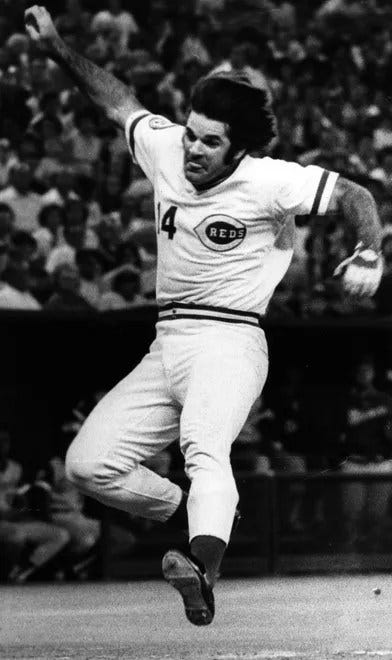
The Dowd Report remains a seminal document in baseball history. It serves as a stark reminder of the consequences of succumbing to temptation and the importance of upholding the integrity of the game. The scandal surrounding Pete Rose continues to spark debate and controversy, even decades later. It serves as a cautionary tale for all involved in professional sports, highlighting the need for constant vigilance against the corrosive influence of gambling.
Welcome to Ballpark Confidential: Baseball’s Backstory on Culture, Society, & History. Whether you’re a die-hard fan, a newcomer to the game, or just someone who enjoys a good baseball story, We’re set to dive deep into the essence of baseball, uncovering pivotal moments and key figures. This is more than a history lesson; it’s a judgment of how baseball reflects and influences our culture and society.
A new installment of River Rat – “Hustle, Heroism, and Hubris: The Pete Rose Conundrum” comes out every Friday!
I’m John ‘The Baseball Buddha’ Reimer, in this first series, titled River Rat – “Hustle, Heroism, and Hubris: The Pete Rose Conundrum”, I’m examining a document that forever changed Major League Baseball – The Dowd Report and sparked a 30+ year debate of one of baseball’s greatest players.
In the last post, we set the stage with the context and the commissioning of the Dowd Report. Today, we get into Section II – Summary of the Report.
Section II is where the investigation begins to unfold in detail. Here, the Dowd Report summarizes the extensive evidence gathered against Pete Rose, pointing to the heart of the allegations. It’s a pivotal section, laying the groundwork for the conclusions that would eventually be drawn.
I have read through Section II in its entirety, bringing to light the evidence that John Dowd and his team pieced together. We’ll explore phone records, testimonies, and other crucial pieces that paint a fuller picture of the situation.
As you read, consider the weight of this evidence. Think about what it means not just for Rose, but for the integrity of baseball. How does each piece of evidence contribute to the larger narrative of what was happening in the late 1980s within the sport?
If you just started reading this series I suggest starting with Part One.
Section II – titled Summary of Report dated May 23rd, 1989.
As detailed more extensively herein, Pete Rose has denied under oath ever betting on Major League Baseball or associating with anyone who bet on Major League Baseball. However, the investigation has developed evidence to the contrary. The testimony and the documentary evidence gathered in the course of the investigation demonstrates that Pete Rose bet on baseball, and in particular, on games of the Cincinnati Reds Baseball Club, during the 1985, 1986 and 1987 seasons. The evidence showed that with few exceptions, Rose did not deal directly with bookmakers but rather placed his bets through others.
As discussed in Section III, during the 1985 and 1986 seasons, Rose placed bets on baseball with Ron Peters, a bookmaker in Franklin, Ohio. Although Rose placed his bets with Peters primarily through Tommy Gioiosa, on several occasions Rose placed bets on baseball games, including Cincinnati Reds games, directly with Peters. Rose’s dealings with Gioiosa, and ultimately with Peters, are corroborated by the testimony of others and by Rose’s own financial records as well. Rose admitted placing bets with Gioiosa on football and basketball games but denied placing any bets on baseball games.
The evidence also showed that Rose placed bets through another friend, Michael Bertolini. Bertolini, in turn, placed bets on Rose’s behalf with an unidentified bookmaker in New York City. One source of this information is a 1988 tape-recorded conversation between Bertolini and another of Rose’s associates, Paul Janszen. During that conversation, Bertolini mentioned, among other things, that Rose had incurred substantial debts to Bertolini, and the New York bookmaker and that Rose had given Bertolini personal checks which Bertolini had cashed, and the proceeds sent to the New York bookmaker. Rose’s financial records reveal checks in the amounts described by Bertolini, made out by Rose to fictitious payees. Rose denied placing bets with Bertolini and denied owing anyone money. Rose acknowledged sending eleven $8,000 checks to Bertolini made out to fictitious payees but said that those checks were loans to Bertolini to be used as payments to athletes for baseball card shows.
During the 1987 baseball season, Rose utilized Paul Janszen to place his baseball bets after Rose and Gioiosa had a falling out in the spring of 1987. Janszen relayed Rose’s baseball bets to an acquaintance of Rose, Steve Chevashore, who in turn placed Rose’s bets with a bookmaker in Staten Island, New York, identified only as “Val.” Rose’s betting on professional baseball, including Reds games, was testified to by Janszen and his girlfriend, Danita Marcum, and was discussed during a taped telephone conversation between Janszen and Chevashore. Rose’s betting on baseball is further corroborated by betting records from Rose’s home which have been identified by an expert as being in Rose’s handwriting. Rose has denied ever placing any bets with Janszen at any time.
In May 1987, “Val” refused to accept bets on behalf of Rose due to Rose’s failure to pay his gambling debts. Thereafter, Rose’s baseball bets were again placed with Ron Peters. However, instead of being placed by Gioiosa, Rose’s bets were placed with Peters by Paul Janszen. Between May and July 1987, Rose bet with Peters $2,000 per game on baseball, including Reds games. Rose’s betting on baseball was also witnessed by Jim Procter and Dave Bernstein who were acquaintances of Janszen.
Section IV analyzes the documentary evidence, including Pete Rose’s betting sheets, the betting notebook maintained by Paul Janszen, and the betting records of Ron Peters. These documents have been analyzed by an expert in gambling investigations who has verified that they reflect actual games played and actual betting lines.
Finally, Section V summarizes the 1987 betting activity, incorporating information from the betting sheets and telephone traffic between Rose, Janszen, Chevashore, “Val,” and Peters between April 8, 1987, and July 5, 1987. As stated by the gambling expert, telephone records indicating short but frequent telephone calls to and from bettors, and to bookmakers, are indicative of professional betting activity. In addition, the timing of the calls also lends further corroboration to the statements of the witnesses questioned during the investigation.
Thus, in sum, the accumulated testimony of witnesses, together with the documentary evidence and telephone records, reveal extensive betting activity by Pete Rose in connection with professional baseball and, in particular, Cincinnati Reds games, during the 1985, 1986, and 1987 baseball seasons.
End of Section II titled Summary of Report
The implications of these findings are far-reaching. They not only challenged the career of one of baseball’s most well-known figures but also put the spotlight on the integrity of the game itself. As we dissect this section, reflect on the broader impact these revelations had on baseball and its core values.
This segment isn’t just about uncovering the facts; it’s about understanding the importance of rules and the consequences of breaking them. Integrity in baseball goes beyond the diamond – it’s about the very spirit of the game and the trust placed in those who play it.
The Dowd Report serves as a stark reminder: actions have consequences, and even the most celebrated figures are not above the foundational principles of the sport.
In this section the evidence surrounding Pete Rose’s alleged betting activities on Major League Baseball games is laid out. It reveals a stark contrast between Rose’s vehement denials and a mountain of evidence implicating him in illegal gambling.
Evidence of Rose’s Betting
The section presents the case against Rose, Rose didn’t just bet directly with bookmakers; he used associates like Tommy Gioiosa, Paul Janszen, and Michael Bertolini as intermediaries. This complex network of bet placement aimed to obscure Rose’s direct involvement.
The report traces Rose’s connections to bookmakers Ron Peters and the enigmatic “Val.” This web of relationships underscores the depth and breadth of Rose’s alleged gambling operation.
A secretly recorded conversation between Bertolini and another associate exposes Rose’s significant gambling debts, while handwritten betting records found in Rose’s home solidify the case against him.
An analysis of phone records not only corroborates witness testimonies but also reveals patterns of communication typical of professional gambling. The frequency and timing of calls between Rose and his associates, as well as known bookmakers, strongly suggest a coordinated betting operation.
Rose’s handwritten betting records found at his residence are a treasure trove of incriminating information. They detail specific games, dates, and amounts wagered, providing undeniable proof of his involvement in illegal gambling.
Numerous individuals, including Rose’s associates and those connected to the betting world, provided damning testimony against him. Their accounts paint a vivid picture of Rose’s gambling habits and the elaborate measures taken to conceal them.
The Key Players in Rose’s Network
Understanding the roles played by key figures in Rose’s alleged betting is crucial:
Tommy Gioiosa: A close confidant who allegedly facilitated bets on Rose’s behalf.
Paul Janszen: An associate who acted as a conduit between Rose and bookmakers.
Michael Bertolini: A friend who reportedly placed bets for Rose.
Ron Peters: A known bookmaker linked to Rose’s gambling activities.
Steve Chevashore: An acquaintance who allegedly relayed bets to the elusive “Val.”
“Val”: A mysterious bookmaker whose identity remains shrouded in secrecy.
As we continue to dissect the Dowd Report, we’ll explore the nuances of the case, the motivations behind Rose’s actions, and the long-term impact on his legacy and the sport he loves.
In the next post we will examine Section III. RESULTS OF INVESTIGATION, A. THE ROSE-GIOIOSA – PETERS BETTING – 1985 & 1986.