


There was a time when youth baseball was about joy. About neighborhood rivalries, matched uniforms, and the dust of a sandlot diamond.
Back in my day, you just showed up with a glove.
The bats and balls were in an old Army duffle bag the coach brought with him, green canvas, fraying at the seams, heavy as hell. It smelled like leather, dirt, and the ghosts of a hundred games. No one owned the gear. It belonged to the team or maybe just to the game itself.
Every kid wanted to be the one to carry it off the field, slung over a shoulder like it meant something. And it did. It meant you were part of it.
The dugout was usually just a bench under a crooked fence. Someone’s mom kept score in pencil. Someone’s dad yelled too much from behind the backstop. It didn’t matter. You played because it was fun because it was yours.
Coaches were dads. Cleats were hand-me-downs. The scoreboard, if there was one, didn’t really matter unless ice cream was on the line.
But that world is disappearing. Maybe it’s already gone.
Today, youth baseball is a $19 billion industry globally, with the U.S. driving a large part of that machine. From private trainers to travel tournaments in Florida, Arizona, Georgia, California and beyond, what once was accessible is now gated by a price tag. Families aren’t just paying for gear and snacks. They’re paying for opportunity. For exposure. For a chance.
And that cost is not just financial, it’s cultural. It’s emotional. It’s spiritual.
At some point over the last 30 years, youth baseball stopped being something you played and started being something you pursued. The rise of travel ball was gradual at first. A couple teams in each region that practiced year-round. Then came the showcases. Then the private lessons. Then the “if you’re not doing it, someone else is.”
Parents, understandably, don’t want their kids to fall behind. If everyone else is investing, what happens if you don’t?
So now we have 8-year-olds with personal strength coaches. 10-year-olds ranked nationally. 12-year-olds flying cross-country every weekend. 13-year-olds with Tommy John surgery.
This isn’t an exaggeration. It’s happening. I’ve seen it. And every conversation I have with a parent ends the same way, “It’s just what we have to do now.”
But that’s a lie. It’s not what we have to do. It’s what the industry has conditioned us to believe. And it’s what so many families simply can’t do.
Youth baseball has become a mirror of broader inequality in this country. Affluent families have access, access to better coaching, better competition, better facilities, better visibility. Working-class and poor families? They’re stuck hoping their local rec leagues haven’t collapsed under budget cuts or disinterest. They’re scrambling to find rides to tournaments they can’t afford to attend.
If the MLB pipeline starts at age 7, then what are we really building? A game for the few, curated at birth, scrubbed clean of grit and improvisation.
That’s why the Little League World Series used to feel different. It was, in theory, the last bastion of democratic baseball. Regional qualifiers. Local kids. No travel rosters. No scouts in the dugout. Just passion and pride.
At least that’s what we wanted to believe.
When I was a kid, very few kids went away to a baseball camp. That was rare. That was special. The guy I backed up in high school, Rob, he went away. He was good, real good. He went to Mickey Owen’s Baseball School in Missouri.
That place had an almost mythic quality to it. You heard the name and immediately imagined sun-scorched fields, serious drills, and kids being taught like pros. Mickey Owen’s wasn’t just a camp, it was immersion. You breathed baseball for a week. No distractions. No video games. Just dirt, leather, and instruction.
Rob came back with a smile and a story. Even if he didn’t get better (though he probably did), it was like he touched something bigger. That experience had weight. Prestige.
But back then, going to a camp like that was a privilege. It wasn’t a prerequisite. You didn’t have to go. Most of us didn’t. We played local. We got better by just playing more games, more reps, more summers.
Compare that to now, where not doing private training or skipping camps can leave you behind before you even hit middle school. We turned the sacred into a system. The dream into a pipeline.
I was at the Little League World Series in 2014. South Williamsport, Pennsylvania. It’s hard to explain the atmosphere to someone who hasn’t experienced it: the hills packed with folding chairs, the flags, the community of it all. There’s something sacred about watching kids play baseball with that much energy and freedom. No million-dollar bonuses, no NIL deals, no agents, just the game.
That year, Jackie Robinson West from Chicago lit up the tournament.
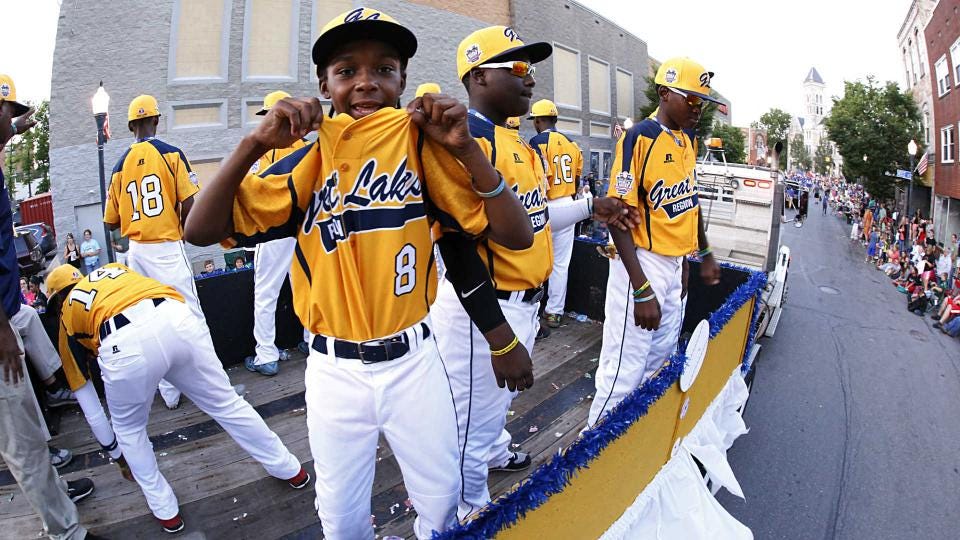
A team of Black kids from the South Side of Chicago. They played fast, with swagger. They smiled big. They were loud in the best way possible. And people responded. There was genuine joy. They were being celebrated, and for a moment, it felt like we were watching something that transcended sports. I saw it with my own eyes, their fans, their pride, the way people stood a little taller when they talked about the kids from Chicago.
But something shifted.
They won the U.S. Championship. They stood as heroes. And then… the backlash.
Their title was stripped after a whistleblower alleged that some players were from outside the designated district. An investigation confirmed it. The adults in charge, league organizers, had indeed violated the rules. But it wasn’t the coaches or administrators being paraded on TV. It was the kids. These 12-year-olds who had become a symbol of possibility were suddenly recast as frauds.
And I can’t help but wonder: if they had looked different, if they had been from an affluent suburb in Connecticut or Northern California, would the response have been the same?
I don’t think the white power structure of Little League, of baseball parents, approved of what that team represented. Not just a great story, but a disruption of what people thought “America’s Team” should look like.
There was joy in South Williamsport that summer. But there was also judgment, simmering under the surface. And when the fall came, it came fast and hard.
I think about that summer often. Because that team reminded me of why I fell in love with baseball in the first place. The rhythms. The rawness. The unpredictability of who might shine. It was the closest we’d come to something real on that kind of stage.
And then the system reminded us that there are rules, spoken and unspoken, about who gets to be celebrated.
We tell kids to hustle, to work hard, to play the right way. But what we reward is money, image, and connections. We sell them a dream while pricing it out of reach for most. We let the game be co-opted by business interests and then pretend it’s still about “character.”
That’s the real shame of the pay-to-play culture. It’s not just that it limits access. It’s that it erases the soul of the sport. The weird kid with a funky delivery who figures it out on a gravel lot? He’s gone. The kid who can’t afford lessons but makes magic with instincts? Not invited. The kid who might’ve been next? Burned out by 14.
We’re replacing creativity with conformity. Wonder with branding. Passion with pressure.
We need to start asking harder questions. Not just about costs, but about values.
Why are we okay with a system that filters out joy and community in the name of exposure?
Why are we so quick to elevate some kids and discard others?
Why do we keep building a sport that looks less like America and more like a gated community?
I still believe in baseball. I still believe in the sound of a bat on a ball, the geometry of a double play, the quiet tension of a full count. But I want the game to mean something again. I want it to belong to more people.
Because when I watched Jackie Robinson West that summer in 2014, I saw what it could be. I saw kids who carried their whole city on their backs, who brought a nation to its feet.
And then I watched the system knock them down.
Not because of what they did. But because of what they represented.
Let’s not pretend youth baseball is just about the game anymore. It’s about control. It’s about profit. And until we fix that, we’re not growing the game. We’re just shrinking who gets to play it.
Good post. No, great post. This is yet another tragic example of both how we're often victims of our own success and the fallout from unrestrained corporate greed. The latter is obvious; the former is more subtle but has to do with the sheer numbers involved in anything successful. Everyone wants in. And then greedy eyes take over and turn a wonderful human tradition into a going profit center.
All of which is so contrary to the long-established spirit of baseball that it makes me ill. Time to go watch "The Sandlot" again.
This is the cold hard truth. Back then we only complained about the coach’s kid having the best opportunities. Now, it’s can we afford all of this additional training, travel, equipment and finding time in our busy lives to manage it all cause if not there’s other kids and families with more resources that will. They’ve taken all of the fun away and turned it into a luxury only few can enjoy. This article definitely stirred up some emotions, that’s how well written it was.