


I loved watching Roberto Alomar. He played the game with a rhythm that was hard to explain but easy to feel. Those early ‘90s Blue Jays teams had all kinds of talent, Paul Molitor, Joe Carter, Devon White but Alomar was the one who gave it balance. He was always in the right spot, whether it was coming through in a big moment or turning a double play. I still remember the time he flipped the ball behind his back to start a double play without breaking stride, like it was just part of the design. He made the game look easy. And he did it night after night.
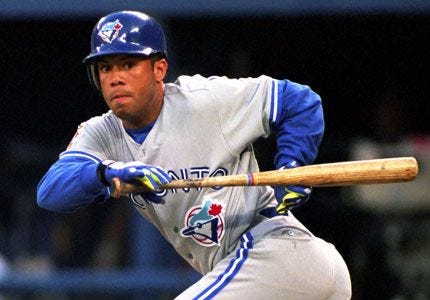
That’s why it hit me hard when I found out, today as a matter of fact, that Alomar was banned from Major League Baseball in 2021 for violating the league’s sexual misconduct policy. I completely missed it. I don’t remember seeing a headline. There was no buzz, no sustained coverage. And yet MLB, without hesitation, removed him from the game.
In April 2021, the league received a report involving an incident from 2014. MLB brought in an independent law firm to investigate. After reviewing the findings, Commissioner Rob Manfred banned Alomar permanently. His contract as a special consultant was terminated. The Toronto Blue Jays followed quickly, cutting ties, removing his name from their Level of Excellence, and taking down his banner at Rogers Centre.
Alomar released a short statement, “I am disappointed, surprised, and upset with today’s news. With the current social climate, I understand why Major League Baseball has taken the position they have. My hope is that this allegation can be heard in a venue that will allow me to address the accusation directly.”
Then the story went quiet.
A few months later, Melissa Verge, a journalist in Canada, published a personal account in The Toronto Star. She alleged that in 2014, when she was 18 and interning at a youth camp affiliated with the Blue Jays, Alomar pressed his body against her and propositioned her. She reported the incident to a team official. Nothing was done. She stayed silent until she saw MLB had taken action, and that’s when she came forward publicly.
Even with that new reporting, the story didn’t catch fire. ESPN and CBS Sports covered the basics when the ban was announced. Verge’s piece was impactful but largely stayed within Canadian media. The New York Times didn’t do a feature. There was no viral moment, no flood of commentary. It just drifted out of view.
Part of that was timing. 2021 was full of big, headline-grabbing stories, Trevor Bauer’s case broke wide open, Deshaun Watson was being investigated, and the U.S. gymnastics scandal was still unfolding. It was a year full of institutional reckoning. In that media environment, a story like Alomar’s, already “resolved” by the league, didn’t get traction.
And maybe that’s why I missed it. Maybe a lot of us did.
What makes this harder is the tension between what he was on the field and what we now have to reconcile off it. There’s no satisfaction in finding out someone you admired has been quietly removed from the game. It just sits there.
To MLB’s credit, they acted quickly. They didn’t wait for public pressure or a media circus. They did the investigation, accepted the findings, and moved. That kind of accountability is rare in sports. The Blue Jays followed suit without hesitation.
The Hall of Fame, though, did not. Alomar’s plaque still hangs in Cooperstown. The Hall issued a statement saying they are a museum, not an investigative body. That his induction reflected the vote at the time. And so, his on-field legacy remains enshrined, while everything else around him has been erased.
I’m still processing it. I’m not interested in performative outrage, and I’m not looking to cancel anyone. But I am trying to understand how someone that central to the game could be erased so completely and so quietly and how I never saw it happen.
Not every story explodes. Some just get buried. This one did. And it deserves a second look.
I was visiting Cooperstown, coincidentally, during his induction week a few years back. The Puerto Rican community was out in force for him as the first inductee from their community since Roberto Clemente. I, too, did not think about his "disappearance" since then.