


I still have his card.
1978 Topps. Number 655. Lyman Bostock of the California Angels. It’s not an action shot. He’s not holding a bat or flashing a smile. It’s a simple, tight frame, just his shoulders and face, eyes looking slightly off to the side. A couple of players are blurred in the background. He looks calm. Serious. Present.
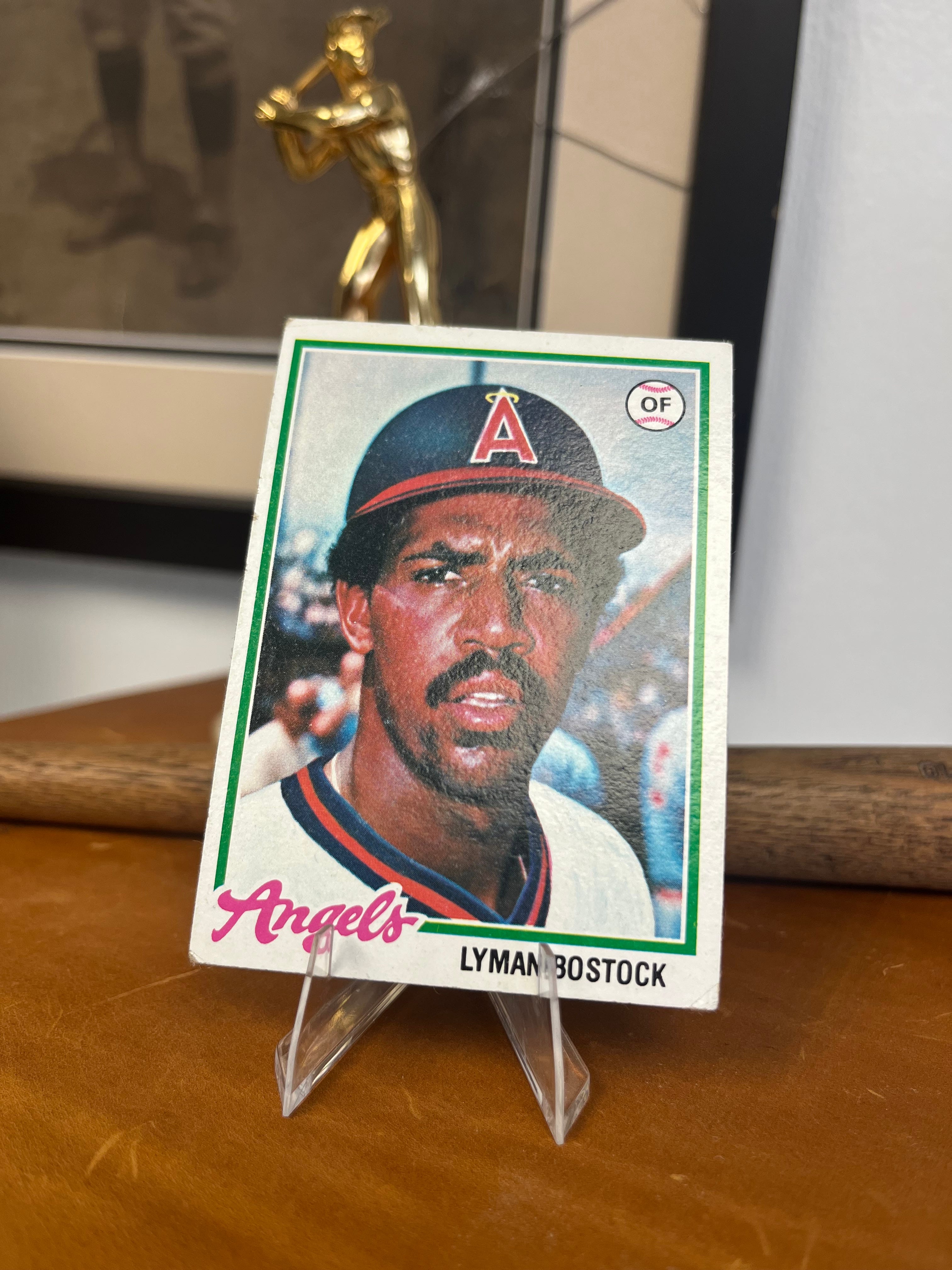
The first time I really saw that card was after I read about him, I must’ve been 11 or 12. I don’t remember exactly where maybe it was the Ashland Daily Press, maybe The Sporting News or Baseball Digest. But I remember what it said, Lyman Bostock had been murdered.
That word hit different. Not “injured.” Not “retired.” Murdered.
And I remember holding that card, looking into his face, frozen there forever and thinking, realizing really, He will never be alive again.
That thought stuck. Him and Thurman Munson. The first two players that taught me death didn’t care about batting averages. Or talent. Or youth. They were gone. And I couldn’t stop thinking about it.
Bostock wasn’t just a good player; he was becoming a great one. He hit .336 for the Twins in 1977. Signed a big free agent deal with the Angels in ’78. And then came the slow start. Nothing awful, just below expectations.
So, he did something almost no athlete would even consider:
He went to the front office and tried to give his salary back.
Said he didn’t deserve it. That he hadn’t earned it. That taking the money didn’t feel right.
They refused, so he donated it to charity.
That wasn’t a PR move. That was who he was. Quiet integrity. A man who believed in accountability not because of contracts, but because of character. He saw the game as something bigger than himself. And in the process, he became something rare in sports, not just a talent, but a teacher.
On the night of September 23, 1978, Bostock was visiting family in Gary, Indiana. The Angels had just played in Chicago, and he wanted to reconnect with relatives in his hometown. He was riding in a car with his uncle and two women, one of whom he’d just met that day.
Her estranged husband was following them.
He pulled up alongside their car, raised a shotgun, and fired. The blast wasn’t even meant for Bostock.
But it hit him.
And just like that, he was gone.
Twenty-seven years old.
The man who killed Bostock pleaded insanity. He was found not guilty by reason of mental illness and was released in under two years.
Meanwhile, Bostock, the man who tried to return his salary, the man who spent time volunteering, the man who stood for something never got a second chance. Or even justice.
There was no redemption arc. No final season. Just a sudden void. And baseball didn’t quite know how to process that. They honored him, quietly. But there was no cultural reckoning. No lasting memory campaign. He simply faded.
Except to people like me.
I keep my 1978 Topps set in three leather bound binders. I flip through it every so often, and when the moment feels right, I pull a card and put it on display in my office. A little ritual of my own rotating tribute to the year I fell in love with the game.
I pulled out Bostock’s card.
He’s sitting there now, propped up, still looking off into the distance. He hasn’t aged. Hasn’t changed. Just like he didn’t get the chance to. But the meaning of the card has changed for me.
It’s no longer a placeholder in a set.
It’s a reminder of the kind of man baseball sometimes loses too early.
Not because of scandal or failure but because of the world.
Some entries in Dark Side of the Diamond are about self-destruction. Some are about deception. This one’s about something harder to hold: senseless loss.
Lyman Bostock didn’t fall from grace.
He never stopped living with it.
And then someone else’s rage took it all away.
I keep his card on display now, not out of nostalgia, but out of respect. Because in a game that talks a lot about character, he actually showed what it looked like.
That face in the card doesn’t smile. It doesn’t sell anything. It just is. Still. Steady. Good.
And I think that’s exactly how he should be remembered.
That was so beautifully written that i can’t get this tragic feeling of an honorable man life being cut short out of my head.
Great post. For those interested there's a very good podcast series narrated by Tom Rinaldi 'We call him Wesley' iwhich was Lyman Bostock's middle name. 8 parts. Worth it.