


I remember when Milton Bradley was tearing up the league; a switch-hitting outfielder with all the tools: power, speed, patience. I watched him play and thought, “This guy’s a star.” In 2008, he led the American League in on-base percentage, hit over .320, and made the All-Star team. But even back then, there was something uneasy about him. Not just a chip on his shoulder, more like a loaded weapon always ready to go off. You could feel it in the way he argued with umpires, barked at teammates, and clashed with fans. Some called it passion. I think it was something darker.
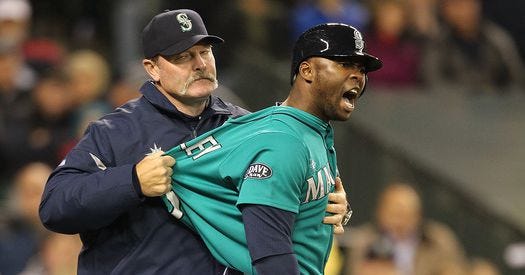
Baseball has always had a way of romanticizing rage. The game will forgive you a lot if you can hit a curveball or run down a fly in the gap. Milton Bradley could do both. So teams kept signing him, hoping they’d be the one to tame the storm. But the storm followed him everywhere. He got in a shoving match with his manager in San Diego and tore his ACL during the confrontation. He accused the Cubs’ fanbase of racism during a miserable year in Chicago. He fought with Jeff Kent in the Dodgers clubhouse. He never stayed anywhere long, not because he wasn’t good enough, but because he was volatile. I remember thinking, why does no one ever stop and say, “This man needs help”?
When his playing days ended, the story didn’t end; it just got worse. Milton Bradley wasn’t just angry on the field. He was abusive at home. In 2013, he was convicted on nine counts of domestic violence. His wife Monique had lived in fear for years, according to court documents. She told friends she was afraid he’d kill her. She filed for divorce. And later that year, she died not by his hand, but in the long shadow of his abuse. Milton Bradley served 32 months in prison. The headlines came and went. Another fallen athlete. Another story we’d rather forget.
But I can’t forget. And I don’t think we should. Bradley’s story matters not because it’s sensational, but because it’s familiar. We’ve seen versions of it before. A player with anger issues is called "fiery" until he’s arrested. A toxic personality is rebranded as “competitive” until someone gets hurt. Baseball, sports in general, has long been guilty of enabling men like Bradley. He was a walking red flag, but talent kept buying him second chances. Every team that signed him saw the warning signs and passed the buck. That’s on them. That’s on all of us who watched and said nothing.
As I write about him now, I have to admit, I see pieces of myself in the story. Not the violence, not the abuse, but the “rage”, the “intensity”, that inner war that feels like both a curse and a power source. I’ve been called passionate. I’ve been called intense. And for a long time, I wore those words like armor, like they made me tougher than the rest. But I’ve also crossed lines. I’ve said things I regret. I’ve been harsh, demanding, even verbally abusive at times. I know what it means to carry a chip on your shoulder so long it becomes part of your identity.
There were times when someone would say something about me, something small and it would sink in deep, “Fuck off”, I’d stew. I’d internalize it. I’d turn it into fuel. I thought I was proving people wrong, but really, I was trying to prove myself wrong. Because underneath it all was this horrible, quiet voice, the one that said I was a fake, a fraud, that I didn’t deserve what I had, that it was all going to come crashing down. That inner dialogue wasn’t just unkind, it was fucking brutal. And the way I treated myself in my own head? Sometimes that spilled over onto the people around me.
I wonder if that same drive, that internal critic turned monster, is what pushed Milton Bradley. I don’t know. I can’t claim to know his mind. But I can recognize the outlines of a man who never felt at peace, who never stopped fighting, even when the enemy wasn’t real anymore. He said once, “People think I’m crazy. I’m not crazy. I’m just passionate. I just want to win.” And I get that. I’ve said something similar. The difference, I hope, is that when I’m confronted, when someone tells me I’ve gone too far, I try to stop. I try to reflect. I try to own it.
Bradley never seemed to have that moment. Or if he did, it came too late. And maybe that’s what haunts me about his story, not just what he did, but what might have happened if someone, anyone, had stepped in early enough to help. If he had been forced to confront the truth of his behavior before it turned to full-scale destruction. If he had looked in the mirror and decided to change. I want to believe people can change. I have to believe that, because I’ve had to change.
That’s why I write these pieces. Not just to point a finger, not to moralize, but to reckon, with baseball, with culture, and with myself. Because stories like Milton Bradley’s don’t just happen in isolation. They echo. They reflect. They ask us what we tolerate, what we excuse, and what we let slide because talent blinds us. And if we’re being honest, I mean truly fucking honest, we have to admit that character has to count for something. Not just on paper, not just in PR campaigns, but in real life.
Milton Bradley’s story doesn’t have a happy ending. But it can still be useful, if we listen. If we stop romanticizing rage. If we stop pretending that intensity is always a virtue. If we recognize the difference between passion and poison. And if we ask ourselves, each time we feel the fire rising, “Who am I trying to prove wrong and why?”
Because maybe the only person I’ve ever really been trying to prove wrong is me.
And maybe, in the end, the only way to win that fight is to stop fighting and start healing.
Another excellent post.
Rage intrigues me. It as a sustained mental state of anger blended with weakness, one that lingers, ebbs and flows, and never abates. It is a behavior pattern born of faulty learning skills when it comes to dealing with frustrations and adversity as a child.
When I encounter rage in others, I am forgiving because I know they are expressing a really shitty introduction to a world they were never taught to deal with.