


I used to close my eyes and see the game.
I didn’t need a screen. I just needed a voice one like Bob Uecker’s, cracking jokes between innings, or Vin Scully’s, weaving stories into pitches like it was second nature. These weren’t just announcers. They were companions. Teachers. Poets. They turned ordinary plays into personal memories.
That’s the game I grew up with. Not the one overloaded with data or broadcast like a financial report. But the one that lived through the radio. Through the air. Through imagination.
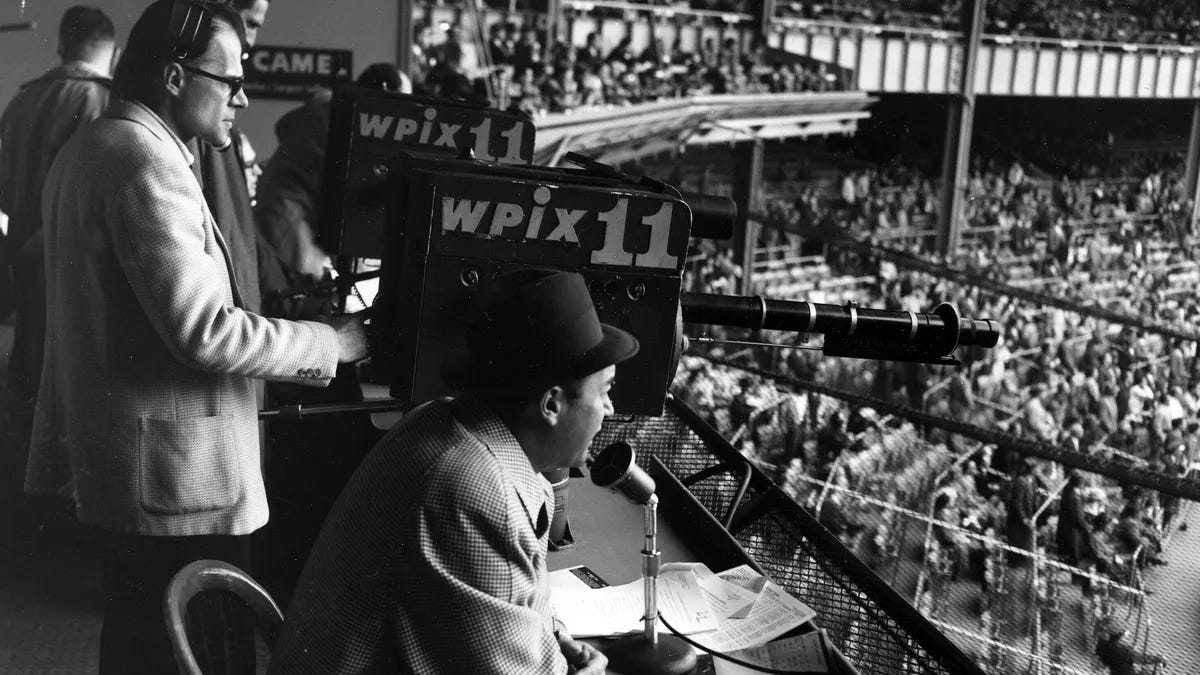
Now? Now we’re flooded with visuals. The screen tells you everything before your gut has time to feel it. And I miss the mystery. I miss the pause. I miss the space.
There was a time and I lived it when you could sit on a porch, drive a lonely highway, or tinker in the garage and still be inside the game. Not watching it. Inside it. All because of a voice on the radio.
Bob Uecker could describe a foul ball, vividly. Vin Scully could turn a lazy fly out into a small parable about life. They left room. Room for silence. Room for anticipation. Room for the game to breathe.
And in that space, your mind did the rest. You saw the outfield in your head. You imagined the windup. You felt the crowd not through images, but through energy.
Now, the screen does it all for you. Nothing is left to wonder. And maybe that’s why it doesn’t stick with us the way it used to.
Today’s broadcasts feel like a cluttered interface. Every pitch comes with velocity, spin rate, launch angle, betting odds, exit velocity. The field is mapped like a military grid. Every moment is over-analyzed, over-commented, over-sold.
Where’s the silence? Where’s the voice?
And it’s not the announcers’ fault they’re doing what the system asks. But what used to be storytelling has become narration. What used to be personal has become programmed.
We’re watching the game more than ever but somehow, we’re experiencing it less.
Maybe that’s why I’ve started doing something a little different with my own work. I am making glove-making videos tearing down old leather, stitching a new pattern, breathing life back into something forgotten, I don’t use modern music or narration.
I use old radio broadcasts. Games from the 1950s. The 1960s. The Dodgers and Redlegs. A warm night in Brooklyn. A forgotten matchup in Cincinnati.
Not because it’s trendy. Because it’s right. Because the sound of that old game, that crackle, that rhythm, is music to my ears. It is a slow burn. It invites the viewer into the moment, the same way Bob Uecker did when I was a kid.
These aren’t just background sounds. They’re the soul of what I’m doing. I'm not just making gloves. I’m reconnecting to a version of baseball that was simpler, quieter, and somehow for me more real.
Imagination is how we fall in love with the game. When we hear the words and form the pictures in our heads, it becomes ours. Not something handed to us, but something we build, like a glove, stitched piece by piece.
That’s what the radio gave us. The gift of doing part of the work. Of owning the moment.
That’s why I keep going back to those old games. To those old voices. Because when Vin paused, I leaned in. When Uecker chuckled, I smiled not because of the joke, but because he was letting me in.
You can’t duplicate that with a statcast overlay.
The screen will never stop glowing. The algorithms won’t stop feeding us more. But I still believe in the quiet game. The slow game. The imagined game.
So when I lace up leather and set the needle down on my machine, I let those old broadcasts roll. I let them talk to me. Not just about the score, but about why this matters.
Because sometimes, the clearest view of baseball… is the one we never actually saw.
The Tigers had Ernie Harrell (radio) and George Kell (TV) from childhood until into my 30s. It was like they experienced the game with the players because they personally knew them! And we did kind of know the players personally through the announcers. Also, the players were with the team to stay - unless there was a big trade. Al Kaline, Norm Cash, Jim Northrup, Denny McClain, Rubber Arm Lolich, Willie Horton, Bill Freehan, Ole Paw Paw Maxwell, Gates Brown, on and on. You got to know your guys, and they were loyal to the fans. Now many watchers can hardly name the players. Unfortunately it is too much contract price now. When Al Kaline got a $100,000 contract offer, he told the management no one was worth that much! Different era, different focus, different fans, different players, and different announcers. Anyone who lived that era misses it badly!
Great read. I still prefer the old style of watching before the silly K-zone box was put up live. It takes away the guessing game of whether, as a viewer, I think it is a ball or strike before the ump makes the call. Now, we have to assume while watching live, that the ump sees it exactly as the screen zone shows us.
I also find it more difficult to focus on the pitch being caught. You often can't see it hit the catcher's mitt because they dot the location with a small white circle as soon as it gets to the zone.
I always liked it when the replay added the K-zone after the pitch just to see for accuracy purpose, but it definitely takes aways from the lexperience while watching live, which is too bad. Keep things simple. Makes it better. Makes us pay attention more as well.