


Over the past few weeks, I’ve walked through how the modern baseball stadium isn’t a ballpark, it’s a casino. How the game experience has been flattened into a series of nudges and feedback loops designed for maximum engagement and minimum reflection. Then we dug into how sports gambling monetized not just the outcomes of games, but the emotional and ethical space around them. What used to be sacred, the pace, the uncertainty, the humanity, was turned into a transaction. A bet.
But the story doesn’t stop there.
If gambling turned fans into customers, fantasy sports turned them into middle managers or so it seemed. Because before FanDuel and DraftKings and algorithmic “optimizers,” there was something far more human at the heart of baseball obsession. This is that story. And it’s where things started to shift.
Before daily lineups, player pricing, and flex spots, there was Strat-O-Matic, invented in 1961 by Hal Richman. This was baseball fandom in its purest form: dice, charts, and a deep, nerdy love for the nuances of the game. You could replay past seasons, simulate fantasy matchups, test out “what-if” scenarios. Were the results perfectly realistic? No. But they felt right. Because they honored the randomness and rhythm of baseball. They left space for things to go wrong and go wonderfully right.
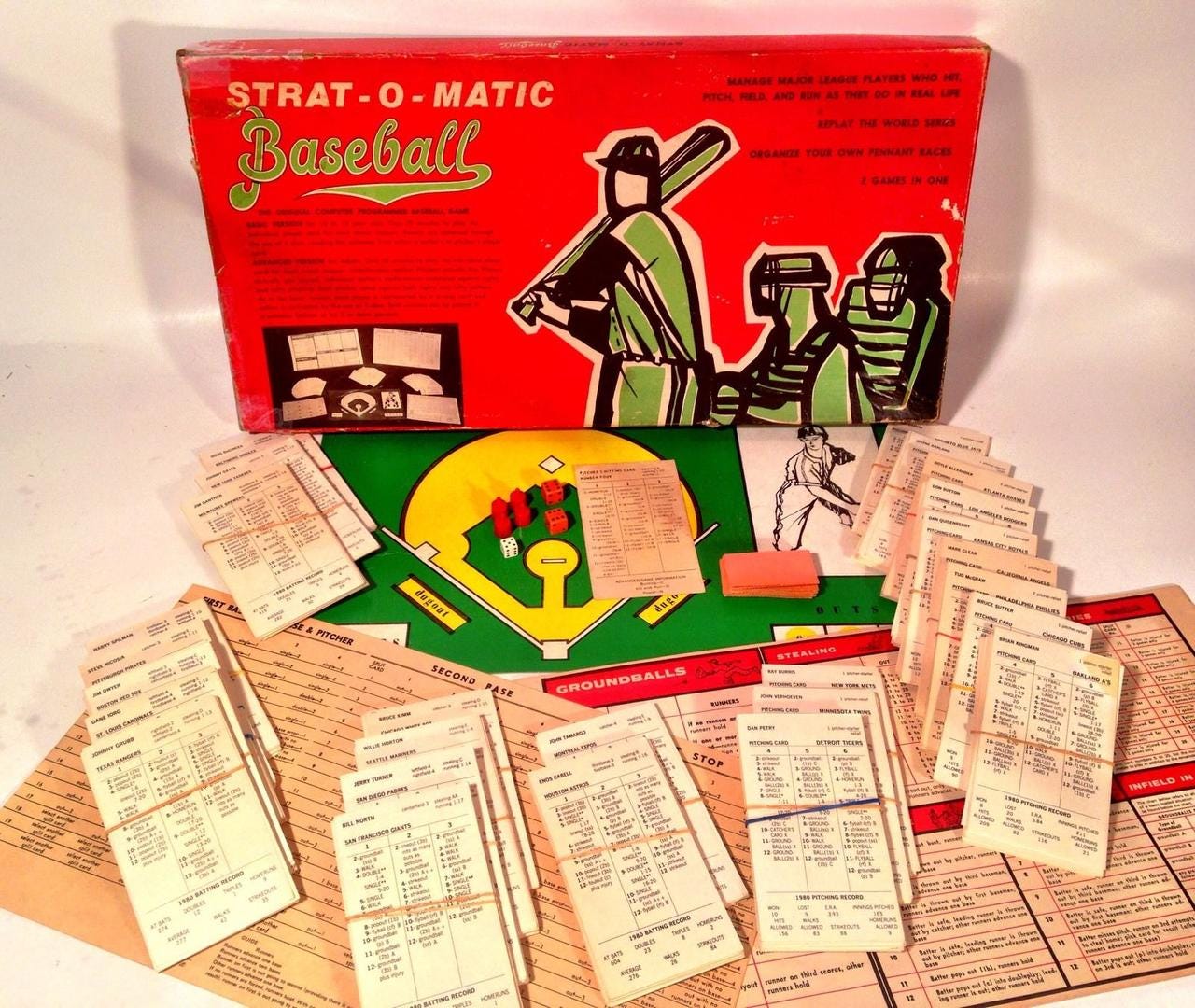
You weren’t betting on games. You weren’t trying to win money. You were chasing something deeper: understanding. Ownership. Control. That was the fantasy.
Then came 1980, and a restaurant in New York City - La Rotisserie Française. A group of friends, led by writer Daniel Okrent, wanted to draft real players and score points based on what happened in real MLB games. They called it Rotisserie Baseball.
It was revolutionary not because it made money (it didn’t), but because it made fandom deeper. It made you care about the third outfielder in San Diego. It made you read box scores, argue over stats, and fall in love with players you never saw on national TV.
And if you were in a keeper league? That was another level.
You didn’t just draft a team. You built one. You scouted young talent. You made tough decisions. You chose who to invest in long-term. Every winter you kept a few players, and every spring you reassembled with your crew to draft new ones, a sacred night, full of strategy, bad beer, printouts, and pride. This was before smartphones, before real-time stats. You had to know the game. You had to watch the game.
Draft Day wasn’t just a transaction. It was a ritual.
And it all ran on System 2 thinking, a concept introduced by Nobel Prize-winning psychologist Daniel Kahneman (I love this guy!) in his groundbreaking book, Thinking, Fast and Slow. System 2 is slow, deliberate, logical. That’s what Rotisserie and Strat-O-Matic demanded. They asked you to analyze, to anticipate, to plan long-term. You weren’t reacting, you were reasoning. It was thoughtful fandom.
Daily Fantasy Sports (DFS)? That’s pure System 1.
Fast. Reactive. Intuitive. Addictive. It gives you the feeling of control, but it’s really just pushing your buttons, literally and psychologically. The lineup optimizer, the alerts, the value plays, they aren’t tools; they’re bait. You aren’t strategizing. You’re responding. And you're doing it in a way that benefits the system more than it benefits you.
As fantasy moved online, that shift became inevitable. Automated scoring. Clean interfaces. No need to follow a team all season. No need to care about a player beyond tonight’s matchup.
The personalization of fantasy sports became the depersonalization of baseball.
DFS took the bones of fantasy and stripped out everything slow, personal, or meaningful. No more season-long arcs. No more emotional attachments. Just a lineup tonight, a contest to join, and a payout tomorrow. Reset. Refresh. Repeat.
This wasn’t about building a team. It was about chasing the edge.
You weren’t managing anymore. You were speculating with real money. You weren’t hoping for long-term growth. You were praying for instant returns. The human element of baseball? Gone. It was all about projections, values, matchups. A player didn’t need to be good. He just needed to be undervalued.
You weren’t rooting for teams anymore. You were rooting for isolated events, a stolen base here, a strikeout there. And if your favorite player slumped? You benched him. Traded him. Cut him. It’s not personal. It’s just business.
Fantasy baseball, especially in its DFS form, sells you the dream of control. That you’re the one calling the shots. That your research, your instincts, your lineup build will make the difference.
But really, you’re feeding the system.
The DFS platforms profit regardless of who wins. They sell engagement metrics to advertisers. They lock fans into constant participation loops. They make every moment bettable, every pitch monetizable.
You’re not managing players. You’re being managed.
And it started innocently in basements, at restaurants, on printed spreadsheets passed around at draft parties. It started with love, with imagination, with an honest hunger to be closer to the game.
We’ve seen this before, this shift from sacred to saturated. From joy to transaction. Just look at baseball card collecting.
It used to be about wonder. You’d buy a pack and hope, really hope, to pull your favorite player. The gum was stale. The corners were never mint. But none of that mattered. Every card had a story. You traded with friends. You showed off your doubles. You stored them in shoeboxes, binder pages, and your memory.
It wasn’t just about having. It was about finding.
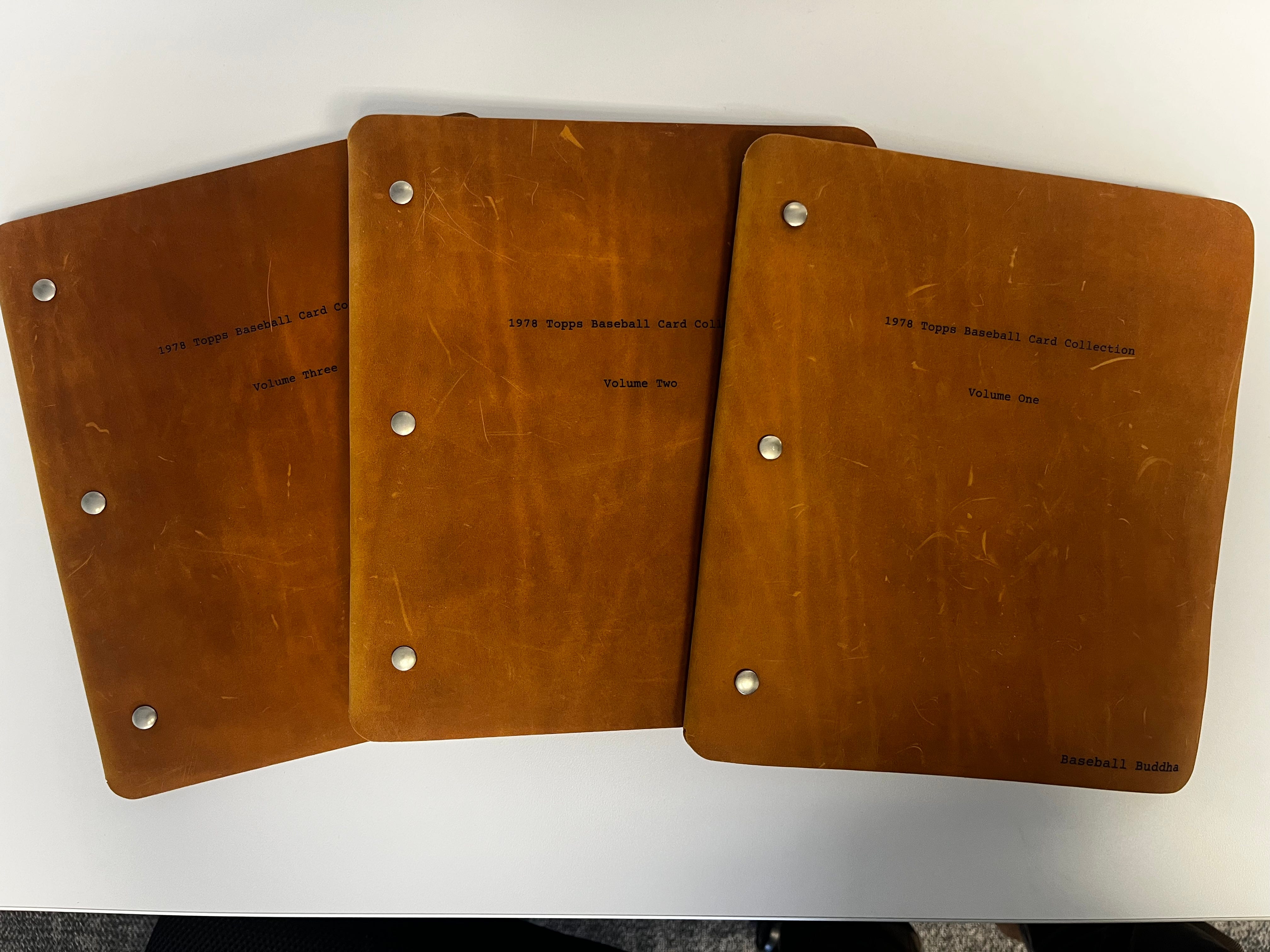
That’s why I still have my 1978 Topps set, tucked into three leather-bound binders. It’s the only set I’ll ever cherish. I built it with my own hands, spending paper route money at the corner store one pack at a time. It wasn’t an investment. It was a journey. And it mattered because I earned every card.
But eventually, the industry scaled. Sets ballooned. Inserts exploded. Rookies were printed in triplicate. You didn’t need to chase anymore, you could just buy the complete set, shrink-wrapped and indexed. What started as a ritual became a checklist. What started as a discovery became a transaction.
And suddenly, the question wasn’t “Which card will I get?” It was “Which set should I buy next?”
And worse: “Why am I buying any of this at all?”
Fantasy baseball followed the same arc.
It began with deep connection to players, stats, the slow unfolding of a season. It was about building something. Living with it. Caring about it. But then the chase got hacked. The experience got completed for you. Just enter the contest. Let the algorithm help you. Optimize your lineup. Hit submit.
And just like that, the story disappeared.
What used to be a season-long narrative became a nightly transaction. What used to be baseball, messy, unpredictable, human became a pricing model in a digital store.
And the worst part? Just like with cards, the thrill doesn’t last. The more you play, the less you feel. The more control you’re given, the more hollow it becomes.
Because the machine doesn’t want you to care.
It just wants you to keep clicking.
What began as a tool to bring fans closer to the game has become another lever in the attention economy, another system engineered to exploit your desire to connect, while quietly replacing connection with compulsion.
So yes, fantasy sports came from a beautiful place.
But just like the ballpark became a casino, and just like gambling blurred the purity of fandom, fantasy has become another layer in a system designed not to help you enjoy baseball…
…but to make sure you never stop engaging with it, even if that engagement is shallow, distracted, and entirely detached from the game itself.
And what comes after engagement?
Let me be clear: I’m not anti-technology. I’m not yearning for some utopian past where everything was better just because it was older. I use apps. I use tools. I understand that change is inevitable and valuable.
But what I am for, unapologetically, is tradition, connection, and integrity.
I believe in the slow burn of a baseball season. In the emotion of a kid pulling a favorite card from a wax pack. In a scorebook scribbled by hand. In a keeper league that lasts decades. I believe in moments that don’t need to be optimized, sold, or gamified to matter.
Because some things shouldn’t be monetized.
Some things should just be loved.
And if we lose sight of that, if we let the machine define the experience, we won’t just lose baseball.
We’ll lose what it was always meant to be.
Wonderful piece! A great take on the current state of the game(s).
Can't believe you didn't mention MicroLeague here for Commodore 64.
Ace Eggleston drove trucks for us a the feed store I started working at in Lockhart, TX. I was 15 and paid 3.25/hr under the table. Ace was a huge O's fan and I was a huge Reds fan. We both loved baseball and connected despite a 20 year age difference. He I voted me to dinner one night and busted out his Stat O Matic. I was blown away. Never seen anything like it.
Until...
Brother brought MicroLeague home on leave from Army one Xmas (88ish) with a 1985 team disk. HOOKED.
My brother had 79 Topps collected in exact same way.
Great article...well played Buddha.