


When I met Donnie Hissa in Helena, Montana, he was right on the edge, just drafted (21st round -626th overall), fresh out of Notre Dame, big midwestern kid with a fastball in the mid-90s and the kind of quiet, unshakable belief you only get before the world starts chipping away at it. We sat down over breakfast, and he told me he just wanted to chase it, to give it a shot before he had to step into the “real” world. That’s how he put it. The real world. As if baseball wasn’t real, as if this thing he loved existed in some mythological realm that he was lucky to step into, even if just for a moment.
He wasn’t making any money. Nobody at that level was. He was from northern Wisconsin, a long way from anything glamorous, and there he was in Helena pitching for scraps. But he had this soft fire in him, this willingness to throw his body at the dream. We all think we’d do it, right? Give everything to the game we love. But I remember sitting there thinking-would I? And the truth is, I didn’t. I couldn’t.
I had some chances. I had some offers to be around the game, to keep chasing it in a different way, writing, promotions, media stuff. But there was no money. No stability. It was all built on passion and access. That’s the con baseball runs. The closer you are to the flame, the less they have to pay you. They know you’ll take the deal, because you just want in. You’ll intern for free because it’s baseball. You’ll work 80-hour weeks doing radio broadcasts in minor league cities for $1,200 a month because it’s baseball. You’ll pull tarp in the rain, dress as a mascot, stuff t-shirts into cannons, all because it feels like you’re part of something sacred.
But here’s the truth I learned spending that whole season chasing baseball across America, it’s a one-sided relationship. Baseball doesn’t love you back. It barely even notices you.
I met fans, scouts, clubhouse guys, batboys, GMs, media interns, trainers, all hanging around the game like moths to a lightbulb. Most of them weren’t getting paid what they deserved. Some weren’t getting paid at all. They were chasing the feeling, the idea that being close to the game would lead to something more. But that’s the trap. The game keeps you close just long enough to drain you, then moves on without a second thought.
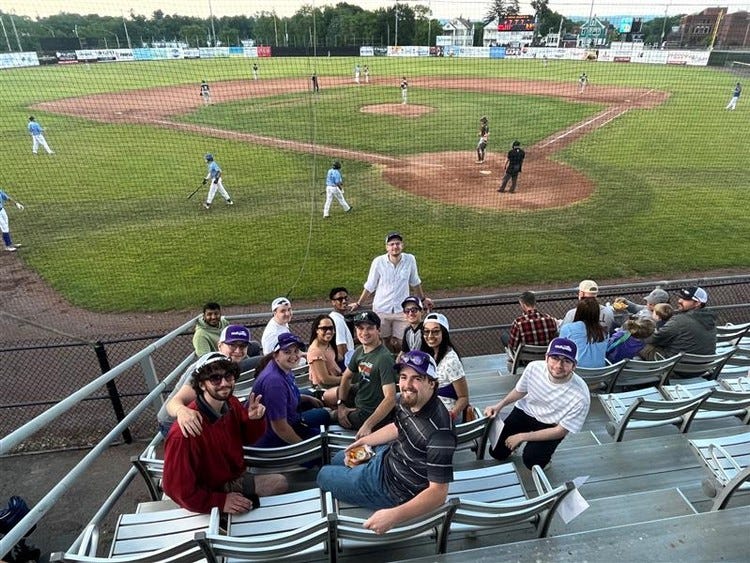
It’s not just the players who get exploited. It’s everyone who buys into the myth. The interns doing stadium ops in the blistering sun. The MiLB broadcasters calling games solo in empty press boxes with one mic and a beat-up laptop. The coaches grinding year-round for minor league stipends and meals at chain restaurants. The front office assistants working two jobs because baseball doesn’t pay enough to cover rent in the same city where the team plays.
They sell it to all of us, this dream. They say, “You’re part of the team.” They say, “This could lead somewhere.” They say, “You’re lucky to be here.” And because we love the game, we believe it. We’ll keep showing up. Keep sacrificing. Keep calling it the grind like that somehow makes the suffering noble.
But here’s the ugly truth, the dream is reserved for the very few. For the first-rounders with seven-figure bonuses. For the golden-armed. For the Ivy League execs who already had the connections. For the ones with enough financial cushion to ride out the bullshit.
Everyone else? We’re just background characters. Necessary but forgettable. If you quit, someone else will take your place tomorrow. If you speak up, there’s someone hungrier behind you who won’t. Baseball counts on that. It’s a self-replenishing labor pool. They’ve commodified passion.
And we’re complicit. Because we let it happen. Because we still show up. Because some of us make it and tell ourselves it was worth it. Because we wear the jerseys and tell our kids to chase their dreams, even if we know deep down that those dreams have fine print in invisible ink.
Donnie Hissa eventually left the game. Like most, he wasn’t bitter, just realistic. He had to make a living. Baseball wasn’t going to do that for him. I think about that breakfast a lot. I think about how many Donnies are out there, right now, throwing their arms out for a sliver of a chance. I think about how many interns are sitting in ballpark offices right now, designing promotions for bobblehead nights, getting paid in hot dogs and “networking opportunities.”
During my Baseball in America Tour, I saw this up close. I visited towns like Clinton, Iowa, where Lucas Mann embedded himself with a low-A team and wrote Class A: Baseball in the Middle of Everywhere. I talked to him about the book, and what stuck with me was how deeply he captured the sameness of it all, the routines, the mundane heartbreak, the quiet unraveling of players who are “living the dream” with no real path forward. He saw it for what it was: a strange, insulated world propped up by denial, hope, and institutional inertia.
Reading Class A felt like reading Ball Four in a parallel mirror, only in the minors. Jim Bouton ripped the mask off Major League Baseball in the '70s, exposing the absurdities, the misogyny, the drugs, the way players were talked to and discarded. Lucas Mann did the same for minor league baseball decades later. And what’s chilling is how similar they are. All these years apart, the game still runs on the same machinery: grind them down, glamorize the suffering, and sell it back to the public as character-building.
I used to think the minor leagues were about development, building the future of baseball. Now I see them for what they were, a glorified lottery system. A way for major league teams to hold cheap labor rights over hundreds of players, betting that one or two would pan out. That’s not development. That’s exploitation.
And look, I get the nostalgia. I still love showing up to a low-A game and seeing a kid with a glove on his hand and hope in his eyes. But nostalgia doesn’t erase the facts. Just because something feels wholesome doesn’t mean it is.
Baseball sells this beautiful idea of the farm system like it’s some sort of rite of passage. But rites of passage are supposed to elevate people. This one just consumes them.
The next time someone calls it the grind, with a fucking smile, like it’s something to be proud of, remember that it’s a meat grinder. And for decades, it was turning real people into dust.
I’ve walked through those ballparks. I’ve talked to the players. I’ve read the books and seen the bus rides. This isn’t bitterness. This is the truth. And if baseball really wants to honor the game, it needs to start by honoring the people it’s built on.
Honor them not with clichés or tweetable fairy tales, but with contracts. With housing. With healthcare. With dignity.
Because behind every call-up to the big leagues is a hundred stories you’ll never hear. And most of those stories don’t end in triumph, they end quietly, painfully, far from the lights.
But I saw them. I remember. And I’m not going to let them disappear. And yet, I still love this game…
Baseball Buddha- If I remember correctly, you have LA connections. I have lived here for 40 years. This is the LA Story just told in baseball terms. The actors, the screenwriters, the set designers, the want to be directors- all chasing the dream. Some make it. Many do not. Years ago I had a former actor come to work for me. He had been chasing the dream all his life, had some small roles in movies like Cannonball Run, but never broke through. He always said he would keep at it until he was 30. When he was 30, he quit, changed careers and worked for me in the law.
One difference nowadays is the kids who spend $50-300k on film school degrees, just to get a chance to break in. That is another layer of tough to see.
Chasing a dream. Ain't that America, for better and often for worse?
Nostalgia is just another thing they use to exploit us. Most of the owners are complete scumbags who would slit your throat for a nickel and not think twice about it.