


The modern sports stadium and the casino might seem like two entirely different worlds at first glance. One is rooted in tradition, community, and sport; the other in risk, excess, and vice. One is where families gather to cheer on their team; the other, where gamblers chase fleeting highs under neon lights. But look a little closer, and you’ll see that the architecture of manipulation that defines the casino has started to infiltrate the ballpark. As the line between entertainment and consumption blurs, fans are becoming less like spectators and more like users, participants in an experience meticulously crafted to control attention, behavior, and emotion.
This is not an accident. It is design by intent.
In her book Addiction by Design, cultural anthropologist Natasha Dow Schüll explores how slot machines are engineered to create a trance-like psychological state she calls "the machine zone." In this zone, players aren't necessarily trying to win, they're trying to stay in. They're chasing a rhythm, a predictability, an escape. The lights blink at calculated intervals. The sounds are pitched at frequencies designed to stimulate, not annoy. The ergonomics of the chair and button placement reduce friction, physically and psychologically, so that players can continue without pause. Even the timing of losses and near-wins is managed through algorithms to keep the player emotionally tethered to the next spin.
The "machine zone" is marked by a paradoxical sensation: you feel both hyper-focused and mentally absent. It's not unlike meditation except engineered by market forces. Players often describe feeling calm, safe, and in control, even as they surrender more and more time, energy, and money.
It's not about reward. It's about persistence. It's about creating an environment where disengagement feels more uncomfortable than continuation, a place where leaving the machine feels like exiting a reality uniquely tailored to your emotional rhythm.
This replication aligns closely with the work of Nobel Prize-winning psychologist Daniel Kahneman (I love this guy), in his book Thinking, Fast and Slow. Kahneman outlines two modes of thinking: System 1, which is fast, automatic, and emotional, and System 2, which is slow, deliberate, and analytical. Stadium and casino environments are carefully curated to favor System 1, reducing friction, minimizing reflective thinking, and maximizing impulsive, intuitive reactions.
When you tap your phone to order nachos, vote in a live poll, or scan a QR code for a digital collectible, you’re operating in System 1. The experience is seamless by design and it's no accident. These environments are structured to bypass your conscious scrutiny and encourage behaviors rooted in emotion, excitement, and routine.
Casinos do this through lights, sounds, and near-wins. Stadiums do it through digital overlays, crowd energy, and gamified interaction. In both cases, the goal is to keep you in System 1, reactive, entertained, and spending while pushing System 2 into the background.
This manipulation of cognitive bias and mental shortcuts isn’t just a technological feat. It’s psychological architecture, built on decades of behavioral research, now playing out in the concourse, on the scoreboard, and inside your pocket.
This machine zone isn't exclusive to casinos anymore. We've started to see it replicated, almost beat-for-beat, in the design of modern stadiums.
Today’s ballpark isn’t designed just to host a game. It’s built to be a multi-sensory entertainment complex. There are bars in the outfield, walk-in stores inside the concourse, private suites with iPad ordering, interactive screens at your seat, social media walls, and even in-stadium betting kiosks. There's a DJ booth, a kids' zone, a "social deck" for influencers, and more LED boards than Times Square. The game itself is still happening, yes, but it often feels like it’s the least essential part of the experience.
Just like in a casino, the stadium is a space that seeks to manipulate your behavior to keep you inside, to keep you engaged, to keep you spending.
Let’s look at how this plays out in real-world ballparks both legacy stadiums adapting to this new entertainment paradigm and the next-generation parks still to come.
In casinos, there are no clocks, no windows, no natural light. The layout is deliberately confusing, with winding paths that disorient and lead players deeper into the gaming floor. Seating is plush and fixed. Machines are angled for isolation and immersion. Music is carefully calibrated, scents are pumped through vents, and payout intervals are staggered to keep dopamine firing.
In stadiums, the cues are different but the intent is similar:
Every surface in a modern stadium serves a purpose, usually commercial. Walls are covered in LED advertising boards. Stairwells feature rotating sponsor messages. Even bathroom stall doors are now ad real estate. Scoreboards flash branding during breaks. You are rarely given a moment without a branded image in your field of view. The goal? Keep your mind occupied and exposed to content at every turn.
Every inning break is filled with noise and light, not silence. Between at-bats, there's walk-up music. During pitcher changes, there are fan contests. Between innings, there’s a jumbotron game, a live camera feed, a player trivia challenge, a kiss cam or a mini betting promo. It’s an endless parade of movement designed to keep your brain engaged even when the game isn’t.
Just like casinos, modern stadiums seek to manage your physical comfort to encourage prolonged attendance and spending. VIP areas are climate-controlled, some concourses are misted or heated depending on season, and certain clubs infuse ambient scenting for mood. Lighting is used to shift energy in different parts of the stadium, directing crowd behavior and influencing psychological states.
The layout of most stadiums is subtly and sometimes not so subtly designed to increase your exposure to sales points. Fans are routed through high-traffic zones lined with premium merchandise, craft beer stands, and novelty food stalls. Shortcuts to exits or restrooms are minimized, ensuring more visual exposure to things to buy. Even escalator placement can be strategic, guiding you toward "experiences" whether you wanted them or not.
The stadium app knows your habits. It tracks the seats you buy, the snacks you order, the replays you watch, and the contests you enter. It may suggest specific food vendors near your section or push discounts on your favorite beer. The more you interact, the more it learns turning you into a behavioral profile, a micro-market of one. What looks like convenience is actually a system of subtle nudges toward spending and prolonged engagement.
Just like a casino optimizes for time-on-machine, a stadium optimizes for time-in-venue. This becomes especially clear when you examine real-world examples:
Dodger Stadium, though steeped in tradition, has transformed with the times. Its new Center Field Plaza acts like a casino floor entrance: part gathering space, part commercial zone. Fans are drawn into an atmosphere of stimulation with interactive exhibits, LED displays, AR experiences with players, and even scent-controlled VIP areas. Its new LED lighting system creates celebratory moments that feel more like a nightclub than a night at the ballpark.
American Family Field in Milwaukee has leaned into tech upgrades to keep fans visually and emotionally engaged. With one of the largest video boards in Major League Baseball and immersive in-stadium destinations like J. Leinenkugel’s Barrel Yard and the interactive Selig Experience exhibit, it nudges fans into exploring, consuming, and participating in curated experiences instead of sitting and simply watching baseball.
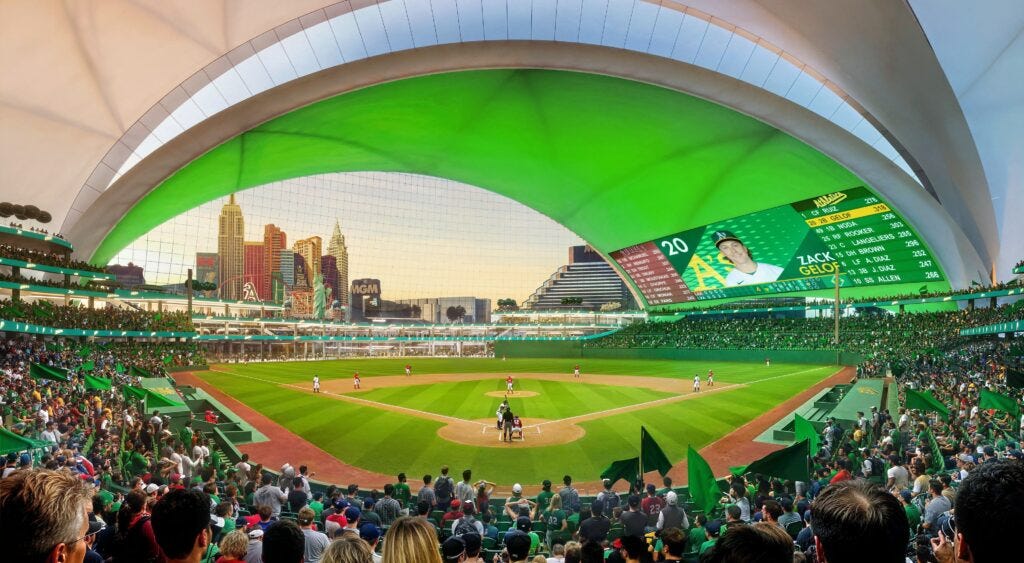
And then there’s the future. Las Vegas, home to the relocated A’s in 2028, is already designing its stadium like a visual spectacle, a domed, layered structure with an 18,000-square-foot video board and a view of the Strip. It's a sports venue that leans into Vegas’s most recognizable export: engineered immersion.
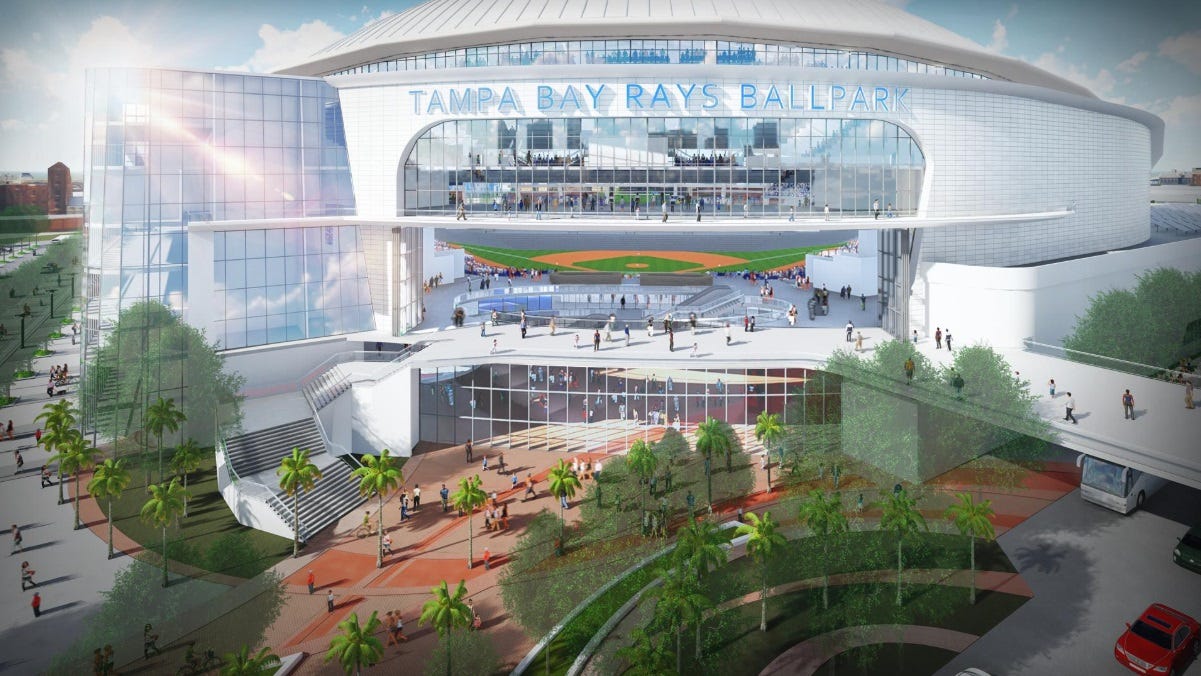
Tampa Bay’s new stadium, slated to open in 2028 as part of a massive redevelopment project, will follow suit with premium clubs, all-field-view concourses, and gamified experiences replacing the famously quirky Touch Tank. It’s not just about seeing the game anymore it’s about being activated at every angle.
These aren’t isolated design choices. They’re part of a growing philosophy in stadium design that mirrors the manipulative architecture of casinos: orchestrated immersion, behavioral nudging, and commercial maximization. And both want your money, but more than that, they want your attention.
In both environments, you are no longer a passive attendee. You are now a data point and a user:
You order food through the team app. This feature not only enhances convenience but also discourages fans from leaving their seats, ensuring continued exposure to advertising, gameplay, and stadium-based content.
You participate in live trivia contests for discounts. These trivia breaks are strategically placed to maintain engagement during game lulls. Fans compete using their mobile devices, keeping their eyes on the screen and on brand-integrated platforms.
You scan QR codes for augmented reality filters. From virtual face paint to player animations, AR is being used to layer digital content over the physical stadium, increasing interactivity while feeding into social sharing loops.
You place in-game bets on pitch outcomes. With the rise of legalized sports betting, many stadiums now allow fans to bet directly from their seats. Micro-betting — predicting the outcome of the next pitch, at-bat, or inning — has made even the slowest moments of the game feel high-stakes.
This gamification of the fan experience is further amplified by the integration of sports betting apps like FanDuel and DraftKings. Fans aren’t just betting at home they’re doing it inside the stadium. Many parks now feature betting lounges, and some even include kiosks to place bets onsite.
FanDuel in particular has taken this integration to the next level. Not only does it operate mobile betting in partnership with several teams, but it has also secured broadcast rights, including a landmark agreement to produce and distribute Milwaukee Brewers games beginning in 2025. This marks the first time a sports betting company has become a rights holder for live professional baseball.
The FanDuel Sports Network is also replacing Bally Sports in some regions, rebranding broadcasts around the betting experience itself. Stats, odds, prop bets, all of it becomes part of the visual storytelling. The line between analyst and oddsmaker is blurring.
This isn't just about interactive fandom. It's about full immersion into a system where every moment of attention can be monetized, every reaction tracked, and every emotional spike whether from a walk-off homer or a failed bet turned into data.
This isn't about building baseball literacy or community; it's about behavioral stickiness.
It’s about attention extraction.
In the casino, the player thinks they're in control because they choose when to press the button. But the machine is designed to pace those interactions. The feedback loop is rigged to provide just enough reward to keep you hooked. It is a masterclass in operant conditioning reinforcement timed not to reward skill, but to provoke compulsion. The player mistakes random intervals for personal agency, confusing participation with influence.
In the stadium, the fan feels engaged because they can vote on the trivia board or pick the next walk-up song via the team app. But this, too, is a carefully curated illusion. You are given small choices that create the feeling of involvement, but none of those choices impact the core experience. You don’t affect the lineup. You don’t call the pitches. You don’t alter the narrative arc of the game.
This illusion of control is precisely what casinos and stadiums share. Both environments are designed to present an array of decisions that feel meaningful but are actually pre-scripted and non-consequential. It’s the difference between pushing a button on a slot machine versus playing chess. One offers the comfort of action without the weight of responsibility. The other requires attention, thought, and consequence.
In this way, stadium design has co-opted the architecture of participation offering the form, but not the substance. The scoreboard asks you to vote. The app tells you your section has won a discount. The PA announcer reads fan-submitted cheers. But these are layers of distraction, not engagement.
The rhythms of fandom once rooted in shared experience, long-form storytelling, and emotional investment are flattened into gamified blips. The game becomes content. The fan becomes a reaction. And what once was a communal act becomes another click in a system optimized not for meaning, but for metrics.
It’s a simulacrum of agency. A digital pantomime of control.
The deeper tragedy in all of this isn’t just that the stadium has become a casino. It’s that baseball is losing its soul.
Baseball is a game of pacing and pauses. It’s a game of story arcs, momentum shifts, and quiet tension. It’s about eye contact with a pitcher, a perfectly turned double play, a foul ball off the knob of the bat that says everything about timing.
But in the new stadium zone, silence is the enemy. Reflection is a revenue gap. Stillness is bad business.
So we pump sound, content, and dopamine into every gap. And we raise a generation of fans who don’t know how to sit with the game. Who need to be entertained by the stadium instead of engaged with the sport.
We also have to talk about tools like ChatGPT in all of this. The ease of use, the instant access to curated information, the way a complex thought can be synthesized into a few sentences? It’s all designed to keep you in System 1. Fast. Smooth. Satisfying. And that's the paradox.
Like the stadium experience, AI tools make things feel frictionless. You don't need to wrestle with an idea, sit with uncertainty, or take the slow road to understanding. You can ask a question and receive a confident, well-formed answer in seconds. That's powerful but it can also be dangerous if we forget what we lose along the way.
We risk outsourcing too much of our cognition. The challenge of forming an opinion becomes secondary to finding one. The muscle of curiosity can atrophy in the presence of ease. And in the same way a trivia app might replace a deeper conversation about the game, an AI response can sometimes replace the meaningful work of wrestling with the unknown.
So while this piece you're reading may have been shaped by a conversation with ChatGPT, the value is only real if you, the reader, stop to reflect. If you slow down. If you reengage System 2 and push back. Think of this tool as a glove it's got to be broken in, used with care, shaped by your hand.
This isn’t a call to abandon modern ballparks. It’s not an anti-technology rant. It’s a call for awareness of how the environment, the experience, and even your emotions are being shaped by design.
We need to understand how we’re being nudged by gamified apps, by curated lighting, by engineered scent and soundscapes. We must recognize how often we’re pushed into System 1 thinking: swiping, tapping, reacting without reflection. We need to ask whether we’re still choosing our own engagement or simply being led along a path engineered to hold us just long enough to convert attention into revenue.
We need to preserve the elements of the game that resist instant gratification: the silence before a pitch, the drama of a long at-bat, the subtle rhythm of innings that don’t yield a run but build tension like chapters in a novel. These are not glitches in the entertainment system they are its soul.
We need to ask ourselves if we’re fans or just users, if we’re sharing in the communal joy and heartbreak of a timeless sport or simply consuming a branded dopamine loop. Are we forming memories? Or are we generating metrics?
Because just like in the casino, the most dangerous thing is thinking we’re the ones in control when the space around us has already anticipated our reactions, structured our movements, and monetized our gaze.
And if baseball has always been a metaphor for life, for fairness, for rhythm, for earned outcomes then we owe it to the game, and to ourselves, to protect the spaces where slowness, thoughtfulness, and imperfection still matter.
We must not let the ballpark become just another interface. We must not let the game become just another machine we feed quarters into.
Next time you're at the ballpark, how much of your experience is being designed for you... and how much is being designed to use you?
Wow. An essay about baseball that explains everything that is happening in our short attention span theatre that we live in. Excellent.
You still get that "old school" experience on TV. Breaks between innings, lack of excesses the park has, allows you to be one with the game. I love being at a park, especially minor league, for full experience occasionally, but give me my chair, a beer, and my rally cap in the living room. Don't get anymore intense than that.