


The Colorado Rockies sit at 27, and even that feels generous once you really sit with it, this is not a franchise suffocated by market limitations or trapped in economic reality, Denver is not a small stage, Coors Field is not a burden, it is an advantage disguised as a challenge, and for thirty years the Rockies have treated it like something to work around instead of something to understand.
From the beginning, the city did its part, when the Rockies arrived in 1993, Denver didn’t hesitate, it showed up immediately and loudly, Coors Field became a destination before the organization had earned it, the Blake Street Bombers turned baseball into a nightly event, Dante Bichette and Larry Walker didn’t just produce offense, they created identity, the game felt alive there in a way expansion teams rarely achieve.
Then came 2007, Rocktober was not just a run, it was a signal, a team caught fire, rode momentum all the way into the World Series, and showed that Denver could matter when the games meant something, that matters because it strips away the usual excuses, the market is there, the fan base is there, the appetite is there, what has been missing is direction.
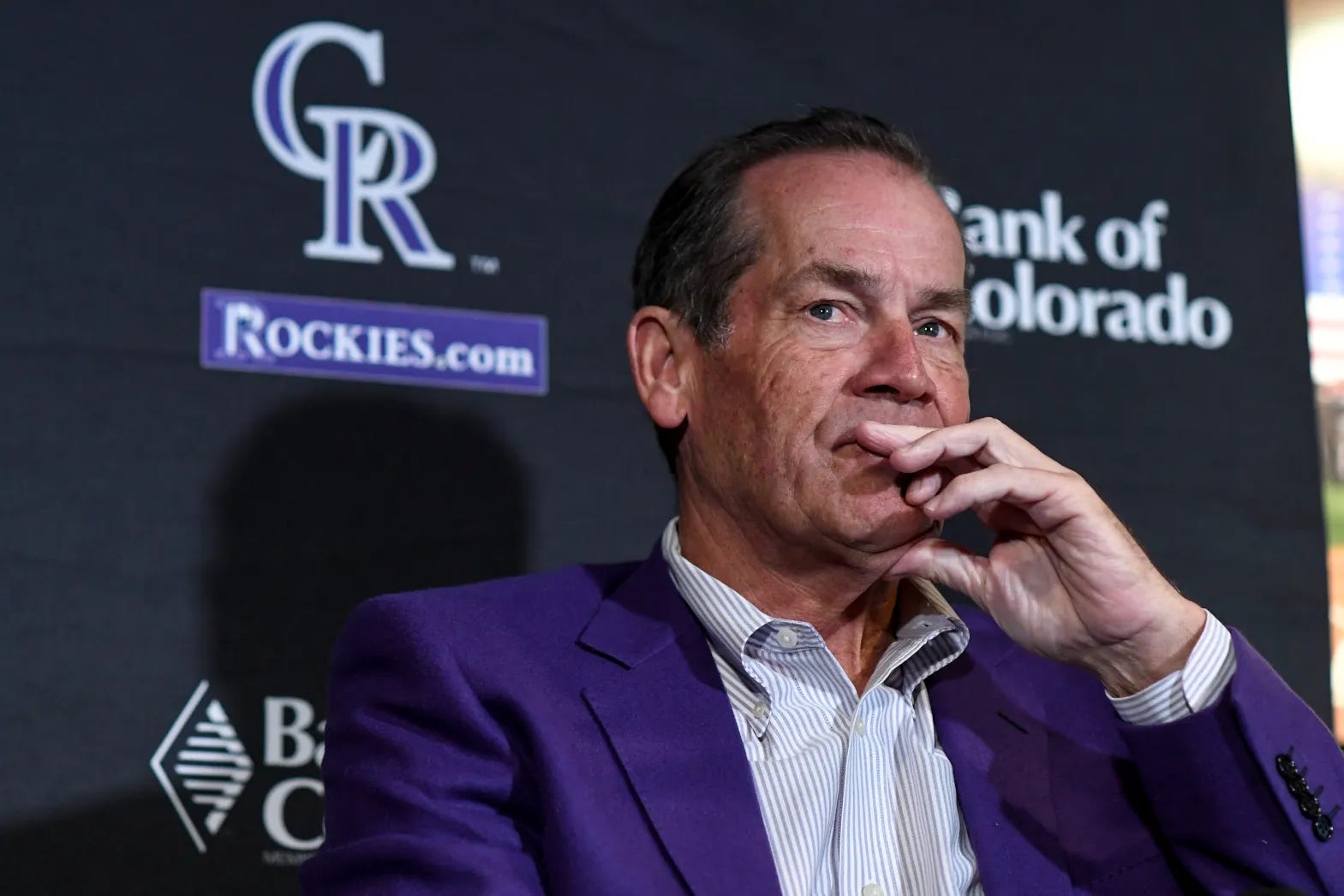
And that is where this gets uncomfortable, the Monfort family has never been invisible, Dick Monfort speaks, he shows up, he presents as someone who cares deeply about the team and the city, that sincerity is real, and that is exactly why the failure lands heavier, this is not indifference, this is conviction without clarity, and over time, that becomes something worse than neglect, it becomes an organization that believes it is right while consistently being wrong.
The Rockies had a real window, not a theoretical one that analysts like to project, a real one you could feel, back to back postseason appearances in 2017 and 2018, Nolan Arenado in his prime, a roster that for a moment stopped being swallowed by Coors Field and instead learned how to survive it, that moment demanded alignment, it demanded escalation, it demanded that ownership recognize what it had and push, instead, the organization fractured itself.
The extension of Arenado was supposed to signal commitment, what followed exposed confusion, internal doubt, direction that shifted depending on who was speaking, and then the move to the St. Louis Cardinals, a trade that didn’t just send away a franchise player, it told everyone paying attention that the Rockies did not believe in their own timeline, when a player of that caliber leaves not because of market limitations but because of belief, that lands squarely at the top.
What followed has been one of the most confusing stretches of ownership behavior in modern baseball, the Rockies are not cheap, which almost makes this worse, they spend, but they spend without structure, contracts appear disconnected from roster reality, investments are made without a clear competitive arc, messaging remains confident while results drift in a familiar range of irrelevance, this is not Oakland dismantling, this is not Miami cycling, this is not Pittsburgh choosing restraint, this is a franchise operating as if intention alone is enough.
And it shows up in the one place ownership cannot hide, adaptation, for three decades, the Rockies have known that Coors Field fundamentally alters the game, pitching behaves differently, development has to be different, roster construction has to be different, there is no excuse for not having a defined, repeatable model by now, instead, they oscillate, at times they act like the environment does not matter, at other times they overcorrect and let it dictate everything, there is no sustained philosophy, no identity that carries from player development to roster construction to in-game strategy, just reaction.
That is not a front office issue, that is ownership, ownership sets tolerance, ownership sets urgency, ownership decides whether continuity is strength or an excuse, in Colorado, continuity has become insulation, loyalty has been extended past the point where it serves performance, familiarity has replaced accountability, over time, that takes hold into something quiet but destructive, stagnation that feels stable.
The most damning part is this, the fan experience is still strong, Coors Field still fills, the atmosphere still holds, people still show up because baseball in Denver is still a good night out, and ownership has leaned on that, not explicitly, not in a way they would ever say out loud, but in a way that shows up in behavior, the urgency never quite matches the opportunity, the pressure never quite builds to a breaking point, the organization exists in a space where being good enough to draw is allowed to coexist with being nowhere near good enough to contend, that is a choice.
So the question becomes unavoidable, what is the plan, not the public version, not the optimistic framing, the actual plan, the one that connects development, roster construction, spending, and identity into something that can be repeated, after thirty years, there isn’t one.
And that absence shows up in the scorecard, competitive intent lands at 26 because the pushes have been episodic, not sustained, fan alignment sits at 25 because the gap between what is said and what is delivered has widened, especially after Arenado, cultural fit earns a 23 because the roots in Colorado are real but execution continues to lag behind the environment, financial integrity comes in at 25, the money exists but it moves without cohesion, labor and organizational culture sits at 25, where loyalty has preserved continuity at the cost of evolution, long term vision is a 26 because there is still no repeatable model for winning at altitude, integrity and accountability lands at 24, absent scandal but marked by explanations that circle issues rather than confront them, relationship to history is a 24, with 2007 still doing too much of the work, impact on the health of the game is a 25, because a strong market living in sustained mediocrity drags on the league more than people admit.
That totals 223 out of 270, above the bottom tier, but that distinction feels technical, because the real difference is this, Oakland was stripped down, Miami resets in cycles, Pittsburgh chose caution and let it harden, Colorado has chosen belief without adjustment.
They are not villains, that would be easier to explain, they are something more frustrating, a franchise with every condition necessary to matter that has spent a decade convincing itself that it already understands why it doesn’t, at some point, that stops being a phase, it becomes identity, and that is why they sit at 27.
Been loving your breakdown of owners. As a long time Rockies fan, I definitely agree with a lot that was said here.
A couple of things that you missed though. First, the Monforts always spent pretty well, they just spent poorly. Second, the team lost a bunch of revenue when our RSN folded. Finally, unlike the owners you’ve covered so far, ownership has taken big steps this off season to revamp the front office, coaching staff, and analytics/support staff.
Also, you had the bad luck of posting this the day after the Bronco’s owners bought a 40% stake in the team and paid off all the Rock’s debt. I think things are looking up for the Rox.
Not trying to dog on your work. Have really been enjoying it and agree philosophically with your views on baseball, fandom, and ownership. Keep up the good work!