


The Miami Marlins sit at 29.
Not because they are a small market, not because Miami does not “get baseball”, not because the fans are fickle. That’s the lazy take people use when they don’t feel like thinking.
They sit at 29 because this franchise has spent three decades teaching its own market to distrust it. They have trained fans to expect betrayal as a business model. They have won two World Series and still managed to feel like a franchise without a stable identity. That combination should be impossible. Yet here we are.
If the A’s at 30 are the modern symbol of contraction and portability, the Marlins at 29 are the modern symbol of instability as operating philosophy.
And it starts at the top.
The first owner was Wayne Huizenga, the South Florida titan who helped bring baseball to the region. He didn’t arrive as a baseball romantic. He arrived as a businessman with a regional vision and a willingness to spend when the moment called for it. In 1997 he went for it hard. The Marlins won the World Series in their fifth season of existence. That should have been the birth of a generational fan base. It should have been the moment Miami became anchored to baseball the way other cities are anchored to the game.
Instead it became the origin story of cynicism.
Huizenga used the title run and then detonated the roster. The first modern fire sale. He made the argument that he couldn’t keep bleeding cash without a stadium and the revenue streams that come with it. He said you shouldn’t fall in love with a team. That line is one of the most revealing ownership quotes in the sport because it tells you exactly how he saw it. A roster is not a relationship. It is inventory. That teardown didn’t just trade players. It broke the emotional contract with the market before it ever had a chance to harden into tradition.
John Henry owned the club briefly after that. His tenure matters mostly because it reinforces how early the franchise became trapped in the stadium narrative. Henry wanted a ballpark, didn’t get what he wanted, and effectively moved on. The ownership position itself felt temporary. The franchise wasn’t being built. It was being negotiated.
Then Jeffrey Loria arrives, and this is where the story becomes a cautionary tale. Loria was an art dealer, combative, controlling, and widely resented even before he showed up because of how the Expos era ended. Yet in 2003, under Loria, the Marlins won again. A second World Series title in seven years. That should have changed everything. It should have turned the Marlins into a durable institution.
Instead it doubled the damage. Because even a second championship didn’t produce continuity. It produced another cycle.
As contracts came due and payroll pressure rose, the teardown instinct returned. The franchise moved core pieces and reset again. Then came the 2012 moment, and this is where the Marlins become one of the most important ownership case studies in modern baseball.
The stadium.
Marlins Park, now loanDepot Park, sits in Little Havana on the old Orange Bowl site. The symbolism should have been perfect. Miami is a deeply Latin city. Baseball is a deeply Latin sport. A retractable roof solves Miami weather. A modern, baseball-first park should have anchored the franchise for fifty years. But the financing turned it into a civic scar.
The public shouldered the overwhelming share of the cost through long-term bonds. Once interest is counted, the taxpayer burden balloons massively over decades. The deal triggered political blowback, lawsuits, and public anger that outlived the stadium’s construction. It became a national example of how not to build a public-private partnership. And then the franchise compounded the injury by breaking its promise almost immediately.
In the lead-up to the stadium opening, the Marlins sold a new era. Rebrand. Flash. Big signings. Miami identity turned up to eleven. Colorful everything. The home run sculpture. The nightclub vibe. The message was clear. We’re back. We’re serious. This will be different.
Then one bad season later, the roster was gutted.
If you want the human cost of that betrayal, you use José Reyes. He described being encouraged by ownership to settle in Miami, to buy a home, to build a life there, and then being traded almost immediately. You can hear the disbelief in the quote because he was processing the same thing the fans had already learned. This franchise will market hope and then sell the parts.
If you want the quote that should be engraved on the tombstone of Marlins trust, you use David Samson. Samson bragged publicly about how the stadium deal was negotiated and then said the quiet part out loud. He said they didn’t care if nobody came, they would play in front of nobody and still have the money. That line matters because it reveals a worldview. Once the stadium revenue streams exist, fan loyalty becomes optional. That is not how civic ownership speaks. That is how extraction speaks.
And then Loria sells the team for a massive windfall after the stadium is built. That is the part that still burns for people. The public assumes the risk, and the owner captures the upside. That perception is poison, even when the legal contracts are airtight. Fans don’t care about the contract. They care about the morality of the transaction.
Then Bruce Sherman buys the franchise in 2017 and brings Derek Jeter in as the face. This is important because it was supposed to cleanse the franchise. Jeter is a symbol of winning culture, professionalism, and long-term credibility. His presence was supposed to signal stability and seriousness. The new regime promised sustainability. The franchise told Miami, in effect, we understand you don’t trust us. We’re going to earn it back.
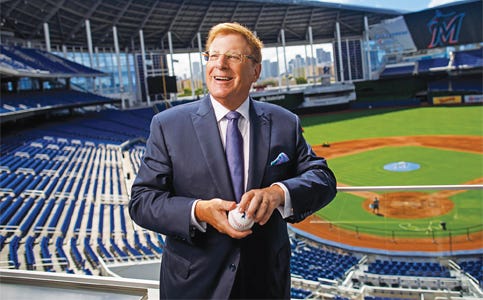
And then they immediately pressed the reset button again.
Stanton gone. Yelich gone. Ozuna gone. Realmuto gone. The most marketable core in years was shipped out quickly. Yes, you can defend it as necessary teardown after Loria’s mess. But the problem is Miami has heard that song too many times. Every new ownership group claims it inherited a mess and needs time. The fans have been asked for time since 1998.
Jeter said at the town hall that he couldn’t sit there and say trust me. He was right. And that line is the indictment. A franchise with two championships had reached a point where its ownership had to ask for trust like it was an expansion team. That is not a fan problem. That is an ownership history problem.
Then Jeter resigns. He says the vision for the future is different than the one he signed up to lead. That matters because it suggests the ceiling is still structural. It suggests that even a guy like Jeter, the embodiment of winning expectations, could not reconcile his concept of competitiveness with the ownership group’s appetite for spending and risk.
Now we hit payroll, because the payroll story is the simplest way to show posture.
The Marlins have repeatedly spiked spending in short bursts and then collapsed it. It happened after 1997. It happened after 2003. It happened after 2012. The pattern is not that they never spend. The pattern is that they spend, sell the hope, and then pull the plug.
The 2012 stadium season is the cleanest example. They spent to create the illusion of a new era and then traded it away immediately. That wasn’t just baseball strategy. That was a breach of trust during a public-financed moment when trust was the only currency they had left.
MLB revenues surged past $10 billion annually in the modern era. Franchise valuations have exploded. Miami’s stadium situation is resolved. They have the asset. They have the roof. They have the city branding. The structural excuses are thinner than they used to be.
Now bring in the Tampa Bay comparison, because it destroys the lazy “small market” narrative.
Tampa Bay exists under similar Florida conditions. It has revenue-sharing support. It has stadium uncertainty. It has payroll constraints. And it has been a sustained contender because it treats constraint as a discipline problem, not an excuse to reset the franchise identity every time payroll gets uncomfortable.
The Rays use revenue sharing as competitive oxygen. The Marlins have too often used it as insulation while the reset button gets worn down to the plastic.
Now the scorecard, with the why embedded in each number the same way we did for the A’s.
Competitive Intent and Effort: 29. The Marlins have not demonstrated sustained commitment to staying in a window once it opens. Their history is ignition followed by demolition. Two titles, and still no sustained era. That is the definition of unstable competitiveness.
Fan Alignment and Honesty: 29. The franchise has repeatedly sold a story it did not support with behavior. Stadium promises followed by a roster dump. New ownership promises followed by another teardown. Trust is the product. They have repeatedly shipped it out of town.
Cultural Fit to the Area: 27. Miami is global, Latin, intense, stylish, and skeptical. The Marlins have tried to market their way into that identity through spectacle, color, and vibe. But cultural fit requires authenticity. Nothing kills authenticity faster than a franchise that constantly reboots its identity and treats stars like temporary assets.
Financial Integrity and Revenue Use: 29. The stadium financing left a permanent scar, and the franchise’s spending posture has too often signaled that ownership would rather reset than risk. The perception, fair or not, is that the public assumed risk and ownership captured upside. Perception is reality when you’re trying to build loyalty.
Labor Ethics and Organizational Culture: 28. Constant churn is a workplace condition. Managers turned over. Front offices changed. Star players were moved. Jeter resigning over vision differences matters here. So does the steady league-wide perception that Miami is not a stable destination.
Long-Term Vision and Stability: 28. The Marlins do not build arcs. They build resets. Even the moments that should have anchored stability, two championships and a new stadium, were followed by chaos.
Integrity and Accountability: 28. The organization has repeatedly externalized blame. Market. Attendance. Politics. Miami. Stadium. Accountability is not just admitting reality. It is absorbing responsibility in a way that builds trust. That has been rare.
Relationship to History and the Game: 26. Two championships exist, but the franchise never allowed those moments to become a durable civic identity. In other cities, history becomes a spine. In Miami, history has often been treated like a highlight reel that doesn’t obligate the present.
Impact on the Health of Baseball: 28. Baseball needs Miami to be alive. Miami is a global baseball city, a gateway market, and a cultural engine. The Marlins’ repeated instability weakens the league’s footprint in a region the sport should dominate.
That is why they are 29.
Composite Score: 252 out of 270
Not because Miami cannot support baseball. Miami has proven it can, when it believes. Not because the Marlins cannot win. They have proven they can, twice. Not because the stadium is badly located. It’s in a culturally important neighborhood and it should have been the anchor.
They are 29 because ownership behavior taught the market to stop caring as a defense mechanism.
The A’s at 30 are the story of a legacy institution being shrunk and made portable. The Marlins at 29 are the story of a market that was never allowed to form a stable bond because ownership kept treating the franchise like a short-term project.
Two titles. One stadium. Thirty years.
Still asking fans to trust.
That is the indictment.
And that is why the Miami Marlins sit at 29.
Overall
Miami: 252
Oakland: 268
Championships are the ultimate goal, but I do think it's an interesting quirk that the Marlins, who have reached the top of the mountain twice, have never won a division.
Thanks for this great piece, as I’ve long wondered about the Marlins. I had forgotten they’ve won two World Series championships. It has been a lost franchise, and, among other things, I don’t understand why they aren’t the Miami Marlins.